Sleep Apnea and CPAP in Taxi Drivers: A Study
A 2026 pilot study tested 32 older taxi drivers in Singapore. 22 had sleep apnea, CPAP use averaged 3.1 hours a night, and reaction time and systolic blood pressure showed no statistically significant change.
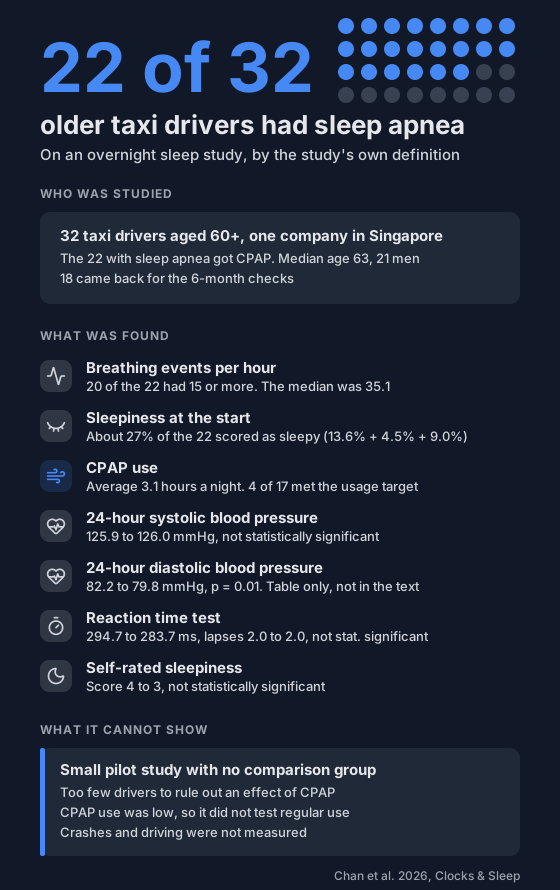
Taxi drivers work long, irregular hours and spend most of them sitting. A small 2026 study from Singapore tested 32 older taxi drivers for sleep apnea. It gave CPAP to the ones who had it, then checked their blood pressure and reaction time six months later.
Most of the drivers had sleep apnea, few used CPAP for long each night, and almost nothing the study measured showed a statistically significant change.
Who was studied?
- 32 taxi drivers aged 60 or over, from one taxi company in Singapore.
- None of them were already on therapy for sleep apnea.
- Each had a full overnight sleep study (polysomnography).
How many had sleep apnea?
22 of the 32, or 68.8%.
The study counted a driver as having sleep apnea with 15 or more breathing events per hour. It also counted 5 to 15 events per hour if the driver scored high enough on a sleepiness questionnaire.
Among those 22 drivers:
- 20 had 15 or more breathing events per hour. The median was 35.1.
- The median age was 63, and 21 were men.
- 63.6% had high blood pressure, 59.0% had high blood fats and 40.9% had type 2 diabetes.
- About 27% scored as sleepy on the sleepiness questionnaire. The paper gives this as three bands of 13.6%, 4.5% and 9.0%, and the total is our sum.
So most of them had a lot of breathing events without scoring as sleepy. For more on that, see sleep apnea without sleepiness.
How much did they use CPAP?
Not much.
- 18 of the 22 came back for the 6-month checks.
- Usage data was available for 17 of them. One machine had an error.
- They used it for 3.1 hours a night on average, give or take 2.3 hours.
- 4 of the 17 (23.5%) met the study's usage target: at least 4 hours a day on at least 70% of days.
The authors think irregular shifts are the likely reason. They say the drivers went to bed late, got up early and slept short hours, so there was little time on CPAP.
For more on CPAP use, see what a review found about sticking with CPAP.
Did blood pressure change?
The authors' conclusion is that it didn't.
- 24-hour systolic: 125.9 mmHg at the start, 126.0 mmHg at 6 months (p = 0.93).
- Systolic in the clinic: 135.6 to 132.1 mmHg (p = 0.39).
- Awake and asleep systolic: no statistically significant change.
- Hours of use: there was no statistically significant link between how much a driver used CPAP and blood pressure at 6 months.
One row of the results table reads differently. It shows 24-hour diastolic pressure going from 82.2 to 79.8 mmHg, with p = 0.01. The paper's text doesn't mention that row. Its starting figure and range are identical to the ones in the awake row, and it doesn't match the 24-hour pulse pressure printed in the same table, so read it with caution.
Related: oxygen burden, CPAP and blood pressure.
Did reaction time change?
The drivers did a 10-minute test where you respond as fast as you can each time a signal appears.
- Reaction time: 294.7 ms at the start, 283.7 ms at 6 months. Not statistically significant.
- Lapses, meaning responses slower than 500 ms: 2.0 before and 2.0 after (p = 0.82).
- Self-rated sleepiness: a score of 4 at the start and 3 at 6 months. Not statistically significant.
An analysis that adjusted for age, BMI, chronic disease, breathing events per hour, sleep duration and CPAP use also found no statistically significant change in the reaction test.
What can't it show?
- Whether CPAP works. There was no comparison group, and only 18 drivers finished. The authors say the small sample limits what the study can show.
- What regular use does. Few drivers met the usage target. The authors point to earlier studies that found lower blood pressure and less daytime sleepiness with CPAP, and say low use may explain why they saw neither.
- Other drivers. These were drivers aged 60 and over from one company, and all but one of the 22 were men.
- Road safety. The study measured a reaction test, not driving or crashes.
The authors declare no conflicts of interest. The paper does not name a funder.
What can you do with this?
Most of these drivers didn't score as sleepy, so not feeling sleepy doesn't rule sleep apnea out. If you snore loudly or someone has heard you stop breathing in your sleep, see a doctor. That matters more if you drive for a living.
Not sure? The sleep apnea risk check takes about a minute and helps you decide whether to talk to a doctor.
On CPAP and finding it hard to keep on for the night? Tell your sleep clinic. You can also track your overnight oxygen alongside CPAP and share the recordings with them.
Not a medical device. Does not diagnose, treat or prevent any condition. Discuss results and changes with a clinician.
References
- Chan YH, Kosasih AM, Kok V, Ou YH, Chng YJC, Gooley JJ, Lee CH. Prevalence of Obstructive Sleep Apnea and Adherence to CPAP for TAXI Drivers. Clocks & Sleep. 2026;8(1):4. doi:10.3390/clockssleep8010004