Which Early CPAP Problems Predict Less Use?
A 2026 study of 121 adults starting CPAP found psychological discomfort was the only group of complaints linked to fewer nights of 4+ hours in the first 2 weeks.
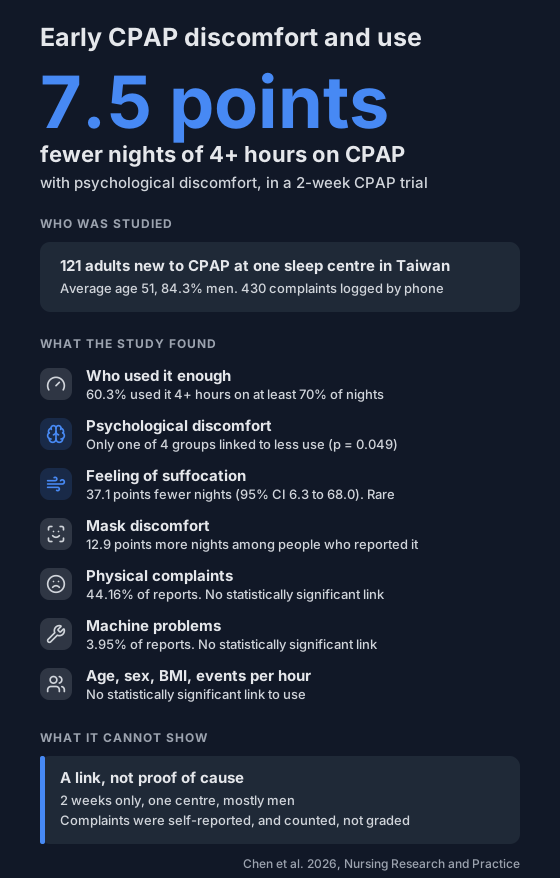
When people struggle with CPAP, the mask usually gets the blame: it leaks, it rubs, the straps are too tight. A study published in 2026 logged every complaint from 121 people in their first 2 weeks on CPAP and checked which ones went with less use.
The mask complaints didn't. The complaints the authors grouped as psychological did.
Who was in the study?
- 121 adults at one sleep centre in southern Taiwan, enrolled between August 2021 and February 2025.
- All had 15 or more breathing events per hour on a sleep lab study, and none had used CPAP before. The average was 51 events per hour.
- Average age 51, and 84.3% were men.
- Each got a free 2-week CPAP trial.
How were the complaints collected?
- A sleep care manager phoned each person on day 3, day 7 and the day before the 2-week clinic visit.
- The calls used open questions about discomfort and worries, and lasted 15 to 20 minutes.
- That gave 430 complaint reports, sorted into 30 types and 4 groups.
- Use came from the CPAP machine's own records: the share of the 14 nights with 4 or more hours of use.
What did people complain about?
The share of the 430 reports in each group, as the paper prints them. They add up to about 103%, and the paper's text calls them shares of participants while its figure note says they are shares of the 430 reports:
- Physical: 44.16%. Breathlessness on CPAP (13.49%), mouth breathing (10.93%) and dry mouth (6.74%) were the most common.
- Mask and fit: 32.09%. Mask discomfort (12.80%) and air leak (12.56%).
- Psychological: 22.79%. Mostly the sense of something foreign on the face from the mask, tubing or leaking air (13.02%), then taking longer to fall asleep (2.79%), waking often (2.56%) and pulling the mask off while asleep (1.86%).
- The machine itself: 3.95%. Things like condensation and noise.
Which complaints went with less use?
On average, people used CPAP for 4 or more hours on 64.78% of nights. 60.3% (73 people) reached the usual target of 4 or more hours on at least 70% of nights.
First, the plain comparison of the two groups, before any adjustment:
- People below the target reported more psychological complaints (p = 0.025).
- People who reached it reported more mask and fit complaints (p = 0.023), including air leak (p = 0.011) and mask discomfort (p = 0.047).
Then the model, adjusted for age, sex, BMI, breathing events per hour, education, lifestyle and other health conditions. The paper writes its results as "% lower adherence". The table gives them as model coefficients on the percentage of nights, so we read them as percentage points:
- Psychological discomfort was the only one of the 4 groups with a statistically significant link to less use: 7.5 percentage points fewer nights of 4 or more hours (95% CI 0.05 to 14.95, p = 0.049).
- A feeling of suffocation had the largest figure: 37.14 points fewer nights (95% CI 6.25 to 68.03, p = 0.018). Few reports mentioned it (the paper's Table 2 shows averages of 0.02 in the group below the target and 0.00 in the group that reached it), and that range is very wide. In the plain comparison it was not statistically significant (p = 0.254).
- Physical complaints and machine problems had no statistically significant link to use.
- Age, sex, BMI and breathing events per hour had no statistically significant link to use either.
Why did mask complaints go with more use?
People who reported mask discomfort (sore or red skin, a mask that moved, straps too loose or tight, the wrong size) had 12.89 points more nights of 4 or more hours (95% CI 2.92 to 22.87, p = 0.011).
Air leak pointed the same way but was not statistically significant in the adjusted model (p = 0.074), and neither was the mask and fit group as a whole (p = 0.093). Both were significant only in the plain comparison above.
The authors' reading is that a mask complaint is an early signal the clinic can act on, with refitting, humidity changes or reassurance. In this study the care manager also adjusted settings such as pressure and temperature during the calls.
Another possible reading, ours and not the paper's: you have to wear the mask for hours to notice that it rubs.
For more on leak, see whether mask leak predicts CPAP use.
What happened after the 2 weeks?
73 people (60.3%) carried on with CPAP. The paper lists what the others moved to, in shares that add up to the remaining 39.7% of the whole group (our sum): 18.2% moved to follow-up with no intervention, 7.4% to surgery, 6.6% to mouth and throat muscle exercises, 5.0% to weight management and 2.5% to medication.
What doesn't it tell you?
Limits the authors state:
- One sleep centre in Taiwan, so the results may not apply elsewhere.
- Only 2 weeks, so it says nothing direct about long-term use.
Limits we'd add:
- It's observational. It shows what went together, not what caused what.
- The psychological result only just passed the usual cut-off (p = 0.049).
- Complaints were counted as reported or not, with no rating of how bad they were.
- The split between groups is a judgement call. Breathlessness on CPAP was counted as physical, a feeling of suffocation as psychological.
- The person collecting complaints was also adjusting the machine settings.
Funding came from Taiwan's National Science and Technology Council, a geriatric medicine research group and a higher education support project at National Sun Yat-sen University. The authors declare no conflicts of interest.
What can you do with this?
These are our suggestions, not the study's findings.
- If CPAP leaves you feeling closed in or short of air, tell your sleep clinic early. Don't wait for the next routine visit.
- Mention mask problems too. In this study people who reported mask discomfort had more nights of 4 or more hours.
- For what a larger body of research says, read the review on sticking with CPAP.
- If you log your nights, here's how to track your oxygen alongside CPAP and share it with your clinic.
Not a medical device. Does not diagnose, treat or prevent any condition. Discuss results and changes with a clinician.
References
- Chen YC, Frange C, Pan SS, Ng CM, Chen YH, Lin CY. Beyond the Mask-Psychological Discomfort as a Predictor of Early CPAP Nonadherence in Moderate-to-Severe OSA Patients: A Prospective Mixed-Methods Study. Nursing Research and Practice. 2026;2026:9630236. doi:10.1155/nrp/9630236