Sleep Apnea in Older Adults: A 2026 Review
A 2026 review found that sleep apnea in older adults often shows up as poor sleep and tiredness, not loud snoring, and that most of the research was done on younger people.
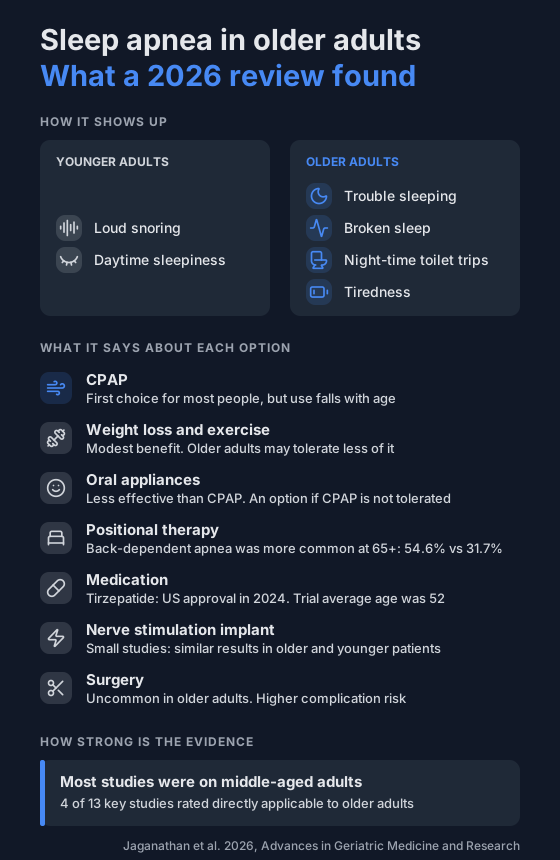
Most descriptions of sleep apnea are about a middle-aged person who snores loudly and nods off during the day. A review published in 2026 says it often looks different in older adults.
The authors went through guidelines and studies up to April 2026.
How is it different in older adults?
Loud snoring and daytime sleepiness are the classic signs in younger people. Older adults more often report:
- Trouble getting to sleep or staying asleep.
- Broken sleep.
- Getting up at night to use the toilet.
- General tiredness.
Those have plenty of other causes, like medication, low mood and other health conditions. The review says that's one reason sleep apnea is often missed in older people.
For the classic signs, see snoring vs sleep apnea.
Why is it harder to spot?
- Questionnaires. The review says the standard symptom checklists may be less reliable in older adults.
- Home tests. They cut out the travel, but the review says simpler home monitors can under-report in people with heart or lung disease. An overnight study in a sleep lab is still the reference test.
Does sleep position matter more with age?
One study in the review suggests it does. It looked at 346 sleep clinic patients. A strongly position-dependent pattern means breathing events at least ten times as frequent on the back as in other positions. 54.6% of the patients aged 65 and over had it, against 31.7% of the younger ones.
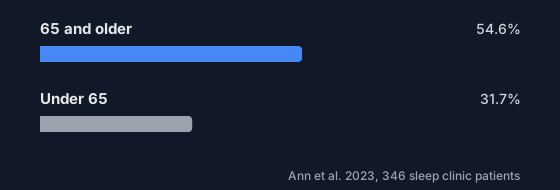
That was a single snapshot of clinic patients, so it doesn't show that age is the cause.
To see whether position lines up with your own overnight oxygen, compare back and side sleeping.
What about CPAP?
CPAP is the first choice for most people with sleep apnea. The review found that people use it less as they get older, especially past 80. The reasons it lists include discomfort, memory problems and hand dexterity.
It also covers oral appliances, positional devices, medication and implants. Which of those suits you is a decision for you and your doctor.
On CPAP already? See tracking your oxygen alongside CPAP.
How strong is the evidence?
Thin, and the authors say so.
- Most of the studies were done on middle-aged adults.
- The review's summary table lists 13 key studies. It rates 4 as directly applicable to older adults.
- It's a narrative review, so the authors chose which studies to include.
If you're older and sleeping badly, tell your doctor, even if you don't snore. Got recordings? Here's how to share them.
Not a medical device. Does not diagnose, treat or prevent any condition. Discuss results and changes with a clinician.
References
- Jaganathan N, Goel V, Liu X, Song W, Kwon Y, Logan J, Healy WJ. Individualized Treatment Approaches for Obstructive Sleep Apnea in Older Adults: Beyond Continuous Positive Airway Pressure. Advances in Geriatric Medicine and Research. 2026;8(3):e260020. doi:10.20900/agmr20260020
- Ann L, Lee CH, Immen R, Dyken ME, Im K. Older Age is Associated With Positional Obstructive Sleep Apnea. The American Journal of Geriatric Psychiatry. 2023;31(11):943-952. doi:10.1016/j.jagp.2023.05.010