Why Events Still Show Up on CPAP
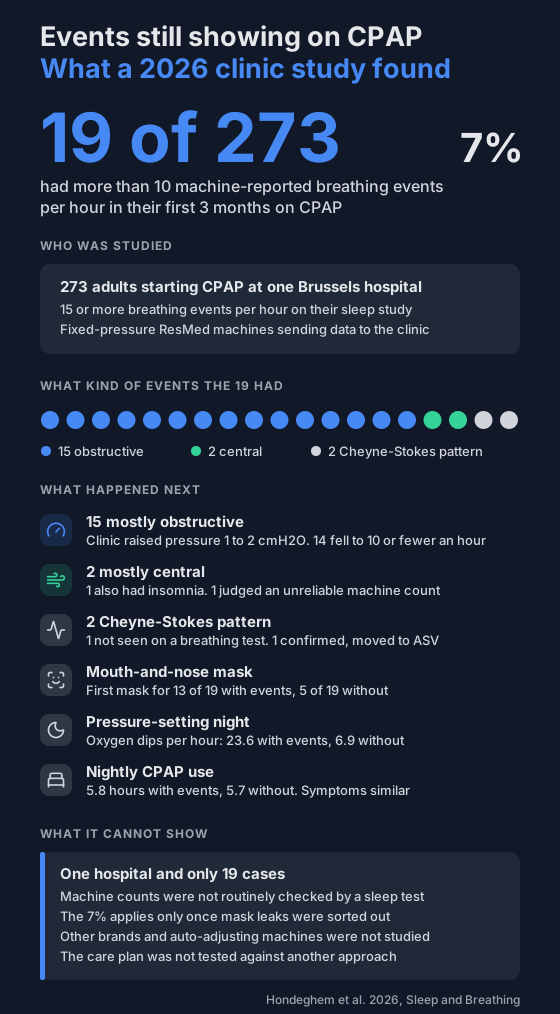
A 2026 Brussels study followed 273 people starting CPAP. 19 still had more than 10 machine-reported breathing events per hour, and most were obstructive events that fell after the clinic raised the pressure.
Your CPAP machine counts the breathing events it still sees each night. Earlier research cited in this paper says 10% to 25% of users have leftover events. A 2026 study from a Brussels hospital looked at how often that happens once mask leaks are dealt with, and why.
Who was studied?
- 273 adults starting CPAP, all with 15 or more breathing events per hour on a sleep-lab study.
- Each had a fixed pressure set during a second night in the lab.
- All used ResMed machines that sent data to the clinic.
- The team read the machine report at the 3-month visit.
How many still had events?
19 of 273, or 7%, had more than 10 machine-reported events per hour. The team only counted events after leaks were corrected, because leaks can make a machine miscount.
What kind of events were they?
- 15 were mostly obstructive. The clinic raised the pressure by 1 to 2 cmH2O, and 14 fell to 10 or fewer events per hour. The other one had very variable leaks.
- 2 were mostly central. One was found to have insomnia too and started cognitive behavioural therapy for it. For the other, the team judged the machine count unreliable.
- 2 showed a Cheyne-Stokes pattern. A separate breathing test on CPAP did not find it in one. It confirmed it in the other, who was moved to a different machine type called auto servo-ventilation.
The authors say a machine can label obstructive events as central or Cheyne-Stokes by mistake. We covered a case like that.
How did the 19 differ from the rest?
Each was matched with a similar patient who had no leftover events.
- 13 of the 19 started on a mouth-and-nose mask, against 5 of 19 in the comparison group.
- On the pressure-setting night they already had more events and more oxygen dips: an ODI of 23.6 against 6.9.
- Nightly use was about the same, 5.8 against 5.7 hours.
- Sleepiness, fatigue and insomnia scores were similar.
What can't it show?
- One hospital and only 19 cases.
- The machine counts were not routinely confirmed with a sleep test.
- The plan was built for regular CPAP users and was not tested against another approach.
- Only fixed-pressure ResMed machines were studied. Other brands count events differently.
What can you do with this?
- If your machine reports events, show the report to your CPAP clinic. Pressure and mask changes are their call.
- An oximeter records overnight oxygen separately from the machine. See tracking your oxygen alongside CPAP.
- Here's how to share recordings with your doctor.
Home oximetry is not a sleep study.
Not a medical device. Does not diagnose, treat or prevent any condition. Discuss results and changes with a clinician.
References
- Hondeghem S, Mettay T, Espana-Dominguez C, Bruyneel AV, Bruyneel M. Prevalence and management of residual respiratory events in OSA patients treated with CPAP: a prospective observational clinical experience. Sleep and Breathing. 2026;30(4):218. doi:10.1007/s11325-026-03767-z