CPAP Shows Cheyne-Stokes? A Blocked-Nose Case
A 2026 case report describes a CPAP machine that reported Cheyne-Stokes breathing in a long-term user. A breathing test found none, and the readings settled after his blocked nose was cleared.
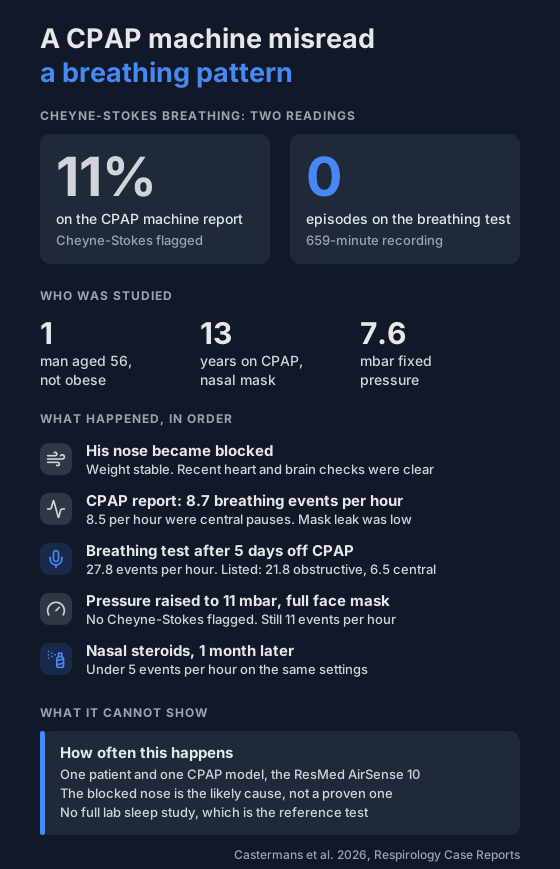
Your CPAP machine keeps its own count of breathing events. A 2026 case report from a Brussels hospital describes one machine that got the type of event wrong.
What is Cheyne-Stokes breathing?
It's a pattern where breathing swells, fades, then pauses, over and over. The authors say it can be linked to heart failure and heart rhythm problems, so doctors follow it up.
Who was the patient?
- A 56-year-old man, not obese, with stable weight.
- 13 years on CPAP with a nasal mask, at a fixed 7.6 mbar.
- Recent heart and brain checks had found nothing.
- He had recently developed a blocked nose.
What did the machine report?
He saw leftover breathing events several mornings in a row. His ResMed AirSense 10 data showed:
- 8.7 breathing events per hour.
- 8.5 per hour were central pauses, where the airway is open but breathing stops.
- Cheyne-Stokes breathing at 11%.
- Low mask leak.
What did the breathing test find?
His doctors ran an overnight breathing test, with a microphone, after 5 days off CPAP. Over 659 minutes it recorded:
- 27.8 breathing events per hour.
- The paper lists 21.8 obstructive and 6.5 central per hour.
- An oxygen desaturation index of 29.3 per hour.
- No Cheyne-Stokes episodes.
Several events were mixed: a central pause first, then a blocked airway. The authors think the machine read that pattern as Cheyne-Stokes. They say machines that judge from airflow alone are known to do this.
What happened next?
- His pressure was raised to 11 mbar, with a mask covering nose and mouth.
- The machine stopped reporting Cheyne-Stokes, but still counted 11 events per hour.
- He was also given nasal steroids for the blocked nose.
- One month later, on the same settings, the count was under 5 per hour.
The authors think the blocked nose made his breathing control less stable.
Related: blocked nose and overnight oxygen.
How strong is the evidence?
Weak.
- It's one patient and one CPAP model.
- The blocked nose is called the likely cause, not a proven one.
- The check was not the full lab sleep study the authors call the reference test.
- The authors say it isn't clear how each maker's machine decides what counts as Cheyne-Stokes.
What can you do with this?
The authors say doctors should know the limits of CPAP data. If your report shows something new, take it to your sleep clinic.
See tracking your oxygen alongside CPAP and how to share it.
Not a medical device. Does not diagnose, treat or prevent any condition. Discuss results and changes with a clinician.
References
- Castermans E, Impens D, Libert W, Bruyneel M. False Detection of Cheyne-Stokes Respiration on Continuous Positive Airway Pressure Resolved After Treatment of Nasal Obstruction. Respirology Case Reports. 2026;14(9):e70745. doi:10.1002/rcr2.70745