Sense of Coherence and CPAP Use: A Study
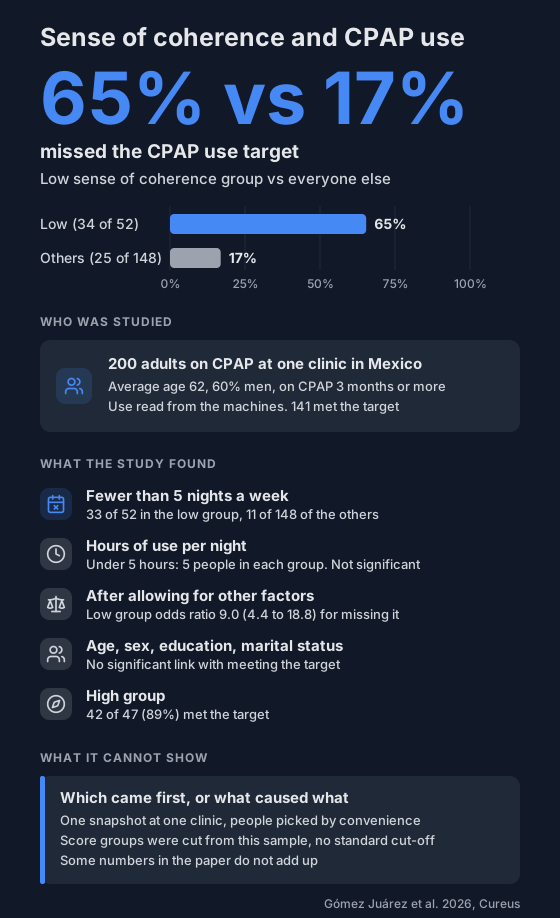
In 200 people on CPAP at one clinic in Mexico, 65% of those with a low sense of coherence missed the CPAP use target, against 17% of everyone else.
Most writing on sticking with CPAP is about the mask, the pressure and the noise. A study published in September 2026 looked at something else: how people see their life in general.
In 200 people on CPAP, those with a low "sense of coherence" were far more likely to fall short of the usual CPAP use target.
What is sense of coherence?
It's an idea from Aaron Antonovsky, who studied what keeps people healthy. It describes how far you feel that:
- Life makes sense. What happens to you is understandable, not random.
- You can cope. You have what you need to handle what comes up.
- It's worth the effort. The challenges are worth engaging with.
The authors say it isn't a fixed personality trait. It's a way of seeing the world that can shift.
The study measured it with a standard 29-item questionnaire, scored from 29 to 203. There's no agreed cut-off, so the authors split this group by its own scores: low (under 108), middle (109 to 124) and high (over 125).
Who was in the study?
- 200 adults at one family medicine clinic in Mexico, all on CPAP for at least 3 months.
- Their average age was 62, and 60% were men.
- Use was read from the CPAP machines' memory cards.
- Meeting the target meant more than 4 hours a night on at least 5 nights a week, which is 70% of nights over 30 days.
- 141 people (70.5%) met it, and 59 didn't.
- The average was 7 hours a night.
What did it find?
Splitting people into the low group and everyone else:
- Missed the target: 34 of 52 in the low group (65%), against 25 of 148 of the others (17%).
- Fewer than 5 nights a week: 33 of 52 in the low group, against 11 of 148 of the others.
- Hours of use per night: 5 people in each group averaged under 5 hours a night. That difference wasn't statistically significant.
So in this study, the gap showed up in how many nights people used CPAP, not in how long they used it each night.
In the high group, 42 of 47 (89%) met the target.
Did other factors explain it?
Not in this study. The authors allowed for age, sex, education and marital status.
- The low group's odds of missing the target were about 9 times higher: an odds ratio of 9.04 (95% CI 4.36 to 18.76).
- None of the other factors had a significant link with CPAP use.
What can't it show?
- Cause. It's a cross-sectional study: one snapshot in time. Struggling with CPAP could lower someone's sense of coherence, not just the other way round.
- Everyone. It was one clinic, and people were picked by convenience, not at random.
- Other health problems. The authors didn't record them, which they list as a limitation.
- Self-report bias. The questionnaire was filled in by the participants themselves.
- Loose reporting. Some figures in the paper don't match each other. For example, the abstract's "74% high" combines the middle and high groups. The counts in this article come from the paper's main comparison table, which adds up.
The authors reported no funding and no conflicts of interest.
What can you do with this?
If you're finding it hard to use CPAP most nights, that's worth raising with your sleep team. This study suggests outlook may be part of the picture, not only the mask.
For other things linked to CPAP use, see the review of what helps people stick with CPAP and how early discomfort relates to use.
Your CPAP shows nights and hours used. An overnight oximeter adds what your oxygen did, so you can track it alongside CPAP and share it with your doctor. To see how your nights change over time, try compare nights.
Not a medical device. Does not diagnose, treat or prevent any condition. Discuss results and changes with a clinician.
References
- Gómez Juárez M, Gaytán Núñez FK, Vargas Hernandez F, Saucedo Martínez MG, Moreno Noguez M, Rojas Ibañez M, Cortes Gonzalez KG, Tamayo Calderon JA, Granados Franco EL, Villar Aguirre E. Sense of Coherence and Its Association With Adherence to Continuous Positive Airway Pressure (CPAP) Therapy in Patients With Obstructive Sleep Apnoea. Cureus. 2026;18(9):e115745. doi:10.7759/cureus.115745