How Accurate Are Smart Rings for Sleep?
A 2026 review of 28 articles found finger-worn sleep trackers matched a sleep lab 87% of the time on asleep or awake, but only 65% on light sleep, and did best on sleep apnea at the highest cut-off.
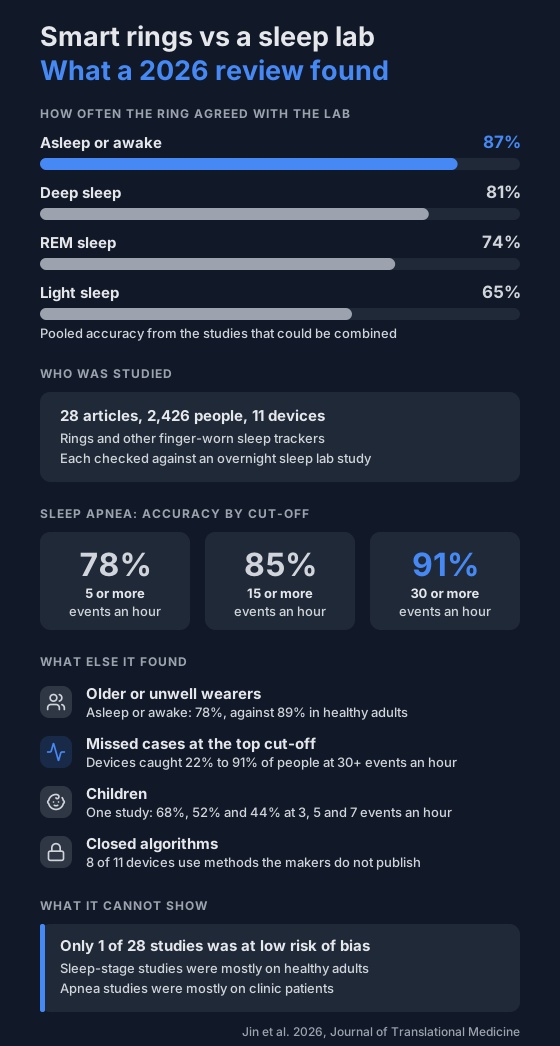
Smart rings give you a nightly breakdown of light, deep and REM sleep, and some now flag possible sleep apnea. How close are those numbers to a sleep lab?
A review published in May 2026 pulled together every study it could find that tested a finger-worn device against an overnight sleep lab study. The short version: good at telling asleep from awake, weaker on sleep stages, and better at sleep apnea the more events per hour a person has.
What did the review look at?
- 28 articles with 2,426 participants, published from 2018 up to April 2025.
- 11 finger-worn devices: Oura Ring, Happy Ring, THIM, SleepOn, Circul Ring, Belun Ring, NightOwl, Biologix, SleepImage Ring, RingConn and the Wellue O2 ring.
- 14 articles tested sleep stages, 13 tested sleep apnea, and one tested both.
- Every study used an overnight sleep lab study (polysomnography) as the reference.
The two groups of studies used different kinds of people.
- Sleep-stage studies were mostly on healthy adults aged 18 to 50.
- Sleep apnea studies were mostly on clinic patients with suspected sleep apnea, more often over 50 and overweight.
How accurate were the rings for sleep stages?
Accuracy here means the share of short time blocks, usually 30 seconds, that the device labelled the same way as the sleep lab.
Pooled across the studies that could be combined:
- Asleep or awake: 87% (7 studies). The review gives the lowest result as 66% and the highest as 93%.
- Deep sleep: 81%.
- REM sleep: 74%.
- Light sleep: 65%.
The three stage figures come from 5 studies.
The spread between devices and versions was wide.
- The best four-stage result was a Happy Ring with an algorithm tuned to each wearer: 81% for light sleep, 95% for deep sleep and 92% for REM.
- The lowest were older Oura Ring versions: 52% for light sleep and 51% for REM on Generation 2 in one study, and 51% for deep sleep on Generation 1.
- The review says most devices got more accurate over time, which it puts down to newer algorithms and more sensors.
Accuracy also dropped outside the healthy young adults most studies used. For asleep or awake, it was 89% in healthy participants and 78% in participants with a health condition. The review gives the same 78% for participants over 50.
For other trackers, see how valid smartwatch numbers are and who wearable studies leave out.
How accurate were they for sleep apnea?
Sleep apnea is graded by breathing events per hour of sleep, with cut-offs at 5, 15 and 30. The studies checked how often a device put a person on the same side of each cut-off as the sleep lab did.
The review's subgroup analysis gives accuracy by cut-off:
- 5 or more events an hour: 78%. Individual adult studies ran from 56% to 100%.
- 15 or more: 85%. Studies ran from 76% to 89%.
- 30 or more: 91%. Studies ran from 86% to 92%.
The review says every device but one was more accurate at the 30 cut-off than at 5 or 15.
Accuracy hides two different kinds of error, and the review reports both.
- At the 5 cut-off, devices caught 85% to 100% of the people the lab put above it. But the share of people below it that they correctly cleared ran from 3% to 100%.
- At the 30 cut-off, devices correctly cleared 91% to 100% of the people below it. But the share of people above it that they caught ran from 22% to 91%.
So a high accuracy figure at the top cut-off doesn't mean a device catches everyone there.
One study tested a ring on 75 children. Accuracy was 68%, 52% and 44% at cut-offs of 3, 5 and 7 events an hour.
What about the Wellue O2 ring?
It's in the review, through one study of 190 people with suspected sleep apnea in Thailand. The review's table gives no accuracy figure for it, so it isn't part of the ranges above.
For studies of ring oximeters, see ring oximeter vs sleep study.
What can't the review show?
- Study quality. Only 1 of the 28 studies was rated at low risk of bias. 20 were rated high risk for how participants were handled, mainly because people were dropped from the analysis for short sleep or a device fault. The authors say the quality of the studies may inflate or bias the accuracy figures.
- Who was tested. Sleep-stage results come mostly from healthy adults, and sleep apnea results mostly from clinic patients already suspected of having it. Neither tells you how a ring does in the general population.
- Children. Only three studies included children or teenagers.
- Closed algorithms. 8 of the 11 devices use proprietary methods, so nobody outside the company can check how the stages are worked out.
- Old versions. Hardware and algorithms change fast. A result for one generation doesn't carry over to the next.
- Few studies. The authors say published tests of consumer devices against a sleep lab are scarce, and they may have missed some devices.
The authors' conclusion is that finger-worn devices may be used for tracking sleep and wake over many nights in healthy adults, or to flag people at the highest cut-off for follow-up. They say the devices shouldn't replace a sleep lab study for lower grade sleep apnea or for a detailed breakdown of sleep stages.
What can you do with this?
- Put more weight on a ring's asleep or awake record than on its split between light, deep and REM.
- Look at trends over weeks, not one night's stage breakdown.
- A ring that reports nothing unusual hasn't ruled anything out. If you snore, stop breathing in your sleep or are tired all day, talk to your doctor.
- Our sleep apnea risk check gives you something to bring to that conversation.
- Home oximetry isn't a sleep study either. For how 3 months of tracking compared with one sleep study in another 2026 study, see one sleep study vs 3 months of tracking.
Not a medical device. Does not diagnose, treat or prevent any condition. Discuss results and changes with a clinician.
References
- Jin Y, Xu J, Yue H, Huang Y, Ma W, Fan X, Wang H, Xu L, Wang J. Performance evaluation of finger-worn devices for sleep stage classification and sleep apnea detection: a systematic review and meta-analysis. Journal of Translational Medicine. 2026;24(1):873. doi:10.1186/s12967-026-08214-x