Ring Oximeter vs Sleep Study: How Close?
A 2025 study put a ring pulse oximeter on 25 adults during 90 lab sleep study nights. The ring counted 2.9 fewer oxygen dips per hour on average, and single nights varied a lot more.
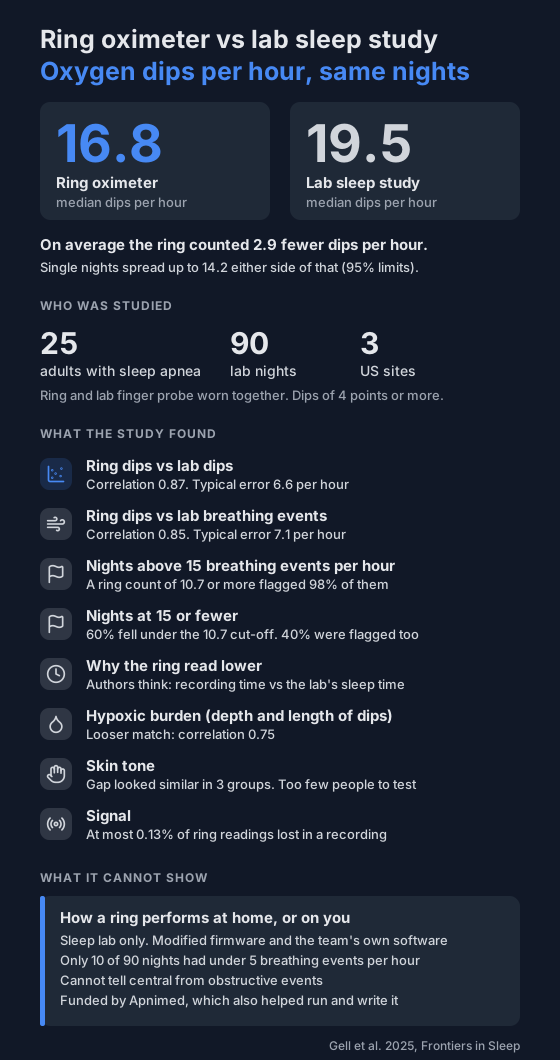
A ring oximeter counts your oxygen dips per hour, the ODI. A lab sleep study counts them too. A small proof-of-concept study in 2025 ran both at once.
Who was studied?
- 25 adults with obstructive sleep apnea, median age 56, 14 men and 11 women.
- Up to four nights each in a sleep lab during a drug trial, 90 nights in total.
- They wore a Viatom ring oximeter (model S9) with modified firmware.
- The researchers counted dips of 4 points or more with their own software.
How close was the ring?
- Median dips per hour: 16.8 on the ring, 19.5 in the lab.
- On average the ring counted 2.9 fewer per hour.
- Single nights varied more: the 95% limits were 14.2 per hour either side of that.
- The correlation between the two counts was 0.87.
- Against the lab's breathing events per hour, it was 0.85.
Why did the ring read lower?
The authors think it's mostly the maths. The ring divides dips by the whole recording, a median of 491 minutes. The lab divides by time asleep, a median of 387 minutes. In an exploratory analysis using sleep time for the ring too, it read 2.8 per hour higher than the lab.
Could the ring flag the busier nights?
The lab scored 55 of the 90 nights above 15 breathing events per hour.
- A ring count of 10.7 dips per hour or more flagged 98% of those nights.
- Of the other nights, 60% fell under that cut-off, so 40% were flagged as well.
- The cut-off was picked to miss few busy nights, at the cost of more false flags.
What else did it report?
- Hypoxic burden, which adds up how deep and long the dips are, matched less closely: a correlation of 0.75.
- The gap looked similar across three skin tone groups, but the authors say the study was too small to test this.
What can't it tell you?
- How a ring does at home. Every night was in a lab.
- How it does without sleep apnea. Only 10 of the 90 nights had fewer than 5 breathing events per hour.
- What caused a dip. Oximetry can't separate central from obstructive events.
- An independent view. Apnimed, which is developing sleep apnea drugs, funded the study and helped design, analyse and write it.
What can you do with this?
Home oximetry is not a sleep study. Read your ODI as a trend across several nights, and share it with your doctor if it worries you.
Not a medical device. Does not diagnose, treat or prevent any condition. Discuss results and changes with a clinician.
References
- Gell LK, Mehta K, Esmaeili N, Taranto-Montemurro L, Sands SA, Pittman SD, Azarbarzin A. Performance evaluation of a ring-worn pulse oximeter for the identification and monitoring of obstructive sleep apnea. Frontiers in Sleep. 2025;4:1549272. doi:10.3389/frsle.2025.1549272