Belun Ring vs Lab Sleep Study: What Matched?
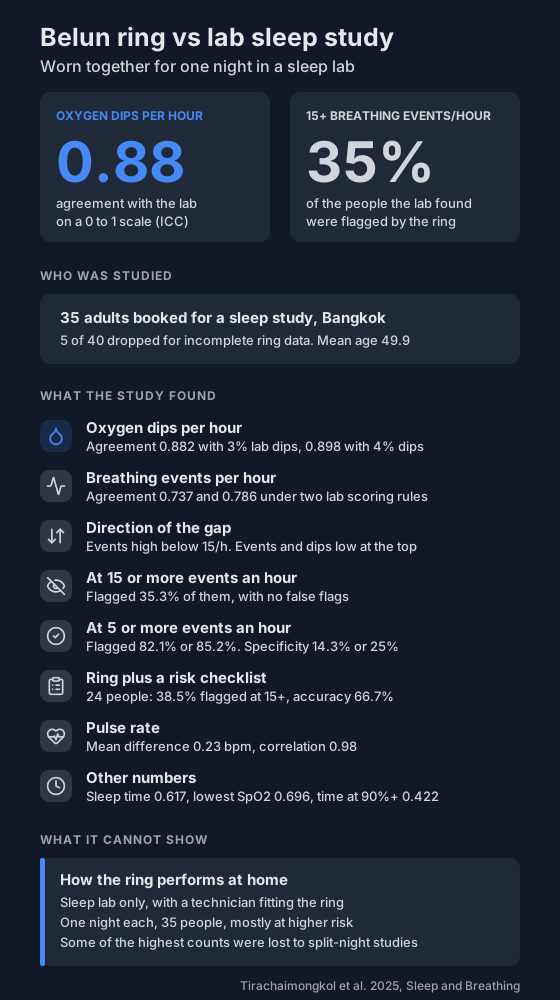
A 2025 study had 35 adults wear the Belun ring during a lab sleep study. Its oxygen dips per hour agreed closely with the lab (0.88), but it flagged only 35% of the people with 15 or more breathing events an hour.
A ring oximeter measures two things directly: blood oxygen and pulse. Some rings then use software to estimate breathing events per hour, which is the number a sleep lab reports.
A 2025 study in Bangkok checked both kinds of number from one ring against a lab sleep study. The oxygen dip count held up well. The estimated breathing event count did not.
Who was studied?
- 40 adults already booked for a full-night lab sleep study at Siriraj Hospital. 5 were dropped for incomplete ring data, leaving 35.
- 19 were men, the mean age was 49.9 and the mean BMI was 25.6.
- 24 of the 35 scored as higher risk on a standard sleep apnea checklist.
- People with heart failure, atrial fibrillation, COPD, insomnia or on oxygen were excluded.
- The lab found 15 or more breathing events per hour in 17 of the 35.
Each person wore the Belun ring on the index finger during the lab night. A technician sized and fitted it. The Belun ring is sold as a home sleep apnea test and has US FDA clearance, so it's not a consumer oximeter. Its software uses oxygen, pulse and movement to estimate breathing events and sleep time.
What matched the lab?
The study scored agreement with the intraclass correlation (ICC), which runs from 0 to 1.
- Oxygen dips per hour (ODI): 0.882 against the lab's count of 3% dips, and 0.898 against 4% dips.
- Pulse rate: a mean difference of 0.23 bpm and a correlation of 0.98.
The dip count wasn't perfect. On the paper's plots, the ring's ODI fell below the lab's at higher counts, and the spread was wider at low counts.
What matched less well?
- Breathing events per hour: 0.737 or 0.786, depending on which of two scoring rules the lab used.
- Sleep efficiency: 0.719.
- Lowest oxygen reading: 0.696.
- Total sleep time: 0.617.
- Share of time at 90% oxygen or above: 0.422. See what T90 is.
- Total recording time: 0.113. The authors think the ring and the lab start and stop the clock differently.
How did the breathing event estimate go wrong?
It was off in both directions.
- Below 15 events per hour on the lab study, the ring tended to read too high.
- At 15 or more, it tended to read too low.
- Estimated total events for the night averaged about 139 in the lab and 110 on the ring. The two still rose and fell together (correlation 0.965).
That shows up when you ask whether the ring put people on the same side of a cut-off as the lab:
- 15 or more events per hour: the ring flagged 35.3% of the people the lab found. It flagged nobody the lab had under 15.
- 30 or more: it flagged 33.3% under one scoring rule and 42.9% under the other, again with no false flags.
- 5 or more: it flagged 82.1% under one rule and 85.2% under the other, but it also flagged most of the people the lab had under 5. Specificity was 14.3% and 25%, from only 7 and 8 people.
Adding the risk checklist didn't change much. Among the 24 higher-risk people, the ring flagged 38.5% of those at 15 or more, and overall accuracy was 66.7%.
The authors conclude the ring works better for confirming a high count than for ruling one out.
Why would the dip count hold up better?
A dip is something the sensor measures. A breathing event is something the software infers from oxygen, pulse and movement.
The authors' suggested reasons for the gaps, none of which they tested:
- Reading high at the low end: the software may count arousals that aren't sleep apnea.
- Reading low at the high end: events in quick succession are hard to separate, poor signal gets excluded, and the software may not be trained on the heart rate patterns of central sleep apnea.
For a different ring's dip count against a lab, see ring oximeter vs sleep study. For why the two numbers differ at all, see what counts as an oxygen dip.
What can't it tell you?
- How the ring does at home. Every night was in a lab, with a technician fitting the ring.
- Much about any one group. 35 people at one hospital, one night each. The 14.3% specificity comes from 7 people.
- How it does in the general population. Most participants were at higher risk already.
- How it does at the top end. Some people with the highest counts were switched to a split-night study, which cut the number of those cases.
- How it does with other conditions. Heart and lung disease were excluded, and a few participants took medication that changes heart rate.
- Which kind of event. The ring's report doesn't separate types of breathing event, so the planned analysis by type wasn't possible.
The study was funded by the hospital's research fund, and the authors declared no conflicts of interest.
What can you do with this?
- If your ring or app shows an estimated breathing event index, this study is a reason to read it more loosely than the dip count.
- Follow your ODI as a trend across several nights.
- Home oximetry is not a sleep study. If your numbers worry you, share them with your doctor.
Not a medical device. Does not diagnose, treat or prevent any condition. Discuss results and changes with a clinician.
References
- Tirachaimongkol V, Banhiran W, Chotinaiwattarakul W, Rungmanee S, Pimolsri C, Srikajon J, Kasemsuk N. Belun Sleep Platform versus in-lab polysomnography for obstructive sleep apnea diagnosis. Sleep and Breathing. 2025;29(4):266. doi:10.1007/s11325-025-03433-w