Oximeter-Only Home Sleep Test: How Accurate?
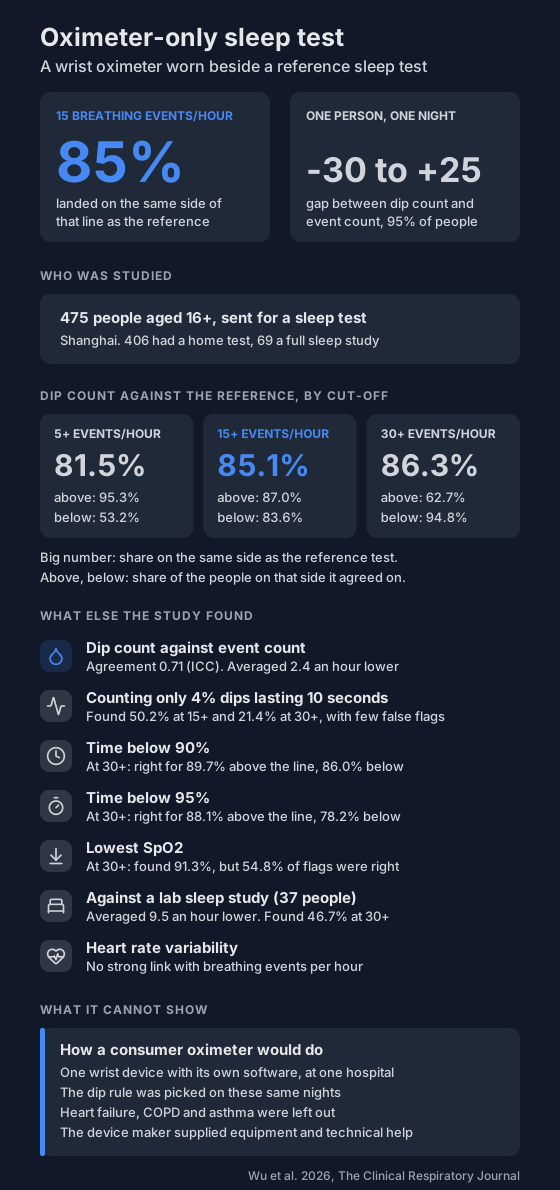
A 2026 study wore a wrist oximeter beside a reference sleep test in 475 people. Its oxygen dip count put 85% of them on the same side of 15 breathing events an hour, but one person's count could be 25 to 30 an hour out.
A sleep test normally records several things at once: airflow, chest movement, oxygen and more. The simplest kind of home test records oxygen and pulse only.
A study published in 2026 checked how far that gets you. 475 people wore a wrist oximeter on the same night as a fuller sleep test. The oximeter's dip count sorted most people onto the same side of a cut-off as the fuller test. For any one person, the two counts could still be far apart.
Who was studied?
- 578 people aged 16 and over referred to a sleep lab at Zhongshan Hospital in Shanghai, between April 2023 and May 2024. They had symptoms like habitual snoring, witnessed pauses in breathing or daytime sleepiness.
- 103 were dropped: 46 for equipment failures or short recordings, and 57 because the two devices' recording times differed by more than 2 hours. That left 475.
- People with heart failure, COPD, asthma, a pacemaker, or on oxygen at night were excluded.
- On the reference test, 32.8% had fewer than 5 breathing events an hour and 26.5% had 30 or more.
What was compared with what?
The device was the PM50-B, a wrist-worn oximeter with a movement sensor, made by Berry. The researchers ran its data through their own software, which used movement to estimate sleep time and to tone down dips that happened while the wrist was moving.
The reference was not the same for everyone:
- 406 people: a multi-channel home test with airflow, chest and belly belts and a finger oximeter. It has no brain-wave channel, so sleep time was estimated by hand.
- 32 people: a full sleep study run unattended.
- 37 people: a full sleep study in the lab.
So this is mostly a comparison with another home test, not with a lab study.
How close was the dip count?
The study tried several ways of counting oxygen dips and kept the one that tracked the reference best: a drop of 2.5% or more lasting at least 5 seconds, counted per hour of sleep. That's an oxygen desaturation index (ODI) with a lower bar than the usual 3% or 4%.
Against breathing events per hour on the reference test:
- The agreement score (ICC) was 0.71, on a scale where 1 is a perfect match.
- On average the dip count was 2.4 an hour lower.
- For 95% of people the gap was somewhere between 29.8 an hour lower and 25.0 an hour higher.
- The average miss, in either direction, was 9.0 an hour.
In the 37 people with a lab study, the dip count averaged 9.5 an hour lower.
Did it sort people the same way?
The study used the standard lines of 5, 15 and 30 breathing events an hour, and checked whether the dip count put each person on the same side as the reference.
| Line | Same side overall | People above the line it found | People below the line it kept below |
|---|---|---|---|
| 5 an hour | 81.5% | 95.3% | 53.2% |
| 15 an hour | 85.1% | 87.0% | 83.6% |
| 30 an hour | 86.3% | 62.7% | 94.8% |
- At the 5 line it put nearly half of the people below it on the wrong side.
- At the 30 line it missed more than a third of the people above it.
- In the lab group it found 46.7% of the people at 30 or more.
- These figures are from the paper's results table. Its summary gives 81.2% and 91.0% for the 15 line, which doesn't match the table.
Does it matter how a dip is defined?
A lot. When the same recordings were counted using only dips of 4% or more lasting 10 seconds:
- It found 50.2% of the people at 15 or more events an hour.
- It found 21.4% of the people at 30 or more.
- It wrongly flagged very few: 97.4% and 99.1% of the people below those lines stayed below.
Different oximeters and apps use different rules, so their dip counts aren't interchangeable. See what counts as an oxygen dip.
What about time below 90% and lowest SpO2?
The study also tested three other numbers. For each one the paper reports an "optimal" cut-off, and it doesn't describe checking those cut-offs on a separate group. At the 30 events an hour line:
- Time below 90%: a cut-off of 2.72% of sleep time found 89.7% of people above the line and kept 86.0% of the rest below it. See what T90 is.
- Time below 95%: a cut-off of 13.63% found 88.1% and kept 78.2% below.
- Lowest SpO2: a cut-off of 75% found 91.3%, but only 54.8% of the people it flagged were above the line.
The authors note that lowest SpO2 rests on a single reading, so one stray value can move it. They also looked at heart rate variability and found no strong link with breathing events per hour.
What can't it tell you?
- How your oximeter would do. This was one device with purpose-built software. The result doesn't carry over to a consumer oximeter or to an app.
- How it does on new people. The dip rule was chosen on these same 475 nights, and the paper describes no separate group to test it or the other cut-offs on.
- Accuracy against a lab study. Only 37 people had one, and the average gap was largest in that group.
- Which kind of event. The study didn't separate obstructive from central events, and didn't match dips to events one by one.
- Other groups. One hospital, people referred with symptoms, and nobody with heart failure, COPD or asthma.
- Independence. The device maker supplied equipment and technical help. The authors declare no conflicts of interest, and the funding came from the National Natural Science Foundation of China and one other grant.
The authors call the agreement acceptable for a first-pass check, not for a final answer.
What can you do with this?
Read the ODI on your own recordings as a count of oxygen dips, not a count of breathing events. Even with a purpose-built device, the two were 25 to 30 an hour apart for some people in this study.
A consumer oximeter can't tell you whether you have sleep apnea, and neither can this app. What you can do is log your nights, watch the trend over several of them and share the recordings with your doctor.
If you snore loudly, someone has seen you stop breathing in your sleep, or you're worn out during the day, see a doctor. The sleep apnea risk check takes about a minute and helps you decide whether to book that appointment.
Not a medical device. Does not diagnose, treat or prevent any condition. Discuss results and changes with a clinician.
References
- Wu X, Qin H, Huang H, Jiang J, Wu X, Liu Z, Li M, Li S. Novel Type IV Monitoring Device With Advanced Oximetry Indicators Offers Accurate Diagnosis of Obstructive Sleep Apnea in Adults. The Clinical Respiratory Journal. 2026;20(2):e70176. doi:10.1111/crj.70176