EEG Headband vs Actigraphy in Older Adults
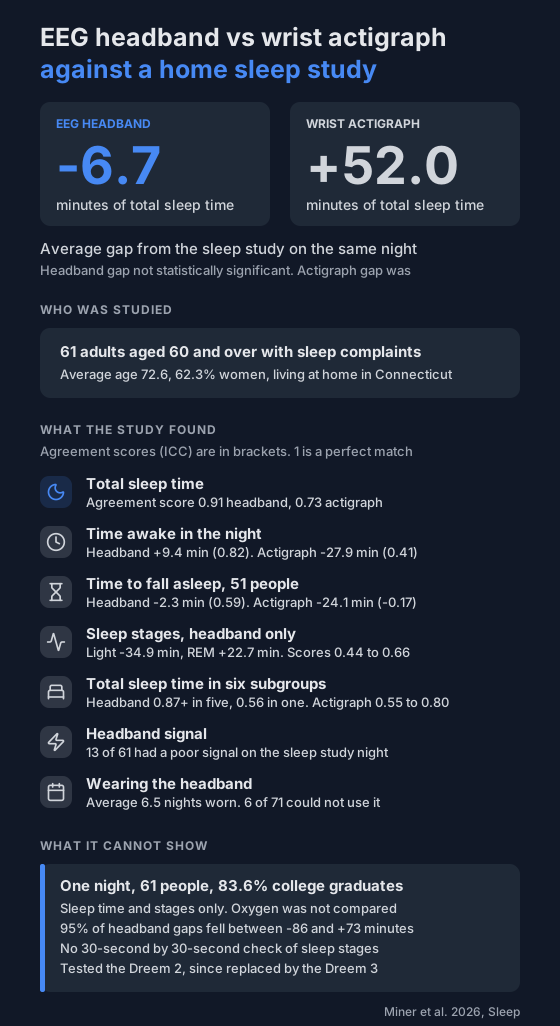
A 2026 study put an EEG headband and a wrist actigraph up against a home sleep study in 61 older adults with sleep complaints. On average the headband was 6.7 minutes off on total sleep time, the actigraph 52.
Wrist actigraphs are the usual research tool for measuring sleep over several nights. They don't measure sleep, though. They count wrist movement and work out sleep from that.
A 2026 study in the journal Sleep tested a headband that reads brain waves (EEG) instead, in older adults who sleep badly.
This study is about sleep time and sleep stages, not oxygen. The headband has a pulse oximeter in it, but the paper doesn't compare its oxygen readings with anything.
Who was studied?
- 61 adults aged 60 and over, living at home around New Haven, Connecticut.
- All reported insomnia symptoms or daytime sleepiness at least once a week.
- Average age 72.6, and 62.3% were women.
- About a third had been told by a doctor they had a sleep disorder, and about a third had used a sleep aid in the past two weeks.
- The authors say two earlier headband studies left out people on sleep medication or with known insomnia or sleep apnea. This one kept them in.
What did they wear?
- The headband: a Dreem 2, with five dry EEG electrodes, worn for up to 7 nights. Its own software scored the sleep.
- The actigraph: an Actiwatch Spectrum Plus on the wrist for 7 days and nights.
- The reference: one night of a full sleep study, set up at home by trained staff and scored by a sleep technologist.
All three were worn on the same night, and that night is what the comparison is based on.
How close was each one to the sleep study?
The paper reports an agreement score (ICC) for each measure. 1 is a perfect match. The authors count 0.75 and above as good to excellent, and below 0.5 as poor.
| Measure | Headband | Actigraph |
|---|---|---|
| Total sleep time | -6.7 min (0.91) | +52.0 min (0.73) |
| Time awake in the night | +9.4 min (0.82) | -27.9 min (0.41) |
| Time to fall asleep | -2.3 min (0.59) | -24.1 min (-0.17) |
| Sleep efficiency | -1.1 points (0.84) | +10.9 points (0.28) |
- The first number is the average gap from the sleep study. The number in brackets is the agreement score.
- None of the headband's four gaps was statistically significant. All four of the actigraph's were.
- The actigraph read more sleep and less time awake than the sleep study did.
- Time to fall asleep is based on 51 people, because 10 fell asleep before the sleep study started recording.
- On that night the actigraph put time to fall asleep at 2.4 minutes on average.
What about sleep stages?
Only the headband reports stages, and it was less accurate there.
- Light sleep: 34.9 minutes less than the sleep study, score 0.66.
- REM sleep: 22.7 minutes more, score 0.44.
- Deep sleep: 5.5 minutes more, score 0.51. That gap was not statistically significant.
The authors say earlier headband studies also found too much REM. Their explanation is that the headband has no eye-movement sensor, so the software may count unclear stretches as REM.
For the same question about rings, see how accurate smart rings are for sleep.
Did it hold up in the worst sleepers?
Mostly. The paper splits out six groups, including people with 15 or more breathing events per hour (35 people), high insomnia scores (20) and memory and thinking problems (13).
- Total sleep time, headband: scores of 0.87 to 0.91 in five of the six groups.
- The exception was the 8 people with frequent leg movements in sleep, at 0.56.
- Total sleep time, actigraph: 0.55 to 0.80. In the leg movement group the actigraph scored higher than the headband, 0.74 against 0.56.
- Time awake in the night: headband 0.54 to 0.90, actigraph 0.23 to 0.59.
Some of these groups are small, so the ranges around those scores are wide. The paper's summary describes the headband's 0.56 to 0.91 range as good to excellent, but by the authors' own cut-offs 0.56 and 0.54 sit in the middle band (0.5 to 0.75), below good.
Could people actually sleep in it?
Most could, but not everyone.
- The 61 people wore it for 6.5 nights on average, and 60 of them managed at least four nights.
- 38 (62.3%) wore it all seven nights.
- The median rating was 4 or 5 out of 5 on every usability question.
- 6 of the 71 people who enrolled dropped out because they couldn't use it. Reasons included trouble starting it, a poor fit and not being able to sleep with it on.
- Those who dropped out tended to be older and were more likely to have memory and thinking problems.
Signal was a problem too. 13 of the 61 had a poor headband signal on the sleep study night. With them left out, the headband agreed more closely with the sleep study on every measure. The authors say poor fit was common and they often added an elastic band over the headband.
What can't this study show?
- It's one night. This is a cross-sectional study, and the comparison comes from a single night per person.
- Averages hide individual error. For total sleep time, 95% of the headband's gaps fell between 86 minutes under and 73 minutes over. The authors call that clinically meaningful variability for one person, and say the range may understate the extremes.
- The stage check is coarse. The team could not line the two recordings up closely enough to compare them 30 seconds at a time, so only nightly totals were compared.
- The sample is small and selected. 83.6% were college graduates and 77.1% were non-Hispanic White.
- The model has been replaced. The Dreem 2 was tested, and the Dreem 3 has since replaced it.
- Nobody knows which device is right across a week. On the other nights the actigraph's time awake, time to fall asleep and sleep efficiency changed least from night to night, but there was no sleep study to check against.
The device makers did not fund the study, and the authors report no conflicts of interest.
What can you take from it?
- The authors say a tracker that works from wrist movement can count lying awake as sleep. In this study the actigraph read 52 minutes more sleep on average.
- Sleep stages and time to fall asleep were the headband's weakest numbers, even with brain-wave sensors.
- A sleep tracker and an oximeter record different things. This study says nothing about oxygen readings.
- One night can differ from the next. See one sleep study vs 3 months of tracking.
- If you're over 60, read who wearable accuracy studies leave out.
If you sleep badly most nights, tell your doctor.
Not a medical device. Does not diagnose, treat or prevent any condition. Discuss results and changes with a clinician.
References
- Miner B, Chen A, Pan Y, Cho G, Talarczyk J, Burzynski C, Polisetty L, Doyle M, Iannone L, Mejnartowicz S, Breier RA, Gill TM, Yaggi HK, Knauert M. Performance of an electroencephalography-measuring headband or actigraphy compared with polysomnography in older adults with sleep disturbances. Sleep. 2026;49(5):zsag053. doi:10.1093/sleep/zsag053