Who Wearable Accuracy Studies Leave Out
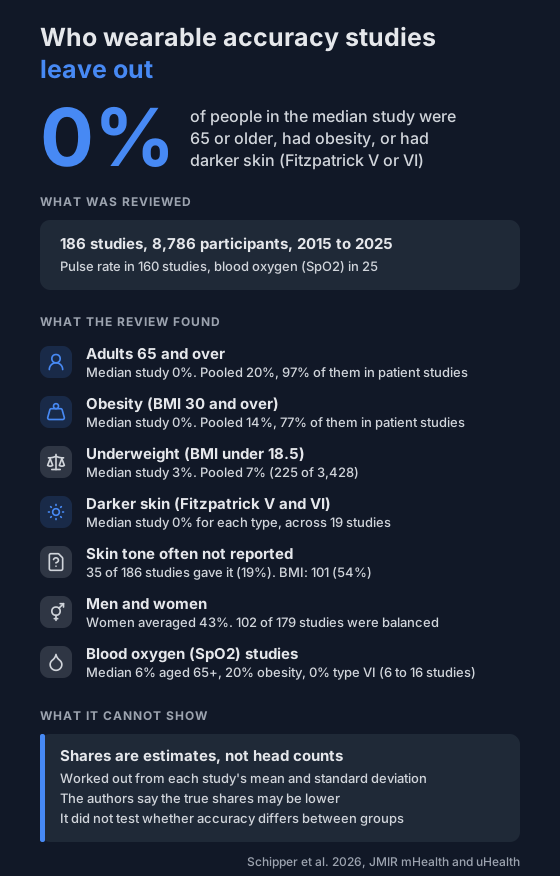
A 2026 review of 186 studies that tested consumer wearables found the median study had 0% older adults, 0% people with obesity and 0% people with the darkest skin tones.
When a watch or ring is tested against a reference device, the result only tells you how it did on the people in the test. A 2026 scoping review asked who those people were.
Across 186 studies of consumer wearables, the median study had an estimated 0% of participants aged 65 or older, 0% with obesity and 0% with the darkest skin tones.
What did the review cover?
- 186 studies with 8,786 participants, from 2015 to 2025.
- Each compared a consumer wearable's optical sensor reading with a reference method.
- 160 studies tested pulse rate and 25 tested blood oxygen (SpO2).
- The median study had 30 participants, and 74% of studies used healthy volunteers.
Who was missing?
The authors estimated each group's share in the median study and across all participants pooled.
- Adults 65 and over. Median study 0%, among the 112 studies that didn't exclude them. Pooled 20% (1,290 of 6,367), and 97% of those were in studies of patients.
- Obesity (BMI 30 and over). Median study 0%, across 89 studies. Pooled 14% (473 of 3,428), and 77% of those were in studies of patients.
- Underweight (BMI under 18.5). Median study 3%. Pooled 7%.
- Darker skin (Fitzpatrick types V and VI). Median study 0% for each type, in the 19 studies with usable skin tone data.
Men and women were closer to even: women averaged 43%.
Only 35 of 186 studies (19%) reported skin tone, and 101 (54%) reported BMI.
What about blood oxygen studies?
Of the 25 SpO2 studies, 16 had usable data for age, 8 for BMI and 6 for skin tone. In those, the median share was 6% for older adults and 20% for people with obesity, but 0% for Fitzpatrick type VI.
Many of these studies used a finger pulse oximeter as the reference. Finger oximeters have their own skin tone bias, so the authors say the comparison may hide some of the error.
What can't it tell you?
- Whether accuracy differs. The review counted who took part. It didn't compare accuracy between groups.
- Exact shares. They were estimated from each study's mean and standard deviation. The authors say the true shares for older adults, obesity and darker skin may be lower.
- Any one device. Results aren't broken down by brand or model.
What can you do with this?
If you're older, have a higher BMI or have darker skin, a wearable's published accuracy figure may rest on few people like you.
- Read your recordings as trends over several nights, not as exact numbers.
- If a reading worries you, share it with your doctor.
Not a medical device. Does not diagnose, treat or prevent any condition. Discuss results and changes with a clinician.
References
- Schipper RM, Oumar Djibrillah F, Roosink M, Winkens L, John A, Hazebroek E, Witteveen A, Berendsen AAM. The Representation of Different Populations in Studies Assessing the Validity of Consumer Wearable Photoplethysmography-Based Measurements: Scoping Review. JMIR mHealth and uHealth. 2026;14:e87324. doi:10.2196/87324