Skin Tone, Oximeters and Wearable Pulse Rate
A 2024 review pooled 27 studies. Pulse oximeters read 1.27 points too high on dark skin and 0.70 on light skin, on average. Wearable pulse rate showed no clear skin tone bias.
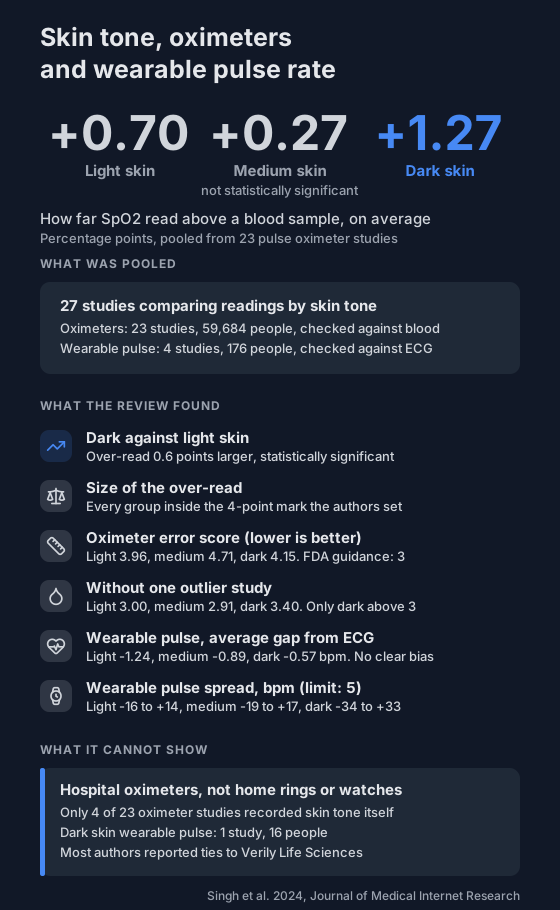
It's well reported that pulse oximeters can read too high on darker skin. A 2024 review pooled the studies to put a number on it, and asked the same question about the pulse rate on smartwatches and fitness bands.
Short answer: oximeters read a little high on both light and dark skin, more so on dark. Wearable pulse rate showed no clear skin tone bias, but there was very little data on dark skin.
For the background, see pulse oximeters and skin tone.
What did the review pool?
27 studies, found in searches up to June 2023.
- Oximeters: 23 studies, 59,684 people and 197,353 readings, each paired with an arterial blood sample.
- Wearable pulse rate: 4 studies, 176 people and 140,771 readings, each paired with an ECG or chest strap. The devices included Apple Watch, Fitbit, Garmin and Xiaomi bands.
- People were sorted into light, medium and dark skin groups.
- About two thirds of the oximeter participants (67.72%) were in the light group. 16.70% were medium and 15.58% dark.
How far off were the oximeters?
On average, SpO2 read higher than the blood sample:
- Light skin: 0.70 points higher (95% CI 0.17 to 1.22).
- Medium skin: 0.27 points higher (95% CI -0.64 to 1.19), which was not statistically significant.
- Dark skin: 1.27 points higher (95% CI 0.58 to 1.95).
The over-read on dark skin was 0.6 points larger than on light skin, and that difference was statistically significant. Medium and light skin did not differ significantly.
The authors set 4 points as the size that would matter in clinical practice, a mark they took from FDA guidance. Every group stayed inside it.
They expected the result for dark skin. The over-read on light skin surprised them. One explanation they offer is that devices tuned on medium skin tones may be a little off at both ends.
Did the oximeters meet the accuracy standard?
Not on the pooled numbers.
The standard error score for oximeters is called ARMS. It combines the average error and the reading-to-reading scatter, and lower is better. US FDA guidance for the sensor type used in 22 of the 23 studies is 3% or less.
- Light skin: 3.96%
- Medium skin: 4.71%
- Dark skin: 4.15%
- All groups combined: 3.60%
The international threshold is looser, at 4%. Light skin passed that one, and medium and dark did not.
One study had much larger error bars than the rest. With it removed, the scores were 3.00%, 2.91% and 3.40%. Only dark skin was then above the FDA figure, and no group was above the international one.
More on these scores in how accurate pulse oximeters are.
What about pulse rate on wearables?
The average gap from the ECG was small, and not statistically significant in any group. A minus sign means the wearable read lower than the ECG.
- Light skin: -1.24 bpm (95% CI -5.31 to 2.83)
- Medium skin: -0.89 bpm (95% CI -3.70 to 1.93)
- Dark skin: -0.57 bpm (95% CI -9.44 to 8.29)
The differences between skin tone groups were not statistically significant either.
Single readings were a different matter. The range that 95% of the gaps between wearable and ECG were expected to fall in was:
- Light skin: -16.02 to +13.54 bpm
- Medium skin: -18.62 to +16.84 bpm
- Dark skin: -33.69 to +32.54 bpm
The standard the authors applied is within 5 bpm either way, so all three groups were outside it. They note that accuracy varied a lot between wearable models.
The dark skin figures come from one study with 16 people, so that wider range is not a firm finding.
For more on wrist devices, see how valid smartwatch numbers are.
What can't it show?
- These were hospital oximeters. All 23 oximeter studies used medical devices, 22 of them with a sensor that shines light through the finger or another body part. Home rings and smartwatch SpO2 were not covered.
- Skin tone was mostly not measured. Only 4 of the 23 oximeter studies recorded skin tone itself. The rest used race or ethnicity, which the authors mapped onto light, medium and dark. They list this as a limitation, because race and ethnicity are not measures of skin tone.
- Mostly unwell people. 18 of the 23 oximeter studies were on patients, and 15 were on hospital inpatients.
- Oxygen level was not looked at. The review did not check whether the error grows at lower SpO2. Nor did it compare sensor types or where the sensor was worn.
- Thin wearable data. Four studies, and one with dark-skinned participants.
- One result was sensitive to the method. With a different statistical assumption, the pulse rate gap on light skin became statistically significant.
- Author ties. Most of the authors reported employment, equity or consulting ties with Verily Life Sciences.
- Older studies. The oldest pooled study is from 1990, and 6 of the 23 oximeter studies are from before 2000.
A later study measured skin tone directly on five home fingertip models: see NHS home oximeters and skin tone.
What can you do with this?
- Read a single SpO2 number as an estimate with a few points of error either way, whatever your skin tone.
- If you have darker skin, keep in mind the reading may sit a little high. In this review the average was about 1.3 points.
- Watch the trend across nights on the same device and finger. A steady offset shifts every night by about the same amount, so changes still show up.
- If your readings don't match how you feel, tell your doctor. A blood test is the reference.
Not a medical device. Does not diagnose, treat or prevent any condition. Discuss results and changes with a clinician.
References
- Singh S, Bennett MR, Chen C, Shin S, Ghanbari H, Nelson BW. Impact of Skin Pigmentation on Pulse Oximetry Blood Oxygenation and Wearable Pulse Rate Accuracy: Systematic Review and Meta-Analysis. Journal of Medical Internet Research. 2024;26:e62769. doi:10.2196/62769