Oxygen Saturation by Age: Women vs Men
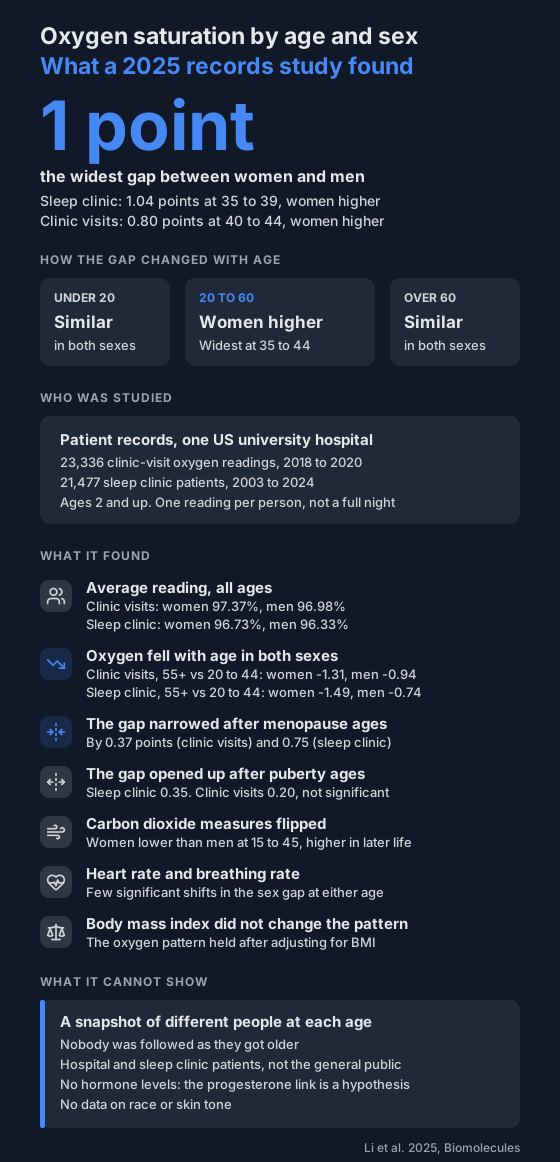
A 2025 study of hospital and sleep clinic records found women's average oxygen saturation was up to about 1 point higher than men's in mid-adulthood, and the gap closed after 60.
Oxygen saturation tends to drift down as people get older. A 2025 study asked whether it drifts the same way in women and men.
It didn't. Women's average was higher than men's from early adulthood, by up to about 1 point, and the gap closed after 60.
New to the number itself? Start with what SpO2 is.
Who was studied?
Researchers at the US National Institutes of Health and the University of North Carolina used two sets of patient records from the same university hospital. They analysed the two sets side by side.
- Clinic visits. Records of 53,252 outpatients, 2018 to 2020. 23,336 of them had a pulse oximeter reading, and those are the ones in the oxygen results.
- Sleep clinic. 21,477 patients sent for an overnight sleep study, 2003 to 2024. The reading used was the one taken at the start of the study, not an overnight figure.
- Ages ran from 2 upwards, split into 16 age groups.
- Each person counted once, with one reading.
The paper declares no conflicts of interest.
What did the oxygen readings show?
- Average oxygen saturation went down with age in both sexes, in both sets of records.
- Women's average was similar to or higher than men's at every age.
- Before 20 and after 60 the two were similar. In between, women were higher.
- The authors' own summary puts the gap at ages 15 to 45.
- The widest gap in the sleep clinic records was 1.04 points, at ages 35 to 39.
- The widest gap in the clinic visit records was 0.80 points, at ages 40 to 44.
Across all ages the averages were close:
- Clinic visits: 97.37% for women and 96.98% for men.
- Sleep clinic: 96.73% for women and 96.33% for men.
Adjusting for body mass index didn't change the pattern.
What happened around menopause?
The study had no record of when anyone reached menopause. It compared ages 20 to 44 with ages 55 and over instead.
- Clinic visits: women's average was 1.31 points lower in the older group. Men's was 0.94 lower.
- Sleep clinic: women's was 1.49 lower. Men's was 0.74 lower.
- So the gap between women and men shrank by 0.37 points in the clinic visits and 0.75 in the sleep clinic.
It ran the same comparison for puberty, ages 2 to 9 against 10 to 19. The gap widened by 0.35 points in the sleep clinic records. In the clinic visit records the change was 0.20, which was not statistically significant.
What else did it find?
- Carbon dioxide. The study used a blood test in the clinic visits and a breath measurement in the sleep clinic. On both, women aged 15 to 45 were lower than men of the same age. In later life it reversed, and women were higher.
- Heart rate and breathing rate. Both fell with age, fastest before about 25. Few of the shifts in the gap between the sexes around puberty or menopause ages were statistically significant.
- Older women. The authors say women's oxygen saturation falls faster with age, and that clinicians should pay more attention to sleep-related breathing problems in older women.
For how sleep apnea itself splits by age and sex, see this study of 556,474 records.
Why would women and men differ?
The authors think hormones are part of it, progesterone in particular, because it stimulates breathing. The years when women's readings were higher roughly match the years between first period and menopause.
They call this speculation. No hormone levels were measured, and age stood in for puberty and menopause.
What can't it show?
- It's a snapshot. This was a cross-sectional study of past records. Different people were measured at each age. Nobody was followed as they got older.
- These were patients. Everyone was seen at one hospital system, and the sleep clinic group had been referred for suspected breathing problems in sleep. The authors say the results may not carry over to the general public.
- Ages were approximate. In the clinic visit records, age was estimated from birth year, to within a year.
- No data on race or skin tone. Skin tone can affect pulse oximeter readings. The authors think it's unlikely to change a comparison between the sexes.
- One reading each. Nothing here describes oxygen across a night.
What can you do with it?
- Don't judge your own reading against an average for your age and sex. The gaps here were 1 point or less, between averages of thousands of people.
- For what else can move a single reading, see how accurate pulse oximeters are.
- Compare your own nights with each other instead.
- If your readings worry you, take them to your doctor.
Not a medical device. Does not diagnose, treat or prevent any condition. Discuss results and changes with a clinician.
References
- Li L, Shi M, Umbach DM, Fan Z. Age Trajectories of O2 Saturation and Levels of Serum Bicarbonate or End-Tidal CO2 Across the Life Course of Women and Men: Insights from EHR and PSG Data. Biomolecules. 2025;15(6):884. doi:10.3390/biom15060884