Bedroom Temperature and HRV in Older Adults
A 2025 study tracked 47 adults aged 65 and over at home for one Australian summer. Night-time bedroom temperatures above 24 °C (75 °F) went with higher odds of a large drop in heart rate variability.
Most heat advice is about hot days. The World Health Organization suggests keeping indoor temperature at or below 26 °C (79 °F) in the daytime, and has no figure for the night.
A study published in December 2025 measured what happens at night. It tracked bedroom temperature and heart rate variability (HRV) in older adults, in their own homes, for a whole summer.
Who was in the study?
- 47 adults aged 65 and over in southeast Queensland, Australia, which has a humid subtropical climate.
- Median age 72. 32 were women and 15 were men.
- None smoked. 20 reported high blood pressure and 33 took prescribed medication.
- The study ran from 1 December 2024 to 17 March 2025.
What was measured?
- Pulse. Each person wore a Fitbit Inspire 3 on the wrist. It works out heart rate and HRV from the pulse signal, and it records HRV only when it judges the wearer to be asleep.
- Temperature. A wall sensor in the main bedroom logged temperature every 10 minutes.
- Hours. Only sleep between 9 PM and 7 AM counted. Of 22,682 recorded hours, 14,179 were clean enough to use.
The main HRV measure was RMSSD, which tracks beat-to-beat changes in heart rate. For how wrist HRV compares with an ECG, see wearable HRV vs ECG.
How warm were the bedrooms?
The median night-time bedroom temperature was 25.9 °C, about 79 °F. The middle half of readings sat between 24.6 and 26.9 °C.
The authors sorted the hours into four bands:
- Below 24 °C (75 °F): 2,378 hours. This was the reference band.
- 24 to 26 °C (75 to 79 °F): 5,052 hours.
- 26 to 28 °C (79 to 82 °F): 5,705 hours.
- 28 to 32 °C (82 to 90 °F): 1,044 hours. Three people never had a bedroom this warm, so this band covers 44 people.
Only 3 hours were above 32 °C, so that band was left out.
What did it find?
The authors counted a "large" change as one they call clinically relevant:
- For HRV, 1.5 standard deviations or more away from that person's own average.
- For heart rate, a rise of 5 beats a minute or more.
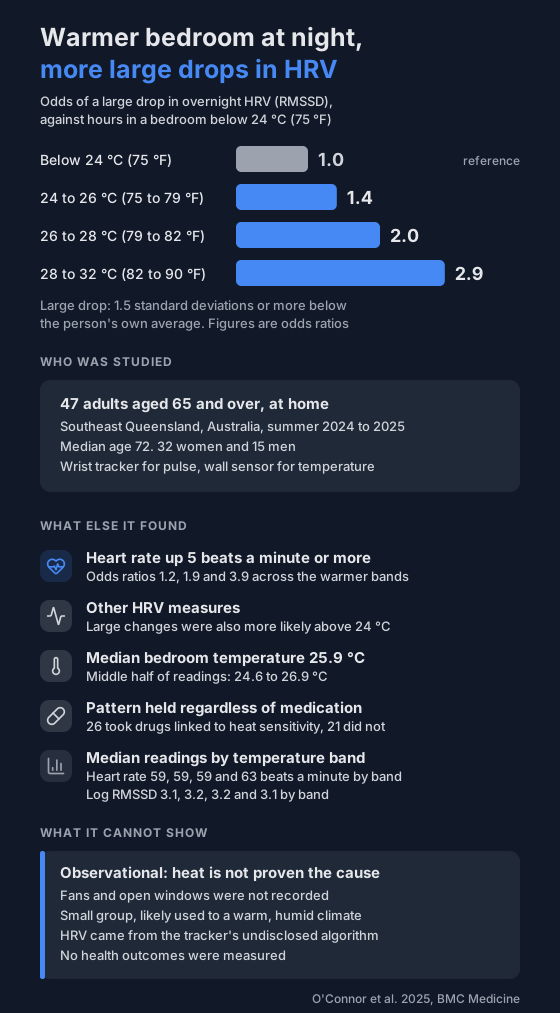
Against the below 24 °C band, the odds of a large drop in RMSSD were:
- 1.4 times as high at 24 to 26 °C (95% confidence interval 1.2 to 1.6).
- 2.0 times as high at 26 to 28 °C (1.8 to 2.3).
- 2.9 times as high at 28 to 32 °C (2.5 to 3.4).
Heart rate went the same way. The odds of a rise of 5 beats a minute or more were 1.2, 1.9 and 3.9 times as high across the three warmer bands.
The other HRV measures followed the same pattern. Large drops in high-frequency and low-frequency power, and large rises in the ratio between them, were all more likely above 24 °C. The authors say the ratio is debated as a measure and should be read with caution.
Did the typical reading change much?
The medians in the paper's table barely moved.
- Median heart rate was 59 beats a minute in each of the three cooler bands and 63 in the warmest.
- Median log RMSSD was 3.1, 3.2, 3.2 and 3.1 across the four bands.
The authors' statistical models still linked warmer bedrooms to lower RMSSD and higher heart rate. The odds above count how often a large shift happened, which is a different thing from the median.
Did medication change the result?
The authors say it didn't. 26 people took medication linked to heat sensitivity and 21 did not. The paper reports the same pattern in both groups, with the numbers in a supplementary table.
What doesn't it tell you?
- Cause. The title says "effect", but it's an observational study. It shows what went together.
- Fans and windows. The study didn't record them. A fan can cool you without changing the room temperature.
- Other people. It was a small group who were probably used to heat. The authors say results may differ in hot, dry climates or in people not used to heat.
- The tracker. HRV came from Fitbit's own undisclosed algorithm, including its decision about when the wearer was asleep.
- Health outcomes. None were measured. The authors say it's uncertain what these changes mean for heat-related illness.
- Sleep and oxygen. The authors say it was not designed as a sleep study, and it didn't record oxygen.
The authors suggest keeping bedrooms at or below 24 °C (75 °F) at night where possible. That's their reading of this one study, not an official guideline.
The study was funded by the Wellcome Trust, and the authors declare no competing interests.
What can you do with this?
You can run the same comparison on yourself.
- Note the bedroom temperature at bedtime for a couple of weeks.
- Compare your overnight pulse on warmer and cooler nights.
- Compare sets of nights, not single nights.
The steps are in does bedroom temperature affect your oxygen?
Not a medical device. Does not diagnose, treat or prevent any condition. Discuss results and changes with a clinician.
References
- O'Connor FK, Bach AJE, Forbes C, Rutherford S, Binnewies S, Sabapathy S, Morris NR. Effect of nighttime bedroom temperature on heart rate variability in older adults: an observational study. BMC Medicine. 2025;23(1):703. doi:10.1186/s12916-025-04513-0