Does Lack of Sleep Make You Thirsty?
A 2026 Korean survey of 2,468 adults found that people sleeping 6 hours or less were more likely to say they felt thirsty often. Much of the link went away once people with diabetes or habitual snoring were left out.
Short sleep has been tied to hunger, blood sugar and kidney function. Thirst has had much less attention.
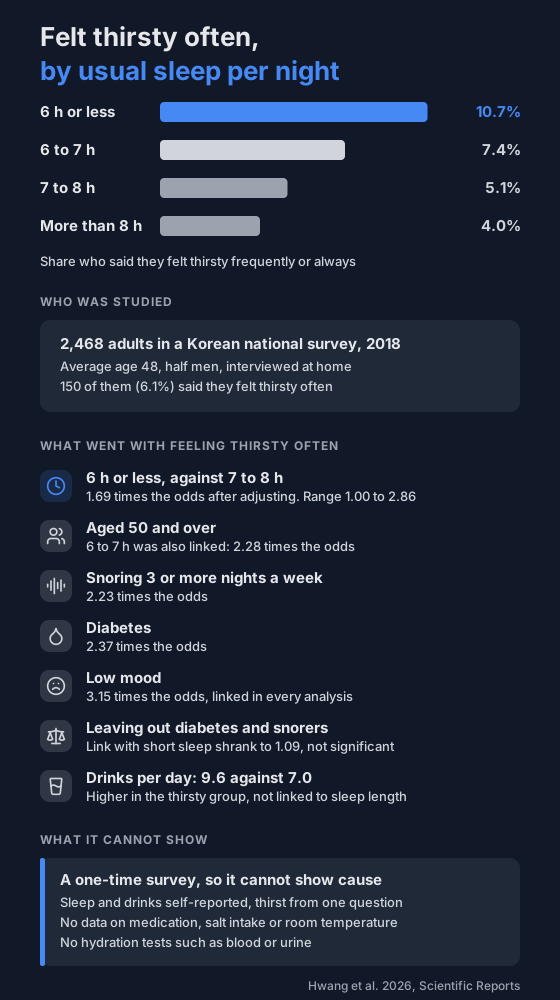
A survey from South Korea, published in May 2026, asked 2,468 adults how long they usually slept and how often they felt thirsty. People sleeping 6 hours or less were more likely to say they felt thirsty often. But much of that link went away once diabetes and snoring were taken out.
Who was in the study?
- 2,468 adults from the 2018 Korean Sleep-Headache Study, a national survey done with door-to-door interviews.
- Average age 48, and about half were men.
- Usual sleep was a weighted average of weeknight and weekend hours over the past month.
- Thirst came from one question: "How often do you feel thirsty?"
- "Frequently" or "always" counted as thirsty often. 150 people (6.1%) said that.
What did it find?
The share who felt thirsty often went down as sleep went up:
- 6 hours or less: 10.7%
- 6 to 7 hours: 7.4%
- 7 to 8 hours: 5.1%
- More than 8 hours: 4.0%
The thirsty group slept 7.0 hours on average, against 7.4 hours for everyone else.
The authors then adjusted for age, sex, job, drinks per day, alcohol, smoking, exercise, high blood pressure, diabetes, BMI, snoring and mood. After that, 6 hours or less went with 1.69 times the odds of feeling thirsty often, compared with 7 to 8 hours. The 95% confidence range runs from 1.00 to 2.86, so the result only just counts as statistically significant. Neither 6 to 7 hours nor more than 8 hours was significantly linked.
What else went with thirst?
After the same adjustments:
- Low mood (a score of 10 or more on a standard depression checklist): 3.15 times the odds. It stayed linked in every analysis, at about 3 to 3.6 times.
- Diabetes: 2.37 times the odds.
- Snoring 3 or more nights a week: 2.23 times the odds.
- Smoking: 1.57 times the odds.
The thirsty group drank more, 9.6 glasses a day against 7.0. But how much people drank wasn't linked to how long they slept.
Does age change the picture?
The authors split the group at 50.
- Under 50: no sleep length was significantly linked. Snoring was, at 3.21 times the odds.
- 50 and over: 6 to 7 hours of sleep went with 2.28 times the odds (2.26 in the abstract, 2.28 in the results table). Diabetes did too, at 2.47 times.
- 6 hours or less: not significant in either age group on its own.
- Both groups: low mood stayed linked, at about 3 times the odds.
Is it really about sleep?
Maybe not. The authors re-ran the numbers leaving people out:
- Without people with diabetes, the link with 6 hours or less fell to 1.50 and was no longer significant. But 6 to 7 hours became significant, at 1.60.
- Without habitual snorers, it fell to 1.43.
- Without both, it fell to 1.09, with no significant link.
The authors conclude the link was largely explained by diabetes and snoring. Diabetes is a known cause of thirst. Snoring often goes with mouth breathing and a dry mouth on waking.
What can't it tell you?
- Cause. It's one survey at one point in time. Short sleep could raise thirst, thirst could cut sleep, or something else could drive both.
- Real hydration. Everything was self-reported. There were no blood or urine tests.
- Day or night. The thirst question didn't separate daytime from night-time thirst, and it wasn't a validated scale.
- Other factors. The survey didn't ask about medication, salt intake or room temperature, which all affect thirst.
- Small group. Only 150 people were in the thirsty group.
- Funding. Support came from the Korean Sleep Research Society and two Korean drug companies.
What can you do with this?
If you're thirsty a lot, tell your doctor. Diabetes is one of the things they may want to check.
If you snore most nights, read snoring vs sleep apnea for the signs worth mentioning too. The sleep apnea risk check takes about a minute.
For another look at what short sleep goes with, see short sleep, heart rate and overnight oxygen. And for how snoring links to day-to-day life, see snoring and quality of life.
Not a medical device. Does not diagnose, treat or prevent any condition. Discuss results and changes with a clinician.
References
- Hwang I, Oh D, Yoon JE, Park JA, Lee WJ, Kim JR, Kim D, Yang KI, Chu MK, Yun CH. Association between sleep duration and thirst in a nationally representative cross-sectional survey. Scientific Reports. 2026;16(1):22306. doi:10.1038/s41598-026-53338-1