Snoring and Quality of Life: A 2026 Survey
A survey of 2,312 adults at Shanghai community health centers found that people who snored 3 or more nights a week scored lower on physical and mental quality of life.
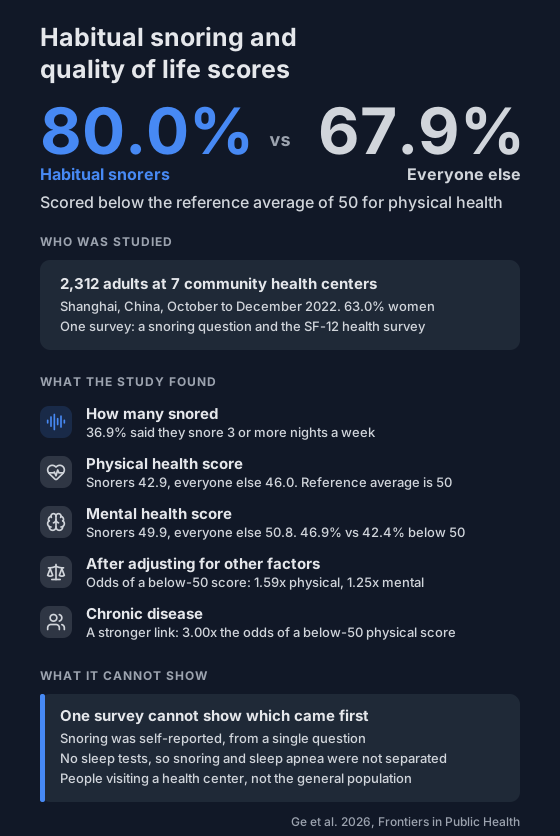
Snoring is often written off as a nuisance for whoever shares the bed. A survey published in August 2026 asked whether people who snore 3 or more nights a week also rate their own health lower.
They did, and the gap was wider for physical health than for mental health.
Who was in the study?
- 2,312 adults visiting 7 community health centers in Shanghai, China, between October and December 2022.
- 63.0% were women, and 51.0% were under 45.
- Each person answered one question about how often they snore.
- "Habitual snoring" meant 3 or more nights a week. 36.9% said yes.
- They also filled in the SF-12, a 12-question health survey that gives a physical score and a mental score. The reference average for each is 50.
What did it find?
| Habitual snorers | Everyone else | |
|---|---|---|
| Physical score | 42.9 | 46.0 |
| Mental score | 49.9 | 50.8 |
| Physical score below 50 | 80.0% | 67.9% |
| Mental score below 50 | 46.9% | 42.4% |
The authors then adjusted for other factors, such as income.
- Habitual snorers had 1.59 times the odds of a below-50 physical score.
- They had 1.25 times the odds of a below-50 mental score.
- Treating the scores as plain numbers, snorers scored 2.38 points lower on physical health and 1.21 points lower on mental health.
Snoring wasn't the strongest link. Having a long-term illness went with 3.00 times the odds of a below-50 physical score.
What doesn't it tell you?
- Cause. It's a single survey, so it can't show whether snoring came before the lower scores.
- Whether it was sleep apnea. Nobody had a sleep test, so the study couldn't separate plain snoring from sleep apnea.
- How accurate the answers were. Snoring was self-reported, and people who sleep alone may not know they snore.
- Everyone. People were recruited while visiting a health center, and may be less healthy than the general population.
- What 50 means. The authors say a score below 50 is below the reference average, not a sign of a health problem. 72.4% of the whole group scored below 50 on physical health.
- The timing. The survey ran late in the COVID-19 pandemic, which the authors say may have affected the mental scores.
What can you do with this?
Snoring 3 or more nights a week is worth mentioning to a doctor, especially with daytime tiredness or pauses in breathing that someone else has noticed. The sleep apnea risk check takes about a minute and helps you decide whether to have that conversation.
Snoring apps vs oximeters explains what each one records. Neither can tell you whether you have sleep apnea.
Not a medical device. Does not diagnose, treat or prevent any condition. Discuss results and changes with a clinician.
References
- Ge X, Sheng Y, Gong R, Wang S, Liu S, Xu C, Yu Y, Yao Y, Cai Y, Xu Z. Self-reported habitual snoring and health-related quality of life among adults attending community health centers in Shanghai, China: a cross-sectional study. Frontiers in Public Health. 2026;14:1891156. doi:10.3389/fpubh.2026.1891156