Sleep Habits and Thyroid Disease: A Study
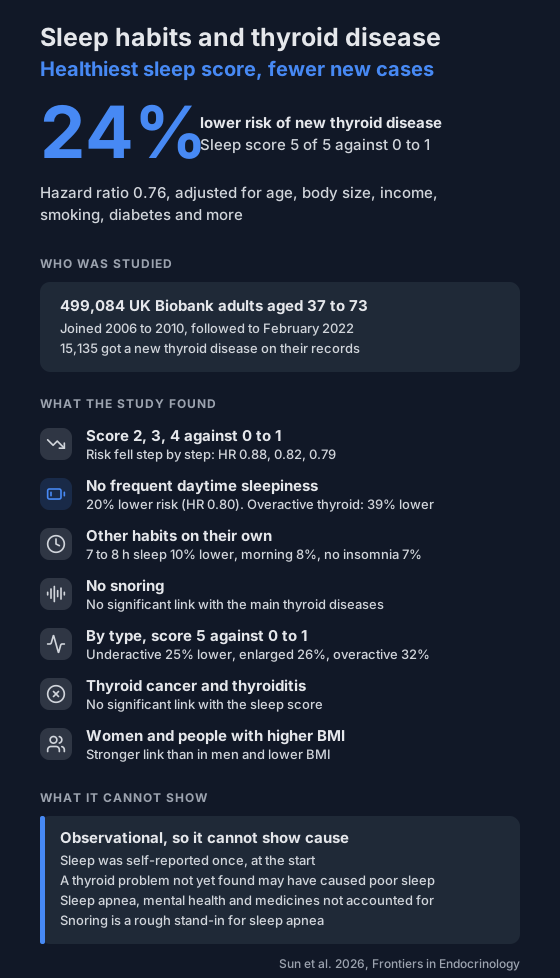
A UK Biobank study of 499,084 adults found that those with all five healthy sleep habits had a 24% lower risk of new thyroid disease. Not feeling sleepy in the day showed the strongest link; snoring showed no significant link.
Your thyroid runs on a daily rhythm, and earlier studies have linked short or poor sleep to thyroid hormone changes. Most of those studies looked at one moment in time, so they couldn't tell which came first.
A study published in October 2026 scored five sleep habits in 499,084 UK adults and followed them for new thyroid disease. Those with all five healthy habits had a 24% lower risk than those with none or one.
Who was in the study?
- 499,084 adults from the UK Biobank, aged 37 to 73 when they joined between 2006 and 2010.
- They were followed until February 2022.
- For each type of thyroid disease, people who already had it at the start were left out.
How did they score sleep?
Everyone answered five questions about their sleep, once, when they joined. Each healthy answer scored 1 point, for a total of 0 to 5:
- Sleeping 7 to 8 hours a day, naps included.
- Being a morning person rather than an evening person.
- Never or rarely having trouble getting to sleep or staying asleep.
- No partner, relative or friend complaining about your snoring.
- Never, rarely or only sometimes dozing off in the day without meaning to.
Few people scored 0, so scores of 0 and 1 were grouped together as the comparison group.
What did it find?
15,135 people got a new thyroid disease on their medical records during follow-up. Most of these (12,537) were an underactive thyroid.
- After adjusting for age, sex, ethnicity, body size, income, education, deprivation, smoking, alcohol, exercise and diabetes, a score of 5 went with a 24% lower risk than a score of 0 or 1 (hazard ratio 0.76).
- Risk went down step by step as the score went up: hazard ratios 0.88, 0.82, 0.79 and 0.76 for scores 2 to 5.
By type, a score of 5 went with a:
- 25% lower risk of an underactive thyroid (hypothyroidism).
- 26% lower risk of an enlarged thyroid without overactivity (nontoxic goitre).
- 32% lower risk of an overactive thyroid (thyrotoxicosis).
There was no significant link with thyroid cancer or thyroiditis.
Which habits mattered on their own?
Each habit was compared on its own, with the same adjustments.
- No frequent daytime sleepiness: 20% lower risk (hazard ratio 0.80), and 39% lower for an overactive thyroid (0.61). This was the strongest link of the five.
- 7 to 8 hours of sleep: 10% lower risk (0.90), against shorter or longer sleep.
- Morning person: 8% lower (0.92).
- No frequent insomnia: 7% lower (0.93).
- No snoring: no significant link with any of the main types of thyroid disease.
The authors point out that daytime sleepiness is a symptom, not just a habit. It can come from short or poor sleep, but also from weight, low mood, medicines and other health problems. Those could explain part of the link.
So where does snoring fit?
Snoring was in the score as a rough stand-in for sleep apnea. On its own, it showed no significant link with the main types of thyroid disease. With snoring taken out of the score, the other four habits still showed the same step-by-step pattern.
A complaint about snoring can't tell harmless snoring apart from sleep apnea. The authors suggest overnight oxygen measures may say more than snoring does. They point to a 2025 study of 452 people with sleep apnea, where a measure of how much oxygen they lost overnight was linked to higher levels of one thyroid hormone (free T3).
For how snoring and sleep apnea differ, see snoring vs sleep apnea. UK Biobank studies using the same score found snoring didn't stand out for pneumonia or neck disc problems either.
Did it differ between groups?
- The link was stronger in women (hazard ratio 0.73) than in men (0.79).
- It was seen in people who were overweight (0.71) or obese (0.70), and in people without diabetes (0.76).
- It didn't differ significantly by age.
The result held when people who got a thyroid disease in the first year were left out.
What doesn't it tell you?
The authors list these limits:
- Cause. It's an observational study. It shows what went together, not that better sleep protects your thyroid. The authors say intervention studies are needed to find out whether changing sleep changes thyroid risk.
- Which came first. A thyroid problem that hadn't been found yet could have caused the poor sleep or sleepiness.
- One snapshot. Sleep was self-reported once, at the start, and may have changed over the years.
- Other factors. Sleep apnea, mental health and medicines weren't accounted for.
- Records. Thyroid disease came from medical record codes, and thyroid medicine use at the start wasn't known. People with sleep problems may also see doctors more, so more thyroid problems get found.
The authors declare no conflicts of interest.
What can you do with this?
These are our suggestions, not the study's findings.
- If you're often sleepy in the day, mention it to your doctor; there are many possible causes.
- If you snore and also feel exhausted in the day, the sleep apnea risk check helps you decide whether to talk to a doctor.
- An overnight oximeter doesn't record snoring or how sleepy you feel. It records your oxygen and pulse through the night, which you can share with your doctor.
Not a medical device. Does not diagnose, treat or prevent any condition. Discuss results and changes with a clinician.
References
- Sun J, Wu Y, Zhao X, Sun L, Lv H, Sun R, Han T, Qiao H. Healthy sleep pattern is associated with reduced risk of incident thyroid disease: a prospective cohort study from the UK Biobank. Frontiers in Endocrinology. 2026;17:1859828. doi:10.3389/fendo.2026.1859828
- Zhou Y, Shi Y, Zhu S, Cao Z, Xie Y, Lu C, Niu X, Ma L, Wang Z, Su Y, Xia Z, Yuan Y, Yang J, Lu R, et al. Independent Association of Sleep Apnea-Specific Hypoxic Burden and Sleep Breathing Impairment Index with Thyroid Function in Obstructive Sleep Apnea: A Retrospective Study. Nature and Science of Sleep. 2025;17:1543-1556. doi:10.2147/NSS.S525750