Sleep Habits and Neck Disc Problems: A Study
A UK Biobank study of 399,862 adults found that those with the healthiest sleep habits at the start were less likely to have a neck disc problem recorded in hospital over about 16 years. Snoring on its own showed no significant link.
Poor sleep and a sore neck often turn up together. Most research on that looks at pain on a given day, not at who goes on to develop a neck problem years later.
A study published in September 2026 followed nearly 400,000 UK adults for about 16 years. People who reported the healthiest sleep habits at the start were less likely to end up with a neck disc problem in their hospital records.
Who was in the study?
- 399,862 adults from the UK Biobank, recruited between 2006 and 2010 at ages 40 to 70.
- Their average age was 56, and 55% were women.
- 95% were white.
- Nobody had a neck disc problem on record at the start.
How did they score sleep?
Everyone answered questions about five sleep habits, once, when they joined. Each healthy answer scored 1 point, for a total of 0 to 5:
- Being a morning person rather than an evening person.
- Sleeping 7 to 8 hours a day.
- No frequent trouble sleeping (insomnia).
- No snoring, as reported by the person.
- No frequent daytime sleepiness.
Most people scored 3 or more. 2.4% scored 0 or 1, and 21.4% scored a full 5.
What counted as a neck disc problem?
A hospital admission record with a neck disc code (ICD-10 M50). That covers slipped or worn discs in the neck, including ones pressing on a nerve or the spinal cord.
Problems seen only by a GP or an outpatient clinic weren't counted.
What did it find?
Over an average of 15.8 years, 2,735 people (0.68%) got a neck disc problem recorded.
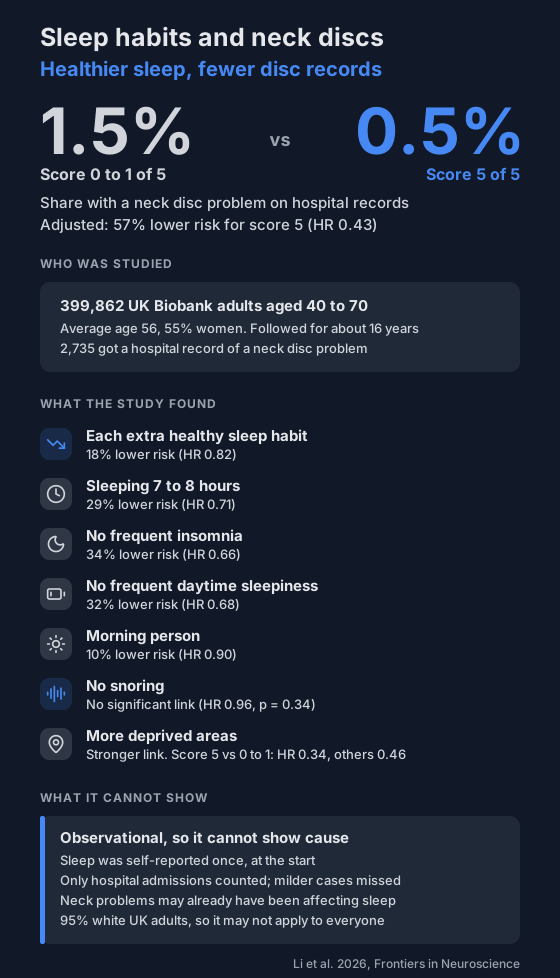
- With a score of 0 or 1, 1.5% did (140 of 9,641).
- With a score of 5, 0.5% did (414 of 85,686).
- After adjusting for age, sex, ethnicity, income, education, area deprivation, BMI, smoking, alcohol, heart and circulation problems and exercise, a score of 5 went with a 57% lower risk than 0 or 1 (hazard ratio 0.43).
- Each extra point went with an 18% lower risk (hazard ratio 0.82).
- Risk went down step by step at every score from 2 to 5.
The link was stronger in the first 10 years of follow-up (hazard ratio 0.79 per point) than after (0.89).
Which habits mattered on their own?
When the authors looked at each habit separately, after the same adjustments:
- No frequent insomnia: 34% lower risk (hazard ratio 0.66).
- No frequent daytime sleepiness: 32% lower (0.68).
- Sleeping 7 to 8 hours: 29% lower (0.71).
- Morning person: 10% lower (0.90).
- No snoring: no statistically significant link (hazard ratio 0.96, p = 0.34, from the paper's Figure 2).
So snoring, the habit most tied to sleep apnea, was the one that didn't stand out.
The authors point out that snoring is a rough stand-in for sleep apnea. Sleep apnea brings broken sleep and repeated oxygen dips, which snoring alone doesn't capture. The UK Biobank had no sleep studies, so the paper couldn't look at sleep apnea itself. For how the two differ, see snoring vs sleep apnea.
Did it differ between groups?
- Age and sex made no significant difference to the link, and it held across BMI, education and income groups.
- It was stronger in more deprived areas. Comparing a score of 5 with 0 or 1, the hazard ratio was 0.34 there and 0.46 in less deprived areas. The authors call this exploratory.
The result held when they:
- Left out anyone whose neck disc problem showed up in the first 3 or 5 years.
- Stopped follow-up at the start of COVID-19.
- Also adjusted for back or neck pain, other disc problems, depression and time spent sitting.
What doesn't it tell you?
The authors list these limits:
- Cause. It's an observational study. It shows what went together, not that better sleep protects your neck.
- One snapshot. Sleep was self-reported once, at the start. Changes over 16 years weren't captured.
- Milder cases. Only hospital admissions were counted.
- Reverse effect. Early neck problems may already have been disturbing people's sleep before they were recorded.
- Other factors. Things like desk work, heavy lifting, arthritis and sleep apnea weren't measured.
- Who it applies to. Mostly white UK adults aged 40 to 70.
Two more things we noticed:
- The paper's text gives being a morning person a 10% lower risk, then says the chronotype link stopped being significant after full adjustment. Its Figure 2 shows that 10% as significant (hazard ratio 0.90, p = 0.009).
- The sleep duration rows in the paper's first table look swapped. They show 95.7% of people who scored 0 or 1 sleeping 7 to 8 hours, which doesn't fit with that group's other answers.
The authors declare no conflicts of interest.
What can you do with this?
These are our suggestions, not the study's findings.
- If you have neck pain or tingling down an arm, see a doctor. A sleep score can't tell you what's going on in your neck.
- If you snore and also feel exhausted in the day, the sleep apnea risk check helps you decide whether to talk to a doctor.
- An overnight oximeter doesn't record snoring, insomnia or your neck. It records your oxygen and pulse through the night. See is an overnight pulse oximeter worth it?
Not a medical device. Does not diagnose, treat or prevent any condition. Discuss results and changes with a clinician.
References
- Li W, Hao Y, Sun R, Cai X, Chen Z, Ma S, Zhuang W. Association of healthy sleep patterns with incident cervical disc disorders: a prospective study. Frontiers in Neuroscience. 2026;20:1940620. doi:10.3389/fnins.2026.1940620