Progressive Muscle Relaxation for Sleep
A 2026 meta-analysis of 14 randomised trials with 957 adults linked progressive muscle relaxation to better self-rated sleep quality, but the trials varied widely and the result was not significant in people 55 and over.
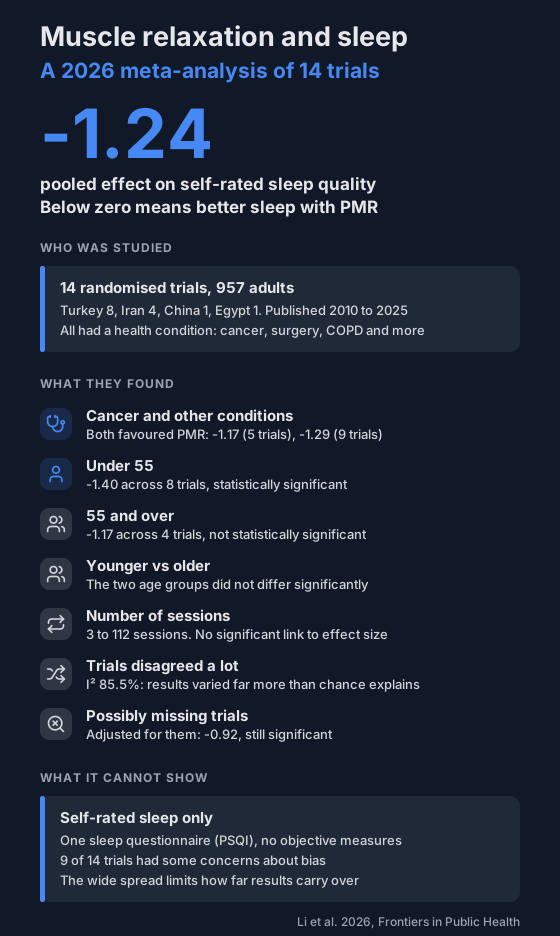
Progressive muscle relaxation (PMR) is one of the most common non-drug suggestions for poor sleep. But single trials have given mixed results. A 2026 meta-analysis pooled 14 randomised trials to see what they add up to.
What is progressive muscle relaxation?
- You tense one muscle group, hold it for a few seconds, then let it go.
- You work through the body that way, group by group, while breathing slowly.
- It was developed by Edmund Jacobson in the 1920s and 1930s.
- It needs no equipment, and the trials in this review ran it in sessions of 20 to 40 minutes where reported.
The authors suggest it may calm the body's stress response and ease anxiety, which could make sleep easier. They didn't test that mechanism.
Who was studied?
- 14 randomised trials with 957 adults: 472 did PMR, 485 didn't.
- Trials came from Turkey (8), Iran (4), China (1) and Egypt (1), published 2010 to 2025.
- Everyone had a health condition. Five trials were in people with cancer. Others covered heart bypass surgery, lung surgery, dialysis, COPD, rheumatoid arthritis, epilepsy, restless legs, fractures and one trial of people with obstructive sleep apnea.
- The comparison groups got usual care, nothing extra, light activity, or standard lung rehab.
- Programmes ran from 3 days to 12 weeks, with 3 to 112 sessions in total.
Sleep was measured with one tool only: the Pittsburgh Sleep Quality Index (PSQI), a standard questionnaire where a lower score means better sleep. The authors declared no commercial or financial conflicts of interest.
What did they find?
- Overall, PMR was linked to better self-rated sleep quality. The pooled effect size was -1.24 (Hedges g, 95% CI -1.71 to -0.77).
- That's a standardised score, not PSQI points. By Cohen's widely used rule of thumb, anything past 0.8 in either direction counts as a large effect.
- People with cancer: -1.17 across 5 trials.
- People with other conditions: -1.29 across 9 trials.
- Removing any single trial left the result between -1.13 and -1.31, so no one trial drove it.
What about people 55 and over?
- Under 55: -1.40 across 8 trials, statistically significant.
- 55 and over: -1.17 across 4 trials, not statistically significant. The confidence interval crossed zero.
- Two trials didn't report ages, so they were left out of this split.
That doesn't mean PMR does nothing for older adults. The test comparing the two age groups found no significant difference between them (p = 0.68). With only 4 trials, the older group's result is just too uncertain to call.
For how sleep problems can look different with age, see sleep apnea in older adults.
Did more sessions mean bigger effects?
No. The authors checked whether the number of sessions lined up with the size of the effect. It didn't, at least not significantly (p = 0.21). One trial with 3 days of sessions and one running 8 weeks both found better sleep scores.
What does "high heterogeneity" mean?
Heterogeneity is how much the trials disagree with each other. Here it was 85.5% (the I² statistic).
- Every trial would give a slightly different answer by chance alone.
- An I² of 85.5% means about 85% of the spread between these trials came from real differences between them, not chance.
- So the trials found genuinely different effect sizes. They differed in who took part, how PMR was taught and how long it ran.
- Splitting by cancer or age didn't explain the spread.
In plain terms: the -1.24 is an average over quite different trials. It tells you the direction is fairly consistent. It doesn't tell you how big the effect would be for any one person or group.
What can't this study show?
- Self-rated sleep only. No sleep lab, no wearable, no oximeter data. The authors list this as a limitation.
- Possible missing studies. Tests suggested some trials, likely with weaker results, may be missing from the published record. Adjusting for that cut the effect to -0.92, still significant.
- Bias concerns. 5 trials were rated low risk of bias and 9 had some concerns. Blinding was the main issue: participants in 5 trials, assessors in 7. It's hard to hide from someone that they're doing PMR.
- Who was in it. Everyone had a health condition, nearly all trials came from Turkey and Iran, and only one was about sleep apnea. The authors say the wide spread limits how far the results apply.
- No long-term picture. The review pooled scores taken when the programmes ended. The authors call for future trials to follow people up afterwards.
What can you do with this?
PMR is cheap and simple to try. If you do, run it as a self-experiment, for example with the sleep experiment planner:
- Note how you rate your sleep before and after a few weeks of practice.
- Keep wearing your oximeter so you can see whether your overnight oxygen and pulse look any different. This review didn't measure either.
- Record several nights, not one. Here's how many nights to record.
- How you feel and what a sensor shows don't always match. See misjudging sleep with sleep apnea.
If you're sleeping badly, talk to your doctor before swapping or adding anything to your current care.
Not a medical device. Does not diagnose, treat or prevent any condition. Discuss results and changes with a clinician.
References
- Li K, Chen S, Liu Y, Yu N. The effects of progressive muscle relaxation on sleep quality in adults: a systematic review and meta-analysis of randomized controlled trials. Frontiers in Public Health. 2026;14:1906525. doi:10.3389/fpubh.2026.1906525