Sleep Apnea: Misjudging How Long You Slept
A 2026 study of 700 adults with sleep apnea found that 1 in 4 misjudged their sleep time by more than 20%. The more breathing events they had, the more likely they were to be off.
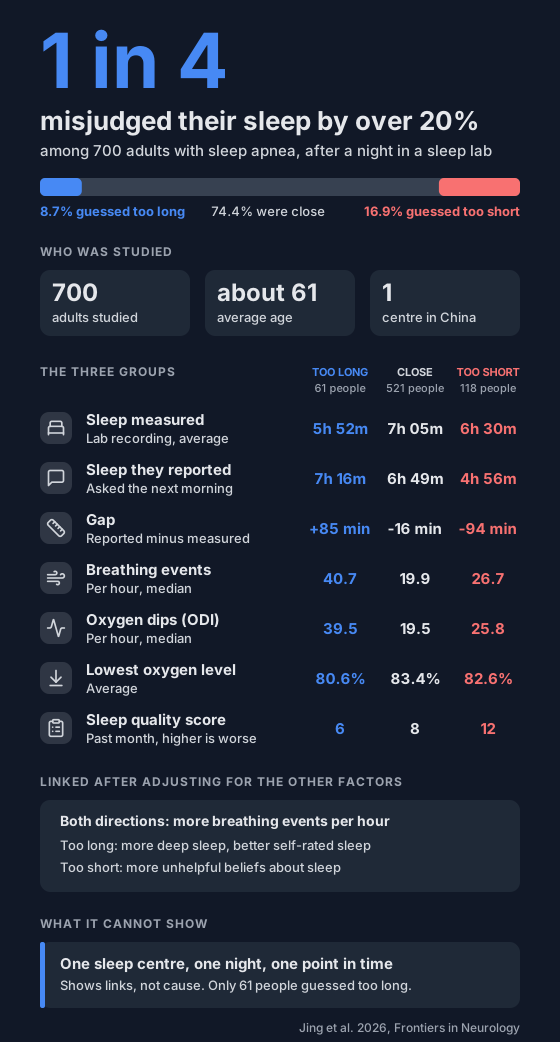
A 2026 study asked 700 adults with sleep apnea how long they'd slept, the morning after a night in a sleep lab. Then it compared their answer with the recording.
Who was studied?
- 700 adults with sleep apnea confirmed by an overnight lab study, at one sleep centre in Jiangsu, China.
- Average age about 61.
- People with depression, an anxiety disorder, chronic pain or other sleep disorders were left out.
Within 30 minutes of the recording ending, each person estimated how long they'd slept.
How far off were they?
- Close (521 people, 74.4%). Their estimate was within 20% of the recording.
- Guessed too short (118 people, 16.9%). They slept 6h 30m on average and reported 4h 56m.
- Guessed too long (61 people, 8.7%). They slept 5h 52m and reported 7h 16m.
The group that guessed too long had the shortest measured sleep. It also had:
- The most breathing events: a median of 40.7 per hour, against 19.9 (close) and 26.7 (too short).
- The most oxygen dips per hour (ODI): 39.5, against 19.5 and 25.8.
- The lowest oxygen low point: 80.6% on average, against 83.4% in the close group.
- The best self-rated sleep over the past month.
The group that guessed too short spent the longest awake in the night: a median of 90 minutes, which they estimated as 120. They rated their past month's sleep the worst.
What was linked to misjudging?
The researchers adjusted for 11 factors at once.
- Both directions: more breathing events per hour, and a lower share of time in bed spent asleep.
- Guessing too long: more deep sleep and better self-rated sleep.
- Guessing too short: more unhelpful beliefs about sleep. Lower anxiety scores and fewer self-reported memory complaints were also linked, though this group's raw scores were higher on both. The authors say the anxiety result goes against earlier research.
Age, BMI and daytime sleepiness didn't differ between the groups.
What can't it show?
- One centre, one night, one point in time. It shows links, not cause.
- Only 61 people guessed too long, so those results are less stable.
- The 20% cut-offs come from insomnia research.
- The authors call the time-asleep-in-bed link preliminary, because both it and the grouping use measured sleep time.
- Nobody recorded whether people were already on apnea therapy.
- Leaving out anxiety disorders narrowed the range of anxiety scores.
What can you do with this?
How you think you slept and what a recording shows can disagree, in either direction. An oximeter doesn't measure sleep time, but you can read its report alongside how you felt. If the two keep disagreeing, share the recordings with your doctor.
Not a medical device. Does not diagnose, treat or prevent any condition. Discuss results and changes with a clinician.
References
- Jing T, Xu M, Wang Y, Cai Y, Gong Y, Zhu L. Factors associated with sleep state misperception in patients with obstructive sleep apnea: a cross-sectional study. Frontiers in Neurology. 2026;17:1925074. doi:10.3389/fneur.2026.1925074