Sitting Time and Sleep: A UK Biobank Study
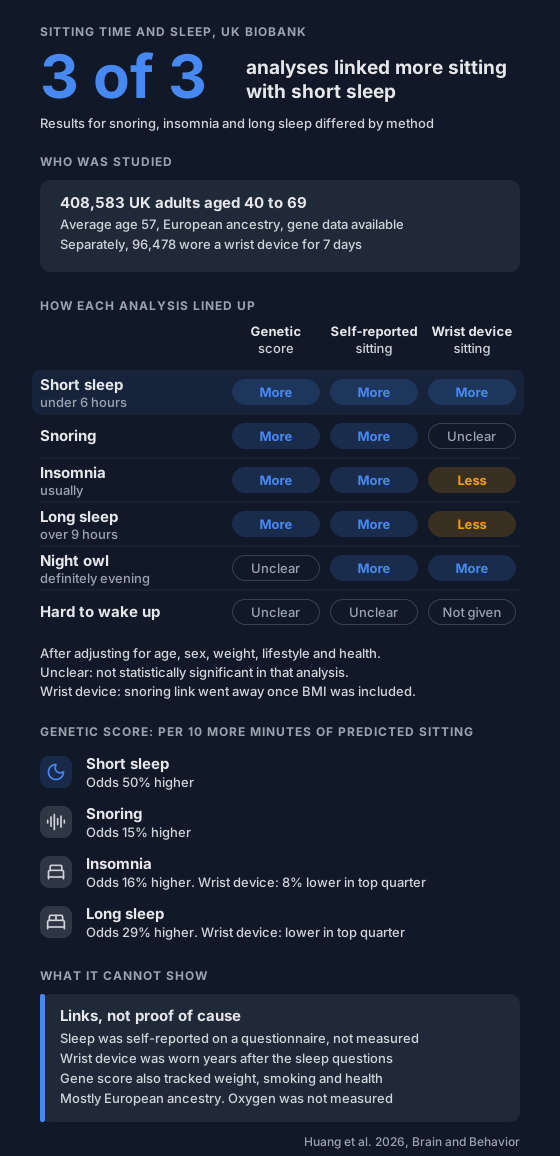
A 2026 UK Biobank study of 408,583 adults linked more sitting with short sleep in all three of its analyses. Results for snoring, insomnia and long sleep depended on the method.
People who sit a lot often say they sleep badly. But plain comparisons can't tell whether sitting affects sleep, poor sleep leads to more sitting, or something else drives both.
A 2026 study in the UK Biobank tried three different ways to get at that question. Short sleep was the one result all three agreed on.
Who was studied?
- 408,583 adults aged 40 to 69 from the UK Biobank, average age 57, all of European ancestry with gene data.
- A separate group of 96,478 UK Biobank adults (average age 56, 94% White) wore a wrist activity tracker for 7 days.
- Sleep came from a questionnaire, not a sleep test: short sleep (under 6 hours), long sleep (over 9 hours), snoring, insomnia, being a night owl, and finding it hard to wake up.
What were the three methods?
- A genetic analysis. It used 132 gene variants linked with sitting time. This approach, called Mendelian randomization, is designed to be less affected by lifestyle and by poor sleep feeding back into sitting.
- Self-reported sitting. What people said about their own sitting time.
- Wrist device sitting. Sitting time measured by the tracker, between 2013 and 2015.
What did it find?
In the genetic analysis, the paper reports that each extra 10 minutes of genetically predicted sitting time went with:
- 50% higher odds of short sleep.
- 29% higher odds of long sleep.
- 16% higher odds of insomnia.
- 15% higher odds of snoring.
Being a night owl and finding it hard to wake up didn't pass the study's significance threshold.
After adjustment, more self-reported sitting went with higher odds of every sleep trait, apart from finding it hard to wake up.
The wrist device agreed on short sleep, but not on everything else:
- Short sleep: more sitting, more short sleep. In the top quarter for sitting, the odds were 1.51 times those of the bottom quarter before adjustment, and the link stayed after it.
- Night owl: also linked with more sitting.
- Insomnia: after adjustment, the top quarter had 8% lower odds, the opposite direction to the genetic result.
- Long sleep: also lower with more sitting.
The authors say those lower figures shouldn't be read as sitting being good for sleep.
What about snoring?
With the wrist device, more sitting went with more snoring at first. The top quarter for sitting had 22% higher odds than the bottom quarter.
That link disappeared once body weight (BMI) was taken into account. An exploratory model estimated BMI could account for about 58% of it, which the authors say doesn't prove BMI is the pathway.
The authors say weight could be a confounder or part of the path from sitting to snoring, and their data can't tell which. For more on how weight and sleep apnea go together, see the obesity and sleep apnea study.
What can't it show?
- Measured sleep. Sleep was self-reported, not recorded. No oxygen or breathing was measured.
- Timing. The wrist tracker was worn 3 to 9 years after the sleep questions were answered.
- Who wore a tracker. They were volunteers, who may differ from the rest of the group.
- The genetic method. It rests on assumptions. The gene score was also linked with higher BMI, smoking and poorer self-rated health.
- Everyone. The genetic sample was all European ancestry.
The authors say results beyond short sleep need cautious interpretation. The study was funded by the National Natural Science Foundation of China, and the authors report no conflicts of interest.
What can you do with this?
The study doesn't show that sitting less will change your sleep. You can still log it for yourself.
If you track your activity and your nights, compare busy days with long sitting days. An overnight oximeter shows how long it recorded, and your oxygen and pulse through the night. The session viewer lets you look through a night's recording.
If you regularly sleep under 6 hours, see what short sleep does to heart rate and oxygen. If you snore, read snoring vs sleep apnea, and talk to a doctor if you're tired during the day.
Not a medical device. Does not diagnose, treat or prevent any condition. Discuss results and changes with a clinician.
References
- Huang H, Zheng L, Zhong C, Lu Z, Li G, Xu C, Cai H, Long G. Causal Associations Between Sedentary Time and Sleep Traits. Brain and Behavior. 2026;16(9):e71776. doi:10.1002/brb3.71776