Best Time to Exercise for Sleep: 13 Trials
A 2026 meta-analysis of 13 randomised trials with 442 people found no clear sleep difference between morning, afternoon and evening exercise. Exercise against no exercise showed a large effect, but it didn't hold up under a stricter test.
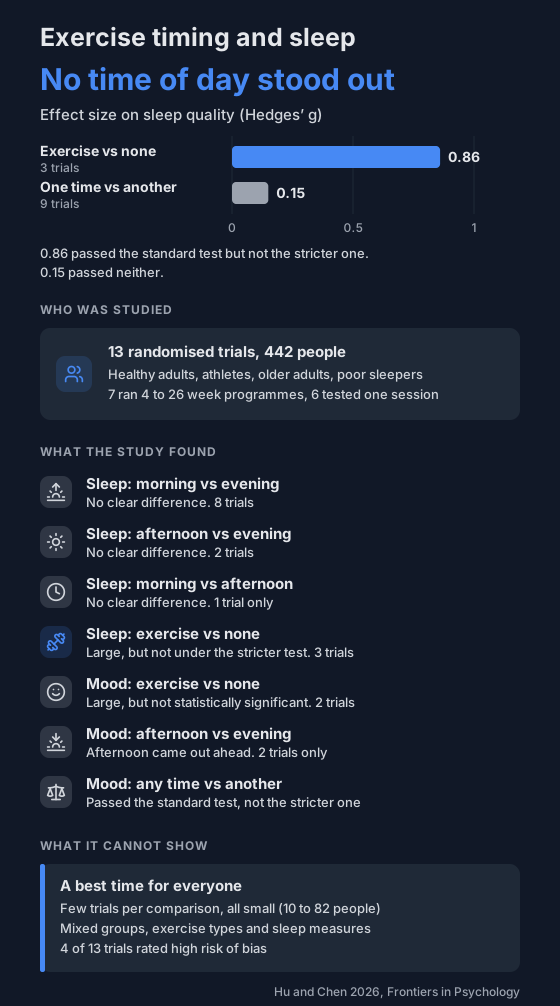
You'll often read that morning exercise is best for sleep, or that evening workouts keep you awake. A meta-analysis published in September 2026 pooled 13 randomised trials on exercise timing, sleep and mood.
For sleep, none of morning, afternoon or evening stood out. Exercise itself seemed to matter more than the clock, but even that result was shakier than it first looks.
Who was in the trials?
- 13 randomised trials from 10 countries, published between 1992 and 2026, with 442 people in total.
- Each trial was small, from 10 to 82 people.
- The groups were very mixed: students, young athletes, sedentary adults with excess weight, older adults with sleep complaints, people with insomnia and people with borderline high blood pressure.
- 7 trials ran exercise programmes of 4 to 26 weeks, and 6 tested a single session.
- Exercise ranged from yoga and step aerobics to interval training and rugby sessions.
- Sleep was mostly measured with a sleep questionnaire, plus wrist trackers, sleep lab recordings and sleep diaries in some.
The time windows were:
- Morning: starting between 6am and 10am, or any time from waking up until noon.
- Afternoon: starting between 12pm and 4pm.
- Evening: starting between 5pm and 9pm, and at least 2 hours before bed.
Did the time of day matter for sleep?
Not clearly. The authors compared trials that tested one time against another directly.
- All timing comparisons together: an effect size of 0.15, which the authors call small and wasn't statistically significant. 9 trials.
- Morning vs evening: 0.08, no clear difference. 8 trials.
- Afternoon vs evening: 0.05, no clear difference. 2 trials.
- Morning vs afternoon: 0.26, no clear difference. Only 1 trial.
That held when they dropped one trial at a time, and when they left out trials rated at high risk of bias (0.11 across 6 trials, still not significant).
So in these trials, evening exercise at least 2 hours before bed showed no statistically significant difference in sleep from morning exercise.
Did exercise help at all?
Maybe, but the evidence here is thin.
Only 3 trials compared sleep after exercise at a set time with sleep after no exercise. Together they showed an effect size of 0.86, which the authors call large, and it passed the standard statistical test.
The authors then ran a stricter test built for meta-analyses with very few trials. It left the 0.86 where it was but widened the margin of error so much that the result could have been zero. With only 3 trials behind it, the authors say this finding has limited robustness.
So the paper's conclusion, that exercise matters more than its timing, is a lean, not a firm result.
What about mood?
- Exercise vs none: a large effect size of 0.95, but not statistically significant. Only 2 trials.
- One time vs another: 0.30, significant in the standard test but not in the stricter one. 5 trials.
- Afternoon vs evening: afternoon came out ahead (0.50, statistically significant). Only 2 trials.
- Morning vs evening: 0.17, no clear difference. 4 trials.
They say the mood signals aren't robust enough for firm timing advice.
What can't it tell you?
- A best time for you. Most comparisons rested on a handful of small trials.
- Single session vs a programme. There weren't enough trials to tell whether timing works differently for each.
- Who it applies to. The groups, exercise types and sleep measures varied a lot.
- Body clock. The analysis grouped sessions by clock time, so a morning person and a night owl exercising at 7pm counted the same.
- Missing studies. With 9 sleep trials, the check for unpublished small studies was weak.
Some calculations relied on assumed correlations, because most crossover trials didn't report them. The sleep results stayed about the same when those assumptions changed; the mood results didn't. The authors report no conflicts of interest.
What can you do with this?
The study doesn't pick a winning time. The authors suggest the time that fits your routine and that you'll keep up is a reasonable choice.
You can test it on yourself as a self-experiment. Log what time you exercised and compare how you slept. The sleep experiment planner helps you set up a fair comparison. If you wear an overnight oximeter, the session viewer shows your pulse and oxygen through each night.
For more on activity and sleep, see the meta-analysis on physical activity and insomnia and the trial of exercise plus sleep coaching. If poor sleep keeps going for weeks, talk to a doctor.
Not a medical device. Does not diagnose, treat or prevent any condition. Discuss results and changes with a clinician.
References
- Hu X, Chen P. Time-of-day effects of acute and regular exercise on sleep quality and mood: a three-level meta-analysis. Frontiers in Psychology. 2026;17:1933599. doi:10.3389/fpsyg.2026.1933599