Morning vs Evening Exercise and Night BP
In a 2026 crossover study of 15 healthy young men, night-time systolic blood pressure averaged 87.6 mmHg after 30 minutes of morning cycling, against 93.3 after evening cycling and 95.8 with no exercise.
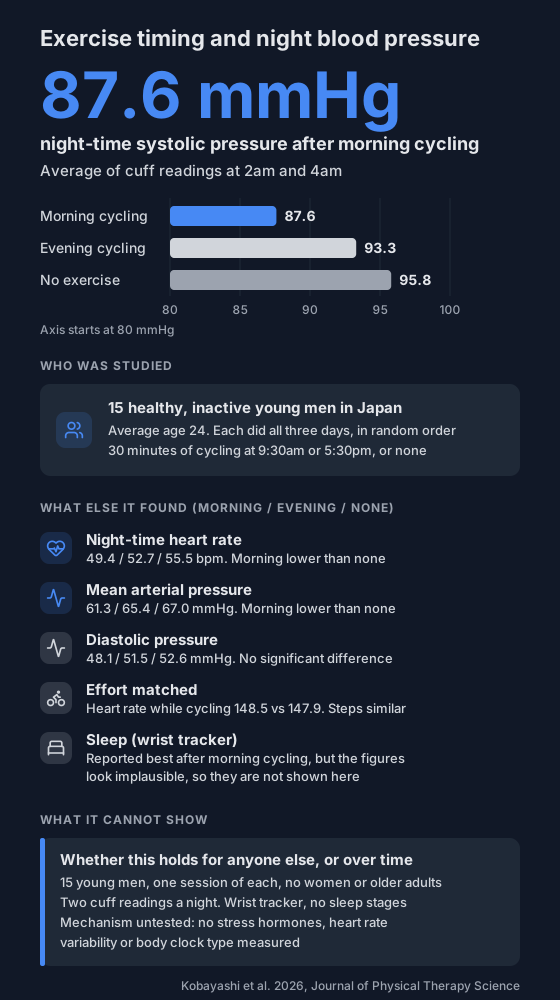
Blood pressure usually drops while you sleep. A small Japanese study published in October 2026 asked whether the time of day you exercise changes how far it drops.
After 30 minutes of morning cycling, night-time systolic pressure was lowest. Evening cycling came second, and a day with no exercise came last.
Who was in the study?
- 15 healthy, inactive young men, average age 24, all with typical blood pressure and no medication.
- Each man did three days, in random order, at least a week apart:
- 30 minutes on an exercise bike at 9:30am.
- The same at 5:30pm.
- No exercise.
- The cycling was at 60 to 65% of heart rate reserve (the abstract says 65%), a pace the men rated as somewhat hard.
- An automatic cuff took blood pressure before exercise and at 2am and 4am, and the study used the average of the two night readings.
- A wrist tracker logged sleep and daily steps.
What did it find?
Night-time systolic pressure, in mmHg:
- Morning cycling: 87.6
- Evening cycling: 93.3
- No exercise: 95.8
The morning day was lower than both other days, and the evening day was lower than no exercise. The authors put the effect sizes at 0.82 for morning against evening, 1.23 for morning against no exercise and 0.32 for evening against no exercise.
Other night-time numbers, morning, evening and none in turn:
- Heart rate: 49.4, 52.7 and 55.5 bpm. Only morning against no exercise was a statistically significant gap.
- Mean arterial pressure: 61.3, 65.4 and 67.0 mmHg. Again only morning against no exercise.
- Diastolic pressure: 48.1, 51.5 and 52.6 mmHg, with no statistically significant difference.
The two cycling days were matched: average heart rate while cycling was 148.5 and 147.9 bpm, and daily steps were almost the same on all three days.
What about sleep?
The paper reports these wrist-tracker figures, but the next section explains why they're hard to trust. From the wrist tracker, morning, evening and none in turn:
- Time in bed spent asleep: 99.0%, 92.6% and 92.3%.
- Minutes to fall asleep: 0.0, 9.2 and 17.6.
- Times woken in the night: 1.3, 15.1 and 10.8.
- Minutes awake after first falling asleep: 4.1, 24.7 and 16.8.
On paper, evening cycling went with falling asleep faster than no exercise, but also with more waking in the night.
For a bigger picture of activity and sleep, see physical activity and insomnia.
Why do some of these numbers look odd?
Some sleep figures are hard to square with 15 different people:
- Falling asleep is listed as 0.0 minutes with a spread of 0.0 after morning cycling, so the tracker had every man asleep the moment the sleep period began.
- Time asleep on the no-exercise and evening days has a standard deviation of only 0.1 percentage points between people.
- Those tiny spreads give effect sizes of 5.42 and 5.12 for time asleep, and up to 6.83 for time awake. An effect size of 0.8 already counts as large.
- Total sleep after morning cycling is listed as 491 minutes, longer than the 11pm to 6am sleep window the men kept for the week before the first trial.
The paper doesn't explain any of this, so read the sleep results as unreliable. The blood pressure readings look more plausible, though the reported effect sizes don't match what the table's averages and spreads give, so they can't be checked either.
What can't it show?
- It's a very small study: 15 men, one session of each kind.
- Only healthy young men. The authors say it's unknown whether it applies to women, older adults or people with health conditions.
- Two cuff readings a night is a narrow window on night-time blood pressure.
- A wrist tracker can't see sleep stages.
- Stress hormones, heart rate variability and body clock type weren't measured, so the authors' explanation, that evening exercise leaves the body revved up at bedtime, is untested.
- It shows one day's effect, not what happens over weeks.
- It was funded by a Japanese government research grant (JSPS KAKENHI), and the authors declare no conflicts of interest.
For how blood pressure dipping links to oxygen at night, see oxygen burden and night-time blood pressure.
What can you do with this?
An oximeter doesn't measure blood pressure, but it does log your pulse rate all night. If you're curious about exercise timing, it makes a simple self-experiment:
- Exercise in the morning on some days and in the evening on others.
- Note which nights were which.
- Plan the nights with the sleep experiment planner.
- Compare your overnight pulse rate across several nights of each in the session viewer.
One night of each tells you little. Here's how many nights to record. If you have a heart or blood pressure condition, talk to your doctor before changing how or when you exercise.
Not a medical device. Does not diagnose, treat or prevent any condition. Discuss results and changes with a clinician.
References
- Kobayashi R, Seki S, Niu K, Kinoshita H, Negoro H. Acute effects of morning versus evening aerobic exercise on nocturnal blood pressure in healthy young men. Journal of Physical Therapy Science. 2026;38(10):464-468. doi:10.1589/jpts.38.464