Physical Activity and Insomnia: 19 Studies
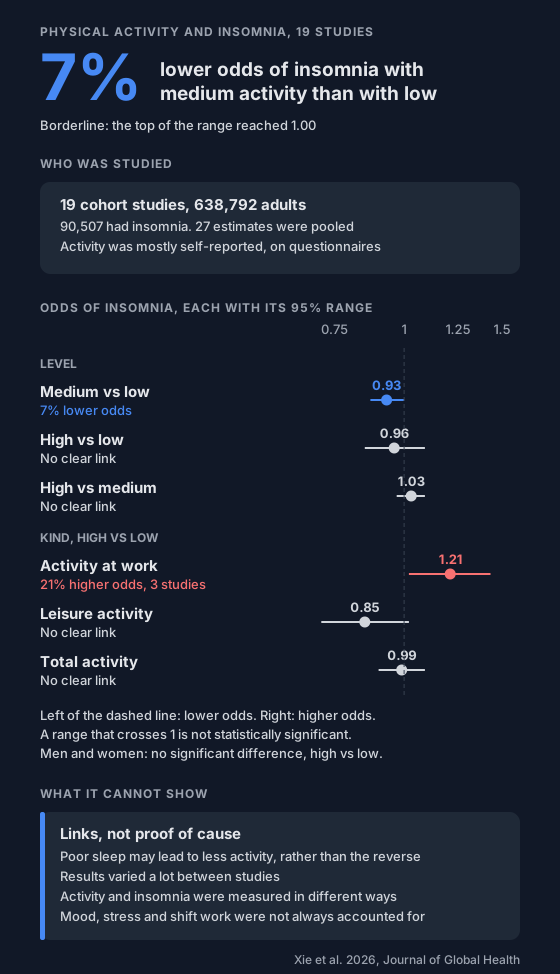
A 2026 meta-analysis of 19 cohort studies with 638,792 adults linked medium activity with 7% lower odds of insomnia than low activity. High activity showed no clear link, and activity at work went with 21% higher odds.
Exercise is often suggested for people who sleep badly, and trials of exercise programmes back that up. But trials are often small and tightly controlled, so they don't tell you much about everyday activity.
A 2026 meta-analysis looked at everyday life instead. It pooled 19 studies that compared how active people were with whether they had insomnia.
Medium activity went with slightly lower odds of insomnia. More than that showed no clear extra link, and activity at work went the other way.
Who was studied?
- 19 cohort studies with 638,792 adults in total, 90,507 of them with insomnia.
- The authors searched six databases up to August 2024, English-language papers only.
- Each study grouped people by activity level with its own cut-offs, mostly from questionnaires.
- Insomnia was defined in different ways: a doctor's finding, a sleep questionnaire, or self-reported complaints.
- The studies' quality averaged 5.3 on a 9-point scale, which the authors call medium.
Medium here means the middle of the low, medium and high levels the paper compares. It describes how active people were, not their sleep.
What did it find?
Compared with low activity:
- Medium activity: 7% lower odds of insomnia (odds ratio 0.93, 95% range 0.87 to 1.00). The top of the range touches 1, so it's borderline.
- High activity: no statistically significant link (odds ratio 0.96, range 0.85 to 1.09).
High activity didn't do better than medium either (odds ratio 1.03, range 0.97 to 1.09). For total activity only, high went with 5% higher odds than medium (1.05, range 1.01 to 1.09).
The authors say the main link was small and close to no effect.
Does the kind of activity matter?
The paper split high vs low activity by where it happened:
- At work: 21% higher odds of insomnia (odds ratio 1.21, range 1.02 to 1.43). This rests on 3 studies, and the authors call it hypothesis-generating.
- Leisure: 15% lower odds, but not statistically significant (0.85, range 0.71 to 1.02).
- Total activity: no link (0.99, range 0.90 to 1.09).
For leisure activity at the medium level, the odds were 11% lower than low (0.89, range 0.79 to 0.99).
The authors suggest physical jobs often come with work stress, which leisure activity doesn't. The study didn't test that.
Was it different for men and women?
Not for high vs low activity. The odds ratio was 0.94 in men and 1.03 in women, and neither was statistically significant.
For medium vs low, women had 4% lower odds (0.96, range 0.93 to 0.99). Men's estimate was 0.80, but its range was wide (0.56 to 1.15).
What can't it show?
- Cause. These are observational studies. They show what went together, not what caused what.
- Direction. People with insomnia may be too tired to be active, rather than activity affecting sleep.
- Other habits. People with medium activity may also eat better and have less stress. Mood, stress, income, illness and shift work weren't adjusted for in every study.
- Consistency. Results varied a lot between studies (I² of 74% in the main analysis).
- Measurement. Activity was mostly self-reported, and insomnia was defined in several ways.
- Multiple tests. The authors say the results are exploratory.
The funnel plot looked symmetrical, so there was no sign of missing small studies, but with 19 studies that check is weak. The study was funded by Chinese government science and traditional Chinese medicine programmes, and the authors report no conflicts of interest.
What can you do with this?
The study doesn't show that changing how active you are will change your sleep. You can still watch it for yourself as a self-experiment.
Log your active days and your rest days, and compare how you slept. If you wear an overnight oximeter, the session viewer shows your pulse and oxygen through each night. For a related study, see sitting time and sleep.
If you're thinking about a sleep tracker for insomnia, read the meta-analysis of wearables for insomnia. If poor sleep keeps going for weeks, talk to a doctor.
Not a medical device. Does not diagnose, treat or prevent any condition. Discuss results and changes with a clinician.
References
- Xie CQ, Xie FF, Cui JH, Kong LJ, Yao F, Fang M. Physical activity as a protective factor for insomnia: systematic review, meta-analysis, and quality assessment of observational studies. Journal of Global Health. 2026;16:04196. doi:10.7189/jogh.16.04196