Do Wearable Sleep Devices Help Insomnia?
A 2026 meta-analysis pooled 16 randomised trials with 910 adults. People using a wearable device fell asleep about 4.5 minutes sooner, but overall insomnia scores did not change significantly.
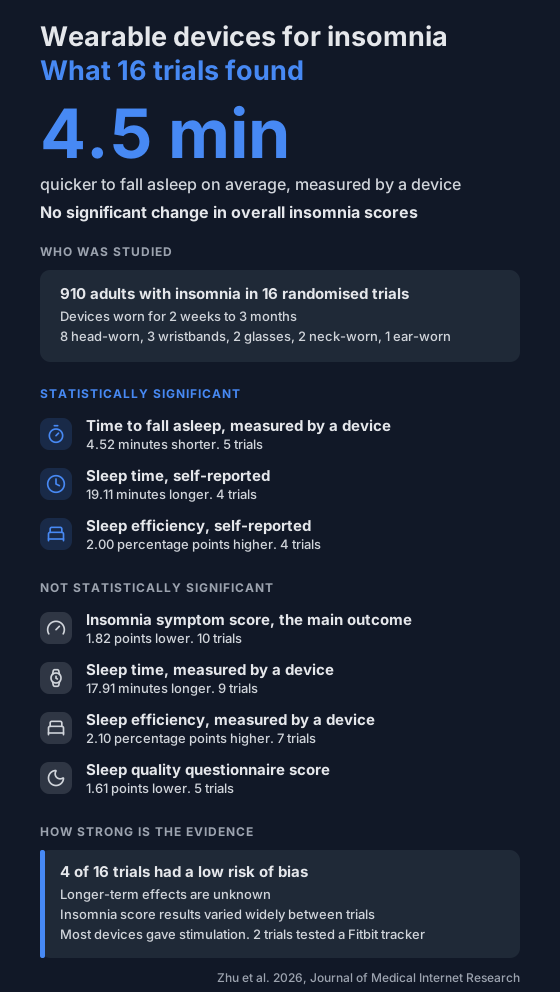
Headbands, glasses, neckbands and wristbands are all sold to people who sleep badly. A meta-analysis published in September 2026 pooled the randomised trials that tested them in adults with insomnia.
People using a device fell asleep about 4.5 minutes sooner. Their overall insomnia symptom scores didn't change significantly.
What was studied?
- 16 randomised controlled trials with 910 adults who had insomnia.
- Trials ran for 2 weeks to 3 months.
- 8 trials used head-worn devices, 3 wristbands, 2 light-filtering glasses, 2 neck-worn devices and 1 an ear-worn device.
- Going by the review's table of trials, most devices delivered stimulation, and only 2 trials used a Fitbit sleep tracker.
What changed?
Three results were statistically significant:
- Time to fall asleep, measured by a device: 4.52 minutes shorter (5 trials).
- Self-reported sleep time: 19.11 minutes longer (4 trials).
- Self-reported sleep efficiency (share of time in bed asleep): 2.00 percentage points higher (4 trials).
What didn't?
- Insomnia symptom score, the review's main outcome: 1.82 points lower (10 trials), not significant.
- Device-measured sleep time: 17.91 minutes longer (9 trials), not significant.
- Self-reported time to fall asleep, device-measured sleep efficiency, time awake in the night, daytime sleepiness and sleep quality scores: no significant difference.
The authors conclude that wearables are an add-on, not a substitute for cognitive behavioural therapy for insomnia, which they call the first-line option.
How strong is the evidence?
- Risk of bias. 4 of the 16 trials were rated low risk, 9 unclear and 3 high.
- Blinding. It was often inadequate, so the authors say the true effect on self-reported results may be smaller.
- Spread. For time to fall asleep and self-reported sleep time, the prediction intervals include zero, so the authors say the effect in a new setting could be nothing.
- Unexplained differences. Insomnia score results varied widely, and device position, trial length and control type didn't explain why.
- Short trials. Longer-term effects are unknown.
- Who took part. Mostly women, mostly from East Asia or North America, as in other wearable studies.
The review's certainty table rates 3 outcomes high, 2 at the second highest of four grades and 4 low.
What can you do with this?
- With only 2 tracker trials, the review says little about trackers on their own.
- If you've slept badly for weeks, see a doctor.
- The authors note that people with insomnia often misjudge their sleep compared with a recording.
An overnight oximeter records oxygen and pulse, not insomnia: here's what one is useful for.
Not a medical device. Does not diagnose, treat or prevent any condition. Discuss results and changes with a clinician.
References
- Zhu W, Chen M, Guo Y, Zhang B, Luo C. Effectiveness of Wearable Digital Therapeutics in Improving Sleep Outcomes Among Individuals With Insomnia: Systematic Review and Meta-Analysis of Randomized Controlled Trials. Journal of Medical Internet Research. 2026;28:e93496. doi:10.2196/93496