WHOOP Strain vs Perceived Effort in Athletes
A small 2026 study of 11 college athletes found WHOOP activity strain and how hard sessions felt only loosely matched (r = 0.29), and sleep measures lined up with each in different ways.
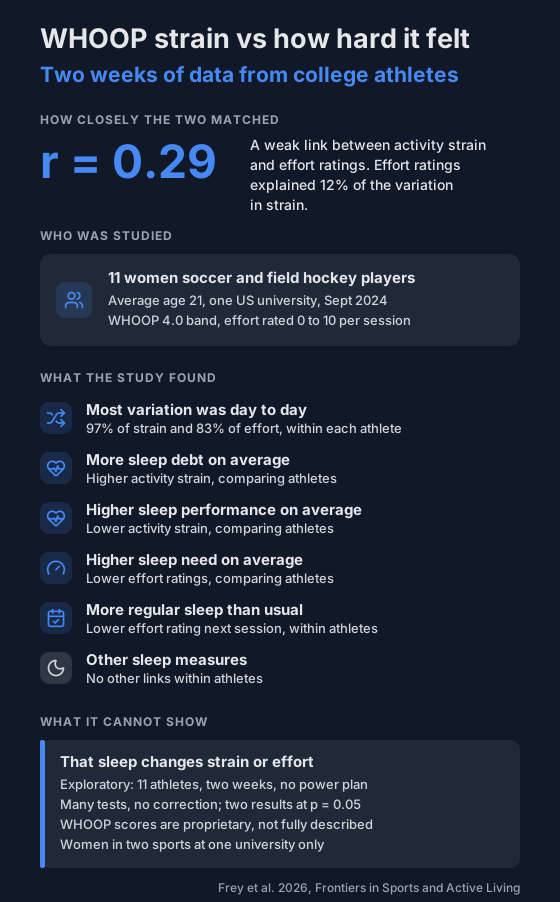
Wearables give athletes a heart-rate-based score for how hard a session was. Coaches also ask athletes to rate how hard it felt. A small 2026 study put the two side by side for two weeks, along with the band's sleep data.
The two scores only loosely matched, and sleep lined up with each in a different way.
Who was studied?
- 15 women from a US university's soccer and field hockey teams signed up in September 2024.
- 13 finished the two weeks.
- 11 had both effort ratings and WHOOP data on the same days, so the analysis covers 11.
- Their average age was 21.
- They wore the team's WHOOP 4.0 band day and night.
- Within 30 minutes of each session, they rated how hard it felt from 0 to 10, before looking at their WHOOP data.
- That gave 147 days of training data and 102 nights of sleep data.
What's WHOOP strain?
It's WHOOP's own 0 to 21 score. The study used activity strain, which the paper describes as the heart and circulation load of one session or game. How WHOOP calculates it isn't published in full.
Did the band and the athletes agree?
Only loosely.
- Across all sessions, strain and effort ratings had a correlation of 0.29, which is weak.
- Allowing for each athlete's own pattern, effort ratings explained 12.1% of the variation in strain.
- The athletes' average effort ratings ranged from 2.2 to 6.3 out of 10, and their average strain from 9.1 to 12.5.
Most of the variation was from day to day, not between people. 97% of the variation in strain, and 83% in effort ratings, was within each athlete.
The authors read this as the two scores picking up partly the same thing and partly different things.
How did sleep fit in?
Each session was matched with the WHOOP sleep data from the night before. The study looked at two kinds of link.
Comparing athletes with each other, by their two-week averages:
- More sleep debt went with higher activity strain.
- A higher WHOOP sleep performance score went with lower activity strain.
- A higher sleep need went with lower effort ratings.
Within each athlete, compared with her own usual:
- A night with more regular sleep timing than usual went with a lower effort rating the next session.
- That was the only within-athlete link.
- No other sleep measure lined up with strain or effort within athletes.
The authors sum it up as poorer sleep on average going with higher strain but lower perceived effort. They suggest that, if this holds, athletes who sleep poorly might push harder than they feel they are, and say it needs more research.
The paper notes that WHOOP sets sleep need partly from the day's strain. The authors read the athletes' high sleep need as a sign of hard training, so sleep need isn't purely a sleep measure.
What can't it show?
- Cause. It's observational, so it shows what went together, not what caused what.
- Small and short. 11 athletes over two weeks, with no sample size worked out in advance, in what the authors call an exploratory pilot.
- Many tests. No correction for running many comparisons, and two of the four links sat right at the p = 0.05 cut-off.
- Proprietary scores. Strain, sleep performance, sleep need and sleep consistency are WHOOP's own calculations.
- Who it covers. Women in two sports at one university, mostly White.
The paper also contradicts itself. The abstract links more sleep need to higher strain, but the results only link it to lower effort ratings. The conclusion links less consistent sleep to lower effort ratings, the opposite of the results. The supplementary results table backs the results section, so this article follows it.
What can you do with this?
If you train with a wearable, its strain score and how a session felt are two different readings. Logging both gives you more to go on than either alone.
A 2026 review of sleep trackers in sport suggests reading trends over 14 to 28 nights rather than single nights; see sleep trackers for athletes. For a larger study on sleep timing and training, read irregular sleep timing, training and HRV.
Not a medical device. Does not diagnose, treat or prevent any condition. Discuss results and changes with a clinician.
References
- Frey AE, Stoke C, Provenzano C, Fanning J. Sleep-related metrics that predict training intensity: an exploratory study in women's college athletics. Frontiers in Sports and Active Living. 2026;8:1849511. doi:10.3389/fspor.2026.1849511