Sleep Trackers for Athletes: A 2026 Review
A 2026 review of 21 studies on consumer sleep trackers for active people listed 9 strengths, 12 weaknesses, 8 opportunities and 8 threats, and suggests reading trends over 14 to 28 nights.
PulseOxTracker Team
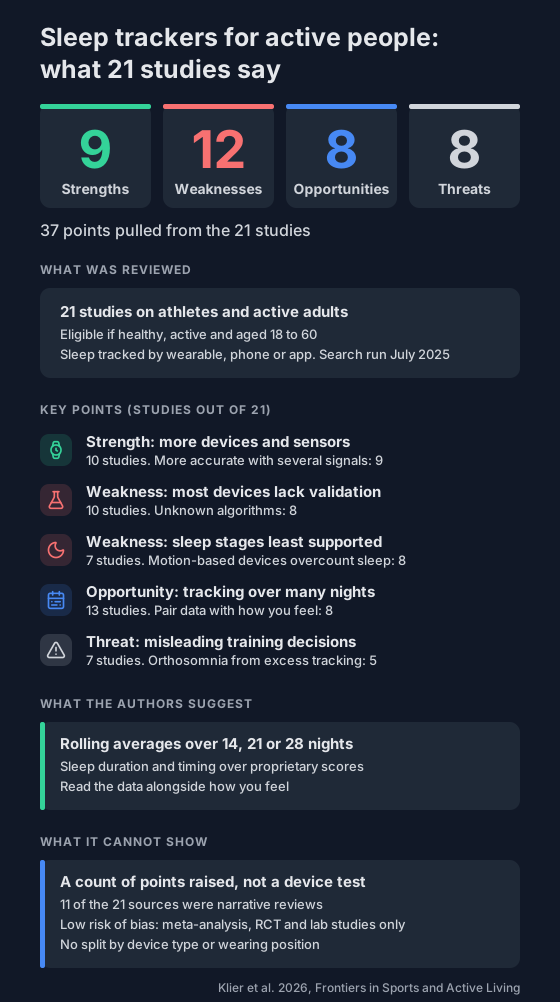
Sleep trackers are sold to active people as a way to manage recovery. A 2026 review went through 21 studies on athletes and sorted what they say into strengths, weaknesses, opportunities and threats.
The weaknesses list was the longest.
What did the review cover?
- A search of three databases in July 2025 ended with 21 studies.
- To be included, a study had to cover healthy, active adults aged 18 to 60 whose sleep was tracked with a wearable, a phone or an app.
- 11 were narrative reviews, 1 was a systematic review with meta-analysis and 9 were original studies.
- The authors pulled out 37 points: 9 strengths, 12 weaknesses, 8 opportunities and 8 threats.
What are trackers good at?
- More devices with more sensors are on sale (10 studies).
- Sleep and wake are sensed more accurately when a device combines signals like heart rate, breathing and movement (9 studies).
- They record in your own bed, not a lab (8 studies).
The most-cited opportunity was tracking over many nights, at home or at a training camp (13 studies).
Where do they fall short?
- Most devices have no validation study (10 studies).
- Makers' specifications differ and their algorithms are unknown (8 studies).
- Devices that rely on movement tend to count too much sleep and too little time awake (8 studies).
- Sleep stages have the weakest evidence (7 studies).
- One study noted that light-based sensors can be thrown off by skin tone or tattoos. See pulse oximeters and skin tone.
Can tracking backfire?
The two threats raised most often:
- Poor data leading to misleading training or recovery decisions (7 studies).
- Orthosomnia, the pursuit of perfect sleep driven by tracker data (5 studies).
What do the authors suggest?
- Look at rolling averages of sleep duration over 14, 21 or 28 nights, not single nights. More on how many nights to record.
- Favour sleep duration and sleep timing over a maker's own scores.
- Read the numbers alongside how you feel.
- For a clinical assessment, they say to use at least a medical device or go to a sleep lab.
What can't it show?
- It counts how often a point came up. It didn't test any device.
- Only the meta-analysis, the randomised trial and the sleep-lab validation studies were rated low risk of bias.
- 11 of the 21 sources were narrative reviews, which were not rated for bias.
- It doesn't separate device types or wearing positions. See sensor fit and pressure.
To put your own nights side by side, try compare nights.
Not a medical device. Does not diagnose, treat or prevent any condition. Discuss results and changes with a clinician.
References
- Klier K, Masur L, Düking P. Consumer-oriented (wearable) sleep technology: a systematic SWOT analysis and recommendations for athletes and fitness enthusiasts. Frontiers in Sports and Active Living. 2026;8:1872518. doi:10.3389/fspor.2026.1872518