Sleep Efficiency and HRV in Footballers
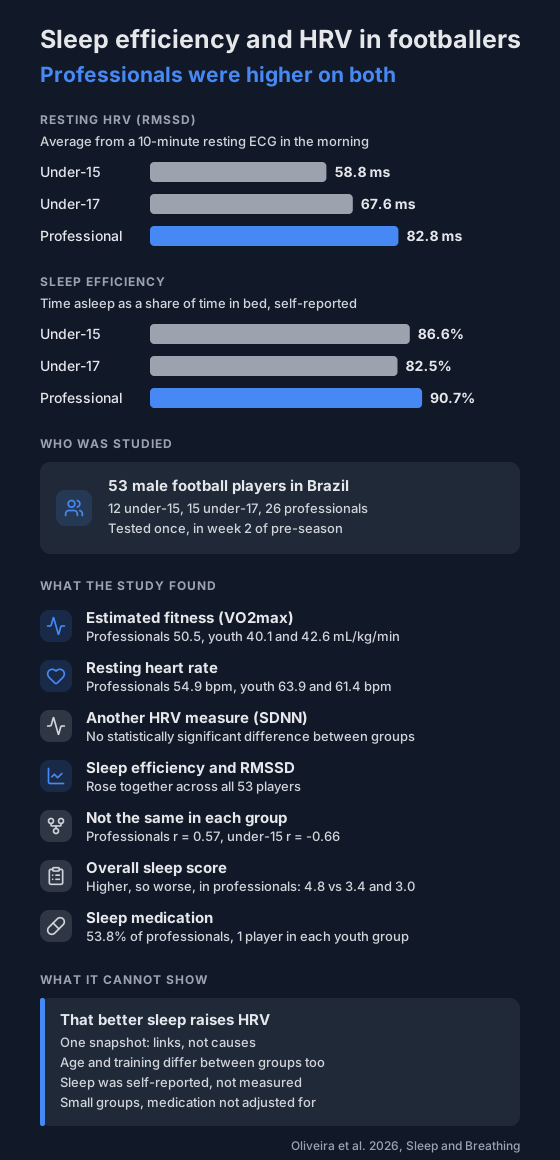
A 2026 study of 53 male football players in Brazil found professionals had higher resting HRV and higher self-reported sleep efficiency than under-15 and under-17 players, and the two went up together.
Athletes often track heart rate variability (HRV) as a sign of recovery, and sleep is one of the things it's thought to follow. A 2026 study compared youth and professional football players during pre-season.
Professionals had higher resting HRV and higher sleep efficiency than the under-15 and under-17 players. Across all the players, the higher one was, the higher the other tended to be.
Who was studied?
- 53 male football (soccer) players from Pinheiro, in north-east Brazil.
- 12 under-15s, 15 under-17s and 26 professionals aged 18 to 28.
- All were tested once, in the second week of pre-season.
- Players with a known sleep disorder, an injury, or medication that affects the heart or nervous system were left out.
What was measured?
- HRV: a 10-minute ECG lying down, in the morning, at least 24 hours after the last training session. The main measure was RMSSD.
- Sleep: the Pittsburgh Sleep Quality Index (PSQI), a standard sleep questionnaire. Sleep efficiency is one part of it: time asleep as a share of time in bed, worked out from the players' own answers.
- Fitness: VO2max estimated from a shuttle-run test.
So sleep was self-reported, not recorded with a tracker or a sleep study.
What did it find?
- RMSSD: 82.8 ms in professionals, against 58.8 ms in under-15s and 67.6 ms in under-17s.
- SDNN, another HRV measure, showed no statistically significant difference between the groups.
- Sleep efficiency: 90.7% in professionals, against 86.6% and 82.5%.
- 84.6% of professionals were above 85% sleep efficiency, against 25% of under-15s and 40% of under-17s.
- Fitness: estimated VO2max was 50.5 mL/kg/min in professionals, against 40.1 and 42.6.
- Resting heart rate: 54.9 bpm in professionals, against 63.9 and 61.4.
- Across all 53 players, sleep efficiency and RMSSD rose together, and so did VO2max and RMSSD (r = 0.61).
Was it the same in every group?
No, and the authors point this out.
- In professionals, higher sleep efficiency went with higher RMSSD (r = 0.57).
- In under-15s it went the other way (r = -0.66).
- In under-17s there was no statistically significant link.
The authors call these group-by-group results exploratory, as each group was small.
Was professionals' sleep better overall?
Not on every measure.
- Their overall PSQI score was higher, which means worse: 4.8, against 3.4 and 3.0. All three averages sat below the cut-off of 5 that the PSQI uses for poor sleep.
- More of them took over 15 minutes to fall asleep, though that difference wasn't statistically significant.
- 53.8% of professionals reported using sleep medication, against 1 player in each youth group. Within the professionals, users and non-users had no statistically significant difference in RMSSD or VO2max.
- A third of under-15s reported daytime sleepiness at the PSQI's second-highest level, and 2 under-17s at the highest. No professional reported either.
What can't it show?
- Cause. It's a single snapshot, so it can't say whether better sleep raises HRV, or the other way round.
- Training vs growing up. The professionals were older and had a longer, more structured pre-season. HRV tends to rise from teenage years into adulthood anyway, and the authors say they can't separate that from training.
- Measured sleep. Sleep efficiency came from a questionnaire, not a tracker or sleep study.
- Medication. Sleep medication use was recorded but not adjusted for in the main analysis.
- Everyone. 53 male players from one town, with small youth groups. Diet and hydration weren't controlled.
What can you do with it?
If you log morning HRV, you can note your sleep beside it and see whether the two move together for you. The live HRV tool measures RMSSD from a Checkme O2 Max's pulse wave.
- Compare your own mornings with each other, not with an athlete's numbers.
- Take the reading at the same time and in the same position each day.
- Look at the trend over weeks. A review of sleep trackers for athletes covers how to read them.
- Sleep timing may matter too: see irregular sleep timing, training and HRV.
For how wrist and chest HRV compare with an ECG, see wearable HRV vs ECG.
Not a medical device. Does not diagnose, treat or prevent any condition. Discuss results and changes with a clinician.
References
- Oliveira NG, Abreu LMS, Ribeiro FB Jr, Silva BFA, Monteiro TNF, Correia MB, Pereira MEV, Costa HA, Mostarda CT, Dias Filho CAA, Rodrigues JFC Jr, Monzani JOB, Garcia ES, Cabido CET, et al. Association of sleep efficiency with cardiac autonomic modulation in young and professional soccer players during pre-season. Sleep and Breathing. 2026;30(5):263. doi:10.1007/s11325-026-03811-y