Does Beer Affect HRV? The BEER-HIIT Trial
71 young adults did 10 weeks of interval training with daily beer, vodka in sparkling water, alcohol-free beer or water, or didn't train. HRV showed no statistically significant differences between groups, but the trial wasn't sized to find them.
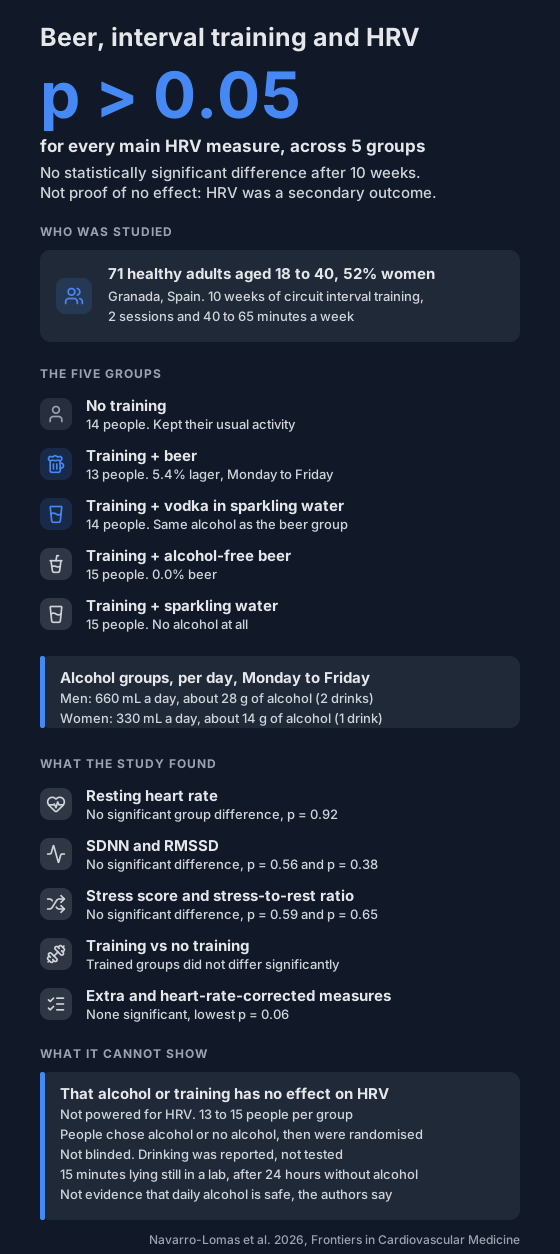
Exercise is often said to raise heart rate variability (HRV), and alcohol to lower it. So what happens to HRV if you train and also drink a beer or two every day?
The BEER-HIIT trial in Spain tried it for 10 weeks. An analysis published in August 2026 found no statistically significant HRV differences between any of its five groups. That's not the same as finding no effect, and the authors say so.
Who was in the study?
- 71 healthy adults aged 18 to 40 in Granada, Spain: 37 women and 34 men.
- None had heart or metabolic disease, took medication for a long-term condition, or had a personal or family history of alcohol problems.
- None was doing a structured exercise or weight-loss program.
- 83 people were assigned to a group; 10 were lost to follow-up and 2 in the no-training group were excluded after an injury.
What did the groups do?
People first chose whether to train. Those who trained then chose alcohol or no alcohol, and were randomly assigned to one of two drinks within that choice:
- No training: 14 people, kept their usual activity.
- Training + beer: 13 people, 5.4% lager.
- Training + vodka in sparkling water: 14 people, the same amount of alcohol as the beer.
- Training + alcohol-free beer: 15 people, 0.0% beer.
- Training + sparkling water: 15 people.
The alcohol-free groups were asked not to drink any alcohol for the whole 10 weeks.
How much alcohol was it?
Drinks were taken Monday to Friday.
- Men: 660 mL a day, one 330 mL bottle with lunch and one with dinner. That's about 28 g of alcohol, or 2 standard drinks.
- Women: 330 mL a day with dinner. About 14 g of alcohol, or 1 standard drink.
The researchers handed out the week's coded drinks and collected the empty bottles. Everyone analysed reported drinking exactly what they were given.
What was the training?
- Two sessions a week for 10 weeks, 40 to 65 minutes a week in total.
- A circuit of eight weight-bearing exercises, including planks, squats, deadlifts, push-ups, battle ropes and burpees.
- Short bursts of 15 to 30 seconds at near-maximum effort, with rests of the same length.
How was HRV measured?
- With a Polar RS800CX heart rate monitor, lying still in a lab for 15 minutes, before and after the 10 weeks. Five minutes of that were analysed.
- After at least 3 hours without food, 24 hours without alcohol or stimulants, and 24 to 48 hours without hard exercise.
- The main measures were SDNN, RMSSD, a stress score and a sympathetic-to-parasympathetic ratio, a rough "fight or flight" versus "rest" balance (called stress-to-rest ratio below).
So it looked at resting HRV after a day off drinking, not at the night after a drink.
What did it find?
No statistically significant differences between the five groups in any main measure:
- Resting heart rate: p = 0.92.
- SDNN: p = 0.56.
- RMSSD: p = 0.38.
- Stress score: p = 0.59.
- Stress-to-rest ratio: p = 0.65.
That covers both questions: beer or alcohol against no alcohol, and training against no training. Extra measures and versions corrected for heart rate weren't significant either; the lowest p value was 0.06.
The paper reports these as test results and box plots, not as average changes for each group.
Doesn't that mean beer didn't matter?
No, and this is the main thing to take from it.
- HRV was a secondary outcome. The trial was sized for other outcomes, and no one worked out how many people it would take to find an HRV difference.
- The groups were small. 13 to 15 people each, so smaller differences could easily be missed.
- "No significant difference" isn't "no effect." The authors write that a missed real difference can't be ruled out.
The authors also say the result isn't evidence that daily alcohol is safe, and alcohol shouldn't be recommended on the back of it. They point out that no level of alcohol is completely risk-free.
Why might training not have shown up either?
The authors suggest a few possibilities, none tested:
- Two sessions a week may be too little. Studies that saw HRV go up with interval training mostly used about three a week for 12 weeks.
- Weight-bearing circuits may load the heart differently from running or cycling.
- Healthy young adults may have little room for their HRV to change.
Earlier BEER-HIIT reports did find gains in fitness and body composition with this program.
What else can't it tell you?
- Full randomisation. People chose alcohol or no alcohol themselves, which may have introduced bias.
- Blinding. Beer, vodka and water taste different, so the study couldn't be fully blinded.
- Drinking outside the study. It was self-reported each week and never checked with a test.
- Older people or people with health conditions. Everyone was healthy and under 40.
- Lab-grade HRV. The Polar monitor isn't the reference method, though studies have reported it as valid and reliable.
- Dropouts. Only people who finished, trained at 80% or more of sessions and had valid HRV readings both times were analysed, which may have added bias.
- Other effects of alcohol. Sleep, recovery and muscle building weren't measured here.
The authors declared no conflicts of interest. The paper doesn't include a funding statement.
How does this fit with your own HRV?
Drinking and HRV have been looked at in other ways. A large wearable study linked drinking more than usual to a lower HRV and a higher heart rate that night; see alcohol, heart rate and sleep in WHOOP data. That's the night after drinking, which this trial didn't measure.
If you want to see your own pattern:
- Take a morning reading at the same time and in the same position each day. The live HRV tool measures RMSSD from a Checkme O2 Max's pulse wave.
- Log drinking days and dry days, and compare trends over weeks, not single mornings.
- Wearable HRV isn't the same as a chest strap or ECG; see how close wearable HRV is to an ECG.
- For what evening drinks did to overnight oxygen in other studies, see alcohol and overnight oxygen.
- For a trial of exercise and HRV in people with more breathing events at night, see exercise, HRV and sleep apnea.
Not a medical device. Does not diagnose, treat or prevent any condition. Discuss results and changes with a clinician.
References
- Navarro-Lomas G, De-la-O A, Dote-Montero M, Castillo MJ, Amaro-Gahete FJ, Plaza-Florido A. Moderate alcohol intake and heart rate variability adaptations to high-intensity interval training in healthy young adults: the BEER-HIIT study. Frontiers in Cardiovascular Medicine. 2026;13:1920023. doi:10.3389/fcvm.2026.1920023