Exercise, HRV and Sleep Apnea: A Study
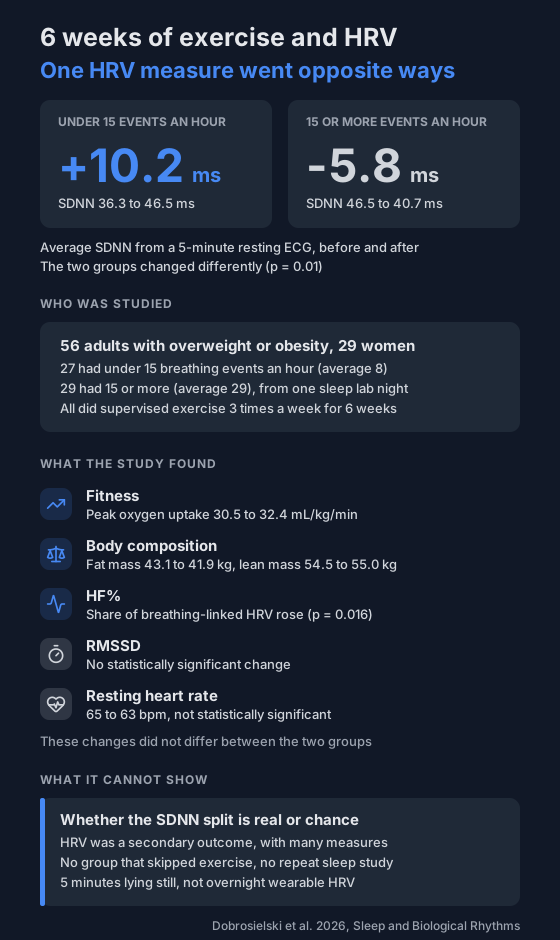
56 adults did 6 weeks of supervised exercise and got fitter on average. One HRV measure, SDNN, went up in those with under 15 breathing events an hour and down in those with 15 or more.
Studies have often found heart rate variability (HRV) goes up with regular exercise. That's one reason people watch the HRV number on their watch.
A 2026 study tried six weeks of supervised exercise in adults carrying extra weight, some with more breathing events at night and some with fewer. On average, they got fitter. But one HRV measure, SDNN, went up in the group with fewer events and down in the group with more.
Who was in the study?
- 56 adults aged 30 to 65 who snored, with a BMI of 27 to 42. The average BMI was about 34.
- 29 women and 27 men, community volunteers recruited by a university in Maryland, USA.
- Each had one night in a sleep lab before starting.
- 27 had under 15 breathing events an hour (average 8).
- 29 had 15 or more (average 29).
- The two groups were similar in age, weight, body fat, blood pressure and fitness at the start.
People with diabetes, heart failure, a past heart attack, uncontrolled high blood pressure or artery disease in the legs causing pain when walking weren't eligible.
What did they do?
- Three supervised sessions a week for six weeks, 18 in total.
- About 40 minutes of aerobic exercise at 60% to 90% of heart rate reserve.
- Then 15 to 20 minutes of resistance exercise for 8 to 10 major muscle groups.
HRV was measured before and after, from a 5-minute ECG. People lay still in the lab between 6 and 9 am, after an overnight fast, breathing at their usual pace.
What changed for everyone?
- Fitness: peak oxygen uptake went from 30.5 to 32.4 mL/kg/min on average.
- Body fat: fat mass went from 43.1 to 41.9 kg, and lean mass from 54.5 to 55.0 kg.
- HF%: the share of HRV linked to breathing rose after training (p = 0.016).
- RMSSD: no statistically significant change.
- Resting heart rate: 65 to 63 bpm in both groups, not statistically significant.
None of these changes differed between the two groups.
Where did the groups split?
On SDNN, a measure of how much the gaps between heartbeats vary overall.
- Under 15 events an hour: 36.3 ms before, 46.5 ms after.
- 15 or more: 46.5 ms before, 40.7 ms after.
- The two groups changed differently (p = 0.01).
A related measure, CVRR, split the same way (p = 0.007).
Two things to keep in mind:
- The group with more events started with a higher SDNN. That gap wasn't statistically significant, but it means the two groups didn't start level.
- The paper reports that the groups changed differently, not a separate test of each group's change.
Why might that happen?
The authors don't know. They suggest that repeated oxygen dips at night may keep the body's "fight or flight" side switched up, and that six weeks may be too short to shift it.
They also point to a 40-week exercise study in people with 15 or more events an hour that found SDNN went up. Whether SDNN would have kept falling past six weeks here is unknown.
What can't it tell you?
- Whether the split is real. HRV was a secondary outcome of a trial built for another question, blood vessel function. The authors say it may have been too small to show HRV changes reliably.
- Chance. Eight main HRV measures, plus a few more, were tested with no statistical correction for that.
- Cause. This wasn't a randomised trial, and there was no group that didn't exercise.
- Whether breathing at night changed. No one had a second sleep study after the program.
- What your watch shows. HRV came from 5 minutes lying still in a lab, not a wearable or a night of sleep.
The study was funded by the US National Heart, Lung, and Blood Institute, and the authors declared no conflicts of interest.
How does this relate to your wearable's HRV?
Loosely.
- Watches and rings usually work out HRV from a light sensor, not an ECG. See how close wearable HRV is to an ECG.
- Apple Watch reports SDNN from short readings through the day. Fitbit reports RMSSD from your main sleep. See how a Fitbit's overnight HRV compared with a chest ECG.
- SDNN and RMSSD aren't interchangeable, and both depend on when and how long you measure.
- The study's numbers are group averages from a 5-minute morning reading. They don't tell you what a rise or fall in your own number means.
If you track HRV, compare like with like: same device, same time of day, trends over weeks. An HRV number can't tell you whether you have sleep apnea. For one study that compared waking HRV with overnight oxygen, see daytime HRV and night breathing.
What can you do with this?
If you snore loudly, someone has heard you stop breathing in your sleep, or you're exhausted during the day, see a doctor. The sleep apnea risk check takes about a minute and helps you decide whether to talk to one.
An overnight oximeter records your oxygen and pulse through the night, and you can share that with your doctor. For how fitness and breathing events went together in a larger group, see sleep apnea, fitness and mortality.
Not a medical device. Does not diagnose, treat or prevent any condition. Discuss results and changes with a clinician.
References
- Dobrosielski DA, Ives SJ, Kubitz KA, Park H, Papandreou C, Patil S. The effects of a six-week exercise program on heart rate variability in adults with and without obstructive sleep apnea. Sleep and Biological Rhythms. 2026;24(4):493-501. doi:10.1007/s41105-026-00666-4