Does Daytime HRV Reflect Night Breathing?
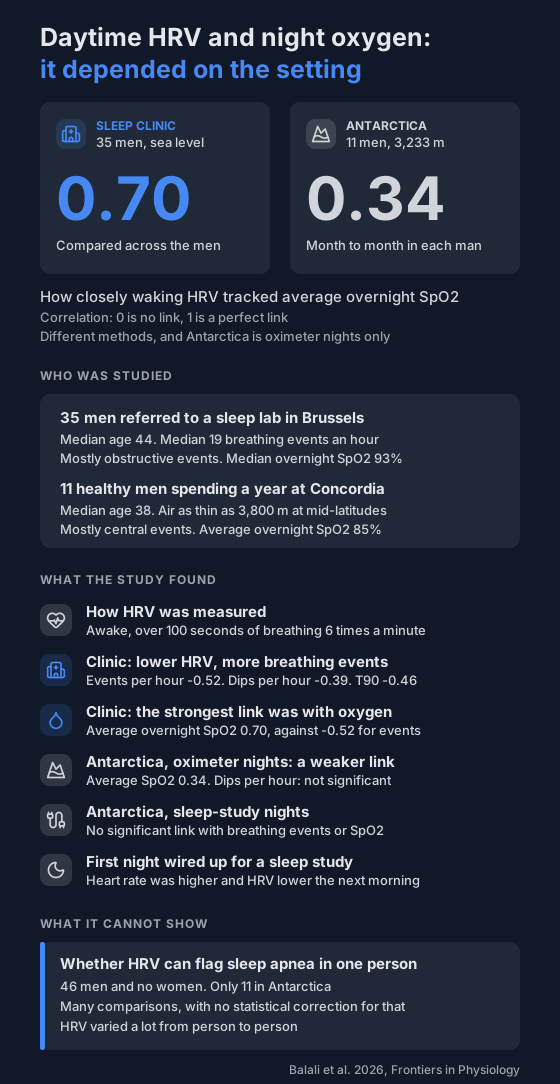
A 2026 study measured heart rate variability in men while awake. In 35 sleep clinic patients it tracked overnight oxygen and breathing events. In 11 men wintering in Antarctica the link was weaker and less consistent.
Heart rate variability (HRV) is the beat-to-beat change in the gap between heartbeats. Earlier studies found that people with sleep apnea tend to have lower HRV, even while awake.
A 2026 study asked whether that holds in two very different settings: a sleep clinic at sea level and a research station in Antarctica. It held in the clinic. In Antarctica the link was weaker and showed up on some nights only.
Who was studied?
Two groups, all men.
- Sleep clinic. 35 men referred to a sleep lab in Brussels with sleep complaints. Median age 44, median BMI 29.
- Antarctica. 11 healthy crew members spending about a year at Concordia station. Median age 38, median BMI 25.
Concordia sits at 3,233 m. The authors say the air there is as thin as at about 3,800 m at mid-latitudes. Thin air like that is known to bring on pauses in breathing during sleep, even in healthy people. For background, see blood oxygen at altitude.
How was HRV measured?
Awake, with an ECG, during paced breathing at 6 breaths a minute. The researchers analysed 100 seconds of it.
- The clinic group did it once, in the evening before an overnight sleep study.
- The Antarctic crew did it about once a month, in the morning, shortly after waking from an overnight recording.
In Antarctica, four of the monthly recordings were planned as full sleep studies. The other nights used a pulse oximeter only.
The main HRV number was RMSSD, a standard measure of beat-to-beat change. Results are given as correlations, where 0 means no link and 1 or -1 means a perfect one.
What did the sleep clinic group show?
Their nights:
- Median 19 breathing events an hour, mostly obstructive.
- Median overnight SpO2 of 93%.
- Median 1.87% of the time in bed below 90% (T90).
Men with lower waking HRV had more going on at night:
- Breathing events per hour: -0.52.
- Oxygen dips per hour (ODI): -0.39.
- T90: -0.46.
- Average overnight SpO2: 0.70, so lower HRV went with lower oxygen.
The link with average oxygen was the strongest of the four. The authors read that as a sign that how deep and how long the dips are may matter more to the heart's rhythm than how many events there are. They did not measure that directly.
What about Antarctica?
The crew's nights were very different:
- Average overnight SpO2 of 85% on the oximeter nights.
- 41 oxygen dips an hour on average.
- 43% of the night below 85% on average.
- 35 breathing events an hour on average on the sleep-study nights, mostly central.
Here the researchers looked at each man over time: when his overnight numbers changed from one month to the next, did his HRV change with them? That is a different kind of correlation from the clinic one, which compared the men with each other. So the numbers from the two groups are not like for like.
On oximeter-only nights:
- HRV rose and fell with average overnight SpO2 (0.34, p = 0.016). The 0.34 is printed in the paper's abstract.
- The link with time below 85% fell just short of statistical significance (p = 0.055).
- There was no statistically significant link with oxygen dips per hour (p = 0.310).
On sleep-study nights:
- No statistically significant link between HRV and breathing events per hour or average SpO2.
Why would the sleep study change things?
The study found the kit itself left a mark. After the first night wired up for a sleep study, morning heart rate was higher and HRV was lower than after nights without it. The researchers left those first nights out of the correlations. Two men had no trial night first, and their sleep-study results were kept in.
They suggest the discomfort of the equipment, thin air and broken sleep together may leave little room for HRV to move. That is their explanation, not something the study tested.
They also list other things at Concordia that can shift HRV: months without the usual cycle of day and night, isolation, and night shifts.
What can't this study show?
- It's small. 46 men in total and 11 in Antarctica. The authors say the non-significant results there are not proof of no link.
- No women. The authors say the findings need checking in women.
- Many comparisons. The correlations were exploratory, with no statistical correction for running so many.
- Different timing. HRV was taken in the evening in the clinic and in the morning in Antarctica.
- Different kinds of events. Mostly obstructive in the clinic, mostly central at altitude.
- A correlation is not a cause. The clinic result is one snapshot of each man.
- Conflicts of interest. The authors declared none.
The authors also say HRV varied a lot from person to person. They say that makes a single HRV cut-off hard to set, and limits what HRV on its own can say about one person. They see it as a possible early warning sign that prompts a check-up, and say it needs testing in each setting first.
What can you do with this?
- Don't read a low HRV number as a sign of one thing. The authors say HRV reflects the total strain on the body and can't tell one cause from another.
- If you want to know about your overnight oxygen, record it directly. Here's how many nights to record.
- Wearable HRV has its own accuracy limits. See wearable HRV against ECG.
- If your recordings or your sleep worry you, share them with your doctor. Home oximetry is not a sleep study.
Not a medical device. Does not diagnose, treat or prevent any condition. Discuss results and changes with a clinician.
References
- Balali P, Omari G, Hossein A, Abdessater E, Batonon C, Hagson H, Wacquier B, Varon C, van den Berg NH, Van Cutsem J, Van Puyvelde M, Furian M, Verges S, Maggioni MA, et al. Heart rate variability during wakefulness reflects sleep apnea indicators but remains context-dependent. Frontiers in Physiology. 2026;17:1793057. doi:10.3389/fphys.2026.1793057