Sleep Apnea, Fitness and Mortality: A Study
A German study of 1,001 adults found that more breathing events and oxygen dips per hour went with lower peak fitness, and more breathing events with more deaths over about 10 years.
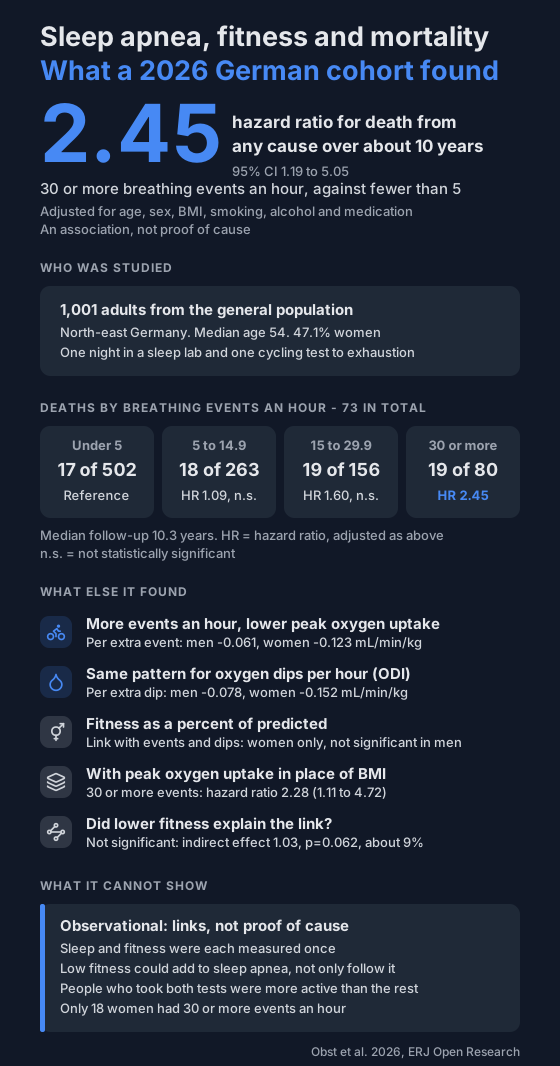
Sleep apnea and low fitness have each been linked to dying earlier. A 2026 German study asked whether lower fitness is the reason sleep apnea goes with more deaths.
More breathing events went with lower fitness and with more deaths, but the part of the second link that ran through fitness was not statistically significant.
Who was studied?
- 1,001 adults from SHIP-TREND, a general population study in north-east Germany.
- Aged 20 to 81, median age 54, and 47.1% were women.
- Each had one night of sleep lab recording between 2008 and 2012.
- Each also did a cycling test to exhaustion, with breathing gases measured. The main fitness measure was peak oxygen uptake: how much oxygen the body uses at full effort.
- Deaths were tracked through the population register until January 2023, a median of 10.3 years.
About half (502) had fewer than 5 breathing events an hour. 263 had 5 to 14.9, 156 had 15 to 29.9, and 80 had 30 or more.
Did more breathing events go with lower fitness?
Yes, in both men and women.
- Breathing events. Each extra event per hour went with a peak oxygen uptake 0.061 mL/min/kg lower in men and 0.123 lower in women.
- Oxygen dips. Each extra dip per hour (ODI) went with 0.078 lower in men and 0.152 lower in women.
Those figures are adjusted for age, smoking, alcohol and some medications.
Median peak oxygen uptake in men was 26 mL/min/kg at 5 to 14.9 events an hour, 24 at 15 to 29.9 and 23 at 30 or more. In women it was 19, 17 and 15.
The authors call the size of these links "relatively modest" and say what they mean for fitness or mortality risk in this population is uncertain.
Was it different for women?
Partly.
When fitness was measured as a percent of the predicted value, more breathing events and more oxygen dips went with lower fitness in women only. In men, neither link was significant.
Among people with 30 or more events an hour, women reached a median 73% of predicted peak oxygen uptake and men reached 97%. That group had only 18 women, and the authors say the findings in women should be read with caution.
Sleep efficiency, total sleep time and time awake in the night were also linked to peak cycling power, as a percent of predicted, in women. In men, only total sleep time was.
Did more breathing events go with more deaths?
Yes. 73 people died during follow-up.
| Breathing events an hour | Deaths | Hazard ratio (95% CI) |
|---|---|---|
| Under 5 | 17 of 502 | Reference |
| 5 to 14.9 | 18 of 263 | 1.09 (0.55 to 2.16), not significant |
| 15 to 29.9 | 19 of 156 | 1.60 (0.80 to 3.23), not significant |
| 30 or more | 19 of 80 | 2.45 (1.19 to 5.05) |
A hazard ratio of 2.45 means the rate of death during follow-up was about 2.45 times that of the comparison group. These ratios are adjusted for age, sex, BMI, smoking, alcohol and some medications (the paper's model 2). The paper prints four models:
- Model 1 adjusted for age, sex and BMI only: 2.78 (1.35 to 5.75) for 30 or more events.
- Model 3 added peak oxygen uptake and dropped BMI: 2.28 (1.11 to 4.72) for 30 or more events.
- Model 4 used fitness as a percent of predicted and left out age, sex and BMI. Its ratios were larger: 3.06 (1.57 to 5.98) for 15 to 29.9 events and 6.17 (3.13 to 12.15) for 30 or more.
- The 15 to 29.9 group was significant only in model 4. The 30 or more group was significant in all four. The Discussion says only the 30 or more group stayed significant.
- The paper also ran events per hour as one continuous measure on a log scale. That ratio was 1.37 in model 1, 1.34 in model 2, 1.31 in model 3 and 1.72 in model 4, and significant in all four. It is a ratio per step on the log scale, so it can't be compared directly with the group ratios above.
- The authors say oxygen dips per hour gave much the same results, but they don't print those numbers.
Other studies on this: sleep apnea deaths in the US and CPAP and long-term survival.
Did lower fitness explain the link?
Not in a way the statistics could confirm.
The authors split the link between breathing events and death into two parts:
- Direct: 1.38 (95% CI 1.07 to 1.78), significant.
- Through lower fitness: 1.03 (95% CI 1.00 to 1.06, p=0.062), not significant.
The total was 1.42 (95% CI 1.10 to 1.83). The estimated share passing through fitness was about 9%, and that share was not statistically significant. The authors call this part of the study exploratory.
What can't this study show?
- Cause. It's observational, so it shows what went together, not what caused what.
- Direction. Sleep and fitness were each measured once. The authors say low fitness could add to sleep apnea, as well as the other way round.
- One night. Each person had a single sleep lab night, which the authors say may have added measurement variability. More on that: multi-night tracking vs one sleep study.
- Who took part. Many invited people declined the sleep study. Those who did both tests were slightly older, more often male and more physically active than the rest of the cohort.
- Few women in the top group. Only 18 women had 30 or more events an hour.
- One region. Everyone lived in West Pomerania, and some people were lost to follow-up.
- Whether exercise changes the outcome. The study didn't test that. The authors say trials are needed to find out whether raising fitness changes survival in people with sleep apnea.
What can you do with this?
- The sleep measures here came from a sleep lab, not a home oximeter. Home oximetry is not a sleep study, though ODI is a number an overnight oximeter also reports.
- If your recordings show a lot of oxygen dips per hour, that's worth showing your doctor.
- Your activity level is worth mentioning at the same visit.
The paper declares no funding and no conflicts of interest.
Not a medical device. Does not diagnose, treat or prevent any condition. Discuss results and changes with a clinician.
References
- Obst A, Stubbe B, Kaczmarek S, Daboul A, Krüger M, Völzke H, Penzel T, Fietze I, Ewert R. Association of obstructive sleep apnoea with exercise capacity and mortality in a population-based study: results of SHIP-TREND. ERJ Open Research. 2026;12(4):01520-2025. doi:10.1183/23120541.01520-2025