Sleep Apnea Deaths in the US: 1999 to 2023
A 2026 study counted 71,202 US deaths that listed both sleep apnea and respiratory failure. The yearly rate went from 0.25 to 2.26 per 100,000 adults between 1999 and 2023.
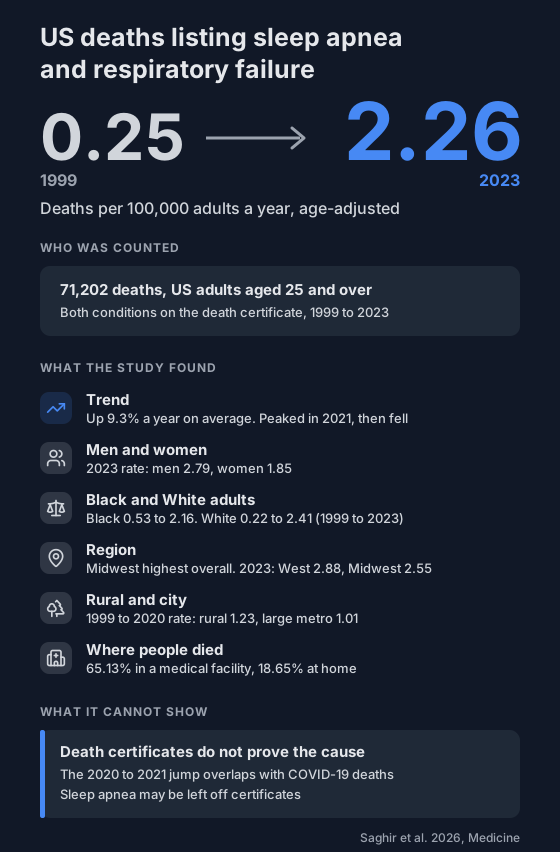
How often do US death certificates list sleep apnea next to respiratory failure? A September 2026 study counted 25 years of them.
Respiratory failure means the lungs can't move enough oxygen in or carbon dioxide out.
What did the study count?
- Death certificates from the CDC WONDER database, 1999 to 2023.
- Adults aged 25 and over.
- Only deaths where both obstructive sleep apnea and respiratory failure were written on the certificate.
- That came to 71,202 deaths.
Rates are per 100,000 adults a year, adjusted for age.
How did the rate change?
- 1999: 0.25 per 100,000.
- 2023: 2.26 per 100,000.
- Average rise: 9.3% a year.
The rise wasn't even:
- 1999 to 2008: up about 14% a year.
- 2008 to 2018: up about 6% a year.
- 2018 to 2021: up about 22% a year.
- 2021 to 2023: down about 12% a year.
Who had the highest rates?
- Men. 2.79 in 2023, against 1.85 for women.
- Black adults overall, the authors say. Their rate went from 0.53 to 2.16. For White adults it went from 0.22 to 2.41, so it was higher by 2023. Other groups' data was unreliable.
- The Midwest overall, the authors say. In 2023 the West was at 2.88 and the Midwest 2.55.
- Some states. Nebraska was highest at 1.92 and New York lowest at 0.58, in data up to 2020.
- Rural areas. 1.23 against 1.01 in large metro areas, in data up to 2020.
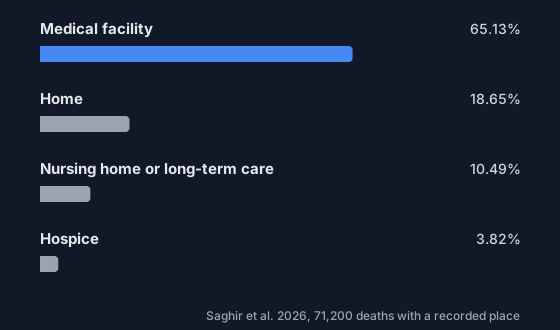
Where did people die?
Why did it go up?
The study can't say. The authors suggest rising obesity, an aging population and more sleep testing, which puts sleep apnea on more records. They also note many people don't keep using positive airway pressure therapy.
What doesn't it tell you?
- Cause. Listing both conditions doesn't show that sleep apnea led to the death.
- The 2021 peak. It overlaps with COVID-19. The authors say it shouldn't be read as sleep apnea causing more respiratory failure deaths.
- The full count. Sleep apnea often goes unrecognised in life, so it may be left off certificates.
- Personal risk. There's no data on weight, smoking or therapy use.
- Type. Sudden and long-term respiratory failure aren't separated.
What can you do with this?
If you snore loudly, stop breathing in your sleep or are exhausted by day, see a doctor. For the other signs, read snoring vs sleep apnea.
The sleep apnea risk check takes about a minute.
An overnight oximeter can't tell you whether you have sleep apnea. It records your oxygen and pulse, and you can share that with your doctor.
Not a medical device. Does not diagnose, treat or prevent any condition. Discuss results and changes with a clinician.
References
- Saghir M, Saghir E, Shoaib N, Sajid B, Affan M, Aminpoor H, Shahid H, Hayat JS, Hussain SS. National mortality trends due to OSA and respiratory failure in U.S adults from 1999-2023: Insights from the CDC-WONDER database. Medicine. 2026;105(38):e50662. doi:10.1097/MD.0000000000050662