Irregular Sleep Timing, Training and HRV
A 2026 study of 54 university students in sport training tracked 1,232 mornings. A harder day than usual and sleep further from its usual time were each linked to lower next-morning HRV, and the training link was stronger after off-time nights.
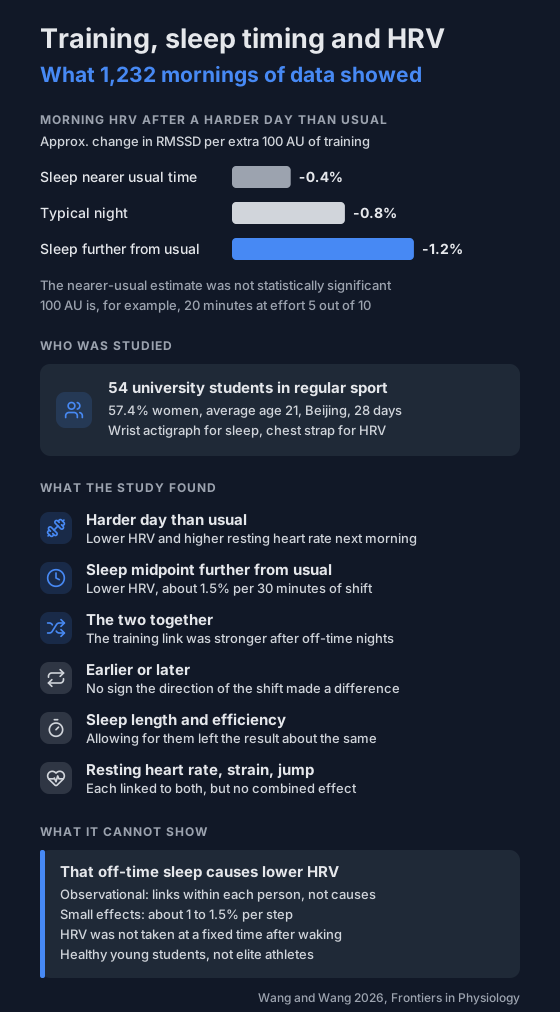
If you log your heart rate variability (HRV) each morning, you've probably seen it dip after a hard workout. A 2026 study asked whether sleeping at an unusual time for you goes with a bigger dip.
It found that a harder day than usual went with lower HRV the next morning, and that the link was stronger when sleep happened further from its usual time.
Who was studied?
- 54 university students in Beijing who trained in sport at least three times a week, and had done so for at least 6 months.
- 57.4% were women, average age 21.
- Endurance, team and strength sports were all included. They weren't selected as elite or varsity athletes.
- People with a known sleep disorder or heart disease were left out.
- 60 people started and were tracked for 28 days in November 2022. 54 had enough valid nights for the analysis, giving 1,232 usable mornings.
What was measured?
- Training load: minutes of training multiplied by how hard the session felt, from 0 to 10. 20 minutes at a 5 is 100 units (AU). The average day was about 250 AU.
- Sleep timing: a wrist actigraph plus a sleep diary gave each night's sleep midpoint, the halfway point between falling asleep and waking. The study looked at how far each night's midpoint sat from that person's own 28-day average, earlier or later.
- Morning HRV: a 5-minute seated recording with a Polar H10 chest strap, before food, caffeine or exercise. HRV was measured as RMSSD.
- Each person was compared with themselves, so a "harder day" means harder than that person's usual.
The median night's midpoint was 21 minutes from that person's average.
What did it find?
- A harder day than usual went with lower HRV next morning: about 0.9% lower for every extra 100 AU.
- Sleep further from its usual time also went with lower HRV: about 1.5% lower for every extra 30 minutes of shift.
- Together, the training link grew stronger the more off-time the night was.
Per extra 100 AU of training, morning HRV was about:
- 0.4% lower after nights nearer the usual time. This one wasn't statistically significant.
- 0.8% lower after a typical night.
- 1.2% lower after nights further from the usual time.
These are small changes. The average RMSSD in the study was 59.5 ms, so 1% is about 0.6 ms.
Did anything else change the picture?
- Earlier or later: there was no sign that the direction of the shift mattered, only how big it was.
- Sleep length and efficiency: allowing for them left the result almost the same.
- The previous morning's HRV: allowing for it left the result almost the same too.
- Resting heart rate, a self-rated strain score and jump height: after harder days and after off-time nights, resting heart rate and strain were higher and jumps were lower. The combined effect seen for HRV wasn't found for any of them.
What can't it show?
The authors are clear about this.
- It's an observational study, so these are links within each person, not causes.
- HRV was taken in a set routine but not at a fixed time after waking. Since a later sleep midpoint often means a later wake-up, the timing of the recording may explain part of the result.
- Things like chronotype, academic stress, travel and the menstrual cycle weren't recorded.
- Actigraphy estimates sleep from movement. It isn't a sleep study.
- A lower morning HRV isn't automatically bad. It can go down during both good and poor training phases.
- One alternative analysis gave a similar but less certain estimate that wasn't statistically significant.
- The authors say the results don't give a cut-off for when to train or rest.
- 54 young, healthy students is a small and specific group.
For how close wrist and chest HRV readings are, see wearable HRV vs ECG.
What can you do with it?
If you log morning HRV, note your bedtime and wake time beside it. The live HRV tool measures RMSSD from a Checkme O2 Max's pulse wave.
- Compare your own mornings with each other, not with someone else's numbers.
- Take the reading at the same point in your morning routine each day.
- Look at the trend over a few weeks, not a single morning. A review of sleep trackers for athletes suggests reading trends over 14 to 28 nights.
- Other things move HRV too, like alcohol and a warm bedroom.
Not a medical device. Does not diagnose, treat or prevent any condition. Discuss results and changes with a clinician.
References
- Wang X, Wang Y. Sleep-timing irregularity moderates the within-participant association between training load and next-morning heart rate variability in university sport participants: a 28-day study. Frontiers in Physiology. 2026;17:1966561. doi:10.3389/fphys.2026.1966561