Sleep After an Ultra-Trail Race
A 2026 field study tracked 18 runners around a 64 km mountain race. They reported sleep changes on the first night only, but an arm-worn tracker showed broken sleep for up to four nights.
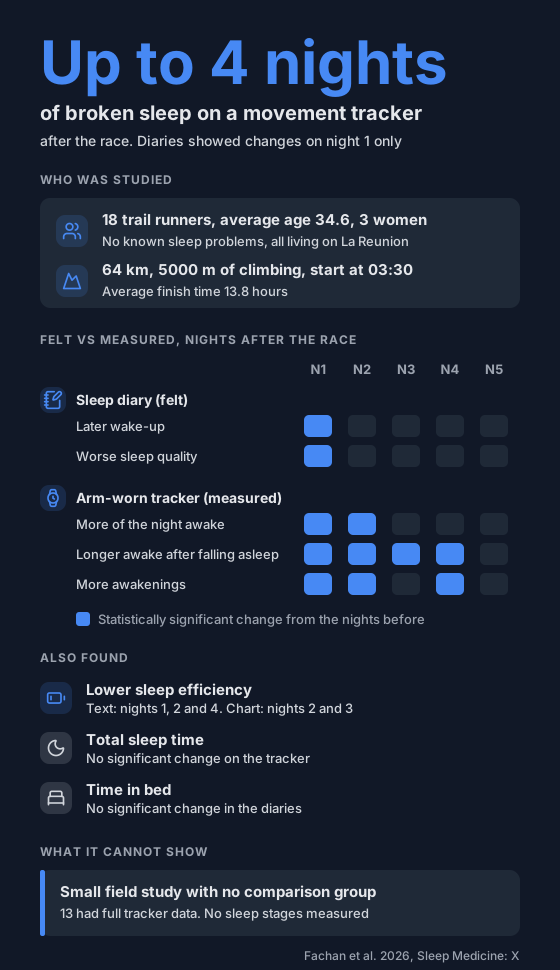
After a long, hard effort you'd expect to sleep like a log. A 2026 field study of mountain ultra-runners found something different. The runners felt their sleep was a bit worse for one night. Their arm-worn trackers showed broken sleep for up to four nights.
Who was studied?
- 18 runners in the Ultra Marathon des Cirques on La Reunion in June 2024: 15 men and 3 women, average age 34.6.
- All were regular trail runners living on the island, with no known sleep problems.
- The race was 64 km with 5,000 m of climbing, reaching up to 3,000 m. It started at 03:30, and the average finish time was 13.8 hours.
- Each runner wore a movement tracker on their non-dominant arm and kept a sleep diary morning and evening.
- That covered 6 nights before the race, including the short night before the 03:30 start, and 5 nights after.
What did the runners notice?
Not much.
- On the first night after the race they woke up later and rated their sleep quality lower.
- Nothing else in the diaries changed significantly after the race.
- Time in bed didn't change significantly.
What did the tracker show?
Broken sleep that lasted longer. These results come from the 13 runners with complete tracker data.
- Sleep efficiency (the share of time in bed spent asleep) was lower after the race. The text says nights 1, 2 and 4; the paper's chart marks nights 2 and 3.
- Share of the night awake was higher on nights 1 and 2.
- Time awake after first falling asleep was higher on nights 1 to 4.
- Number of awakenings went up on nights 1, 2 and 4.
- Total sleep time didn't change significantly.
So the runners didn't sleep less overall. Their sleep was more broken, and their diaries picked up little of it.
Why might that happen?
The study didn't test causes. The authors suggest a mix of:
- Sleep loss from the 03:30 start, and built-up fatigue.
- Muscle damage, inflammation and pain waking people up.
- Low oxygen at altitude and heat during the race.
They also think work and family commitments in the days after the race may explain why total sleep didn't go up.
The study didn't measure oxygen, pain or inflammation, so these are ideas, not findings. For what altitude does to oxygen readings, see blood oxygen at altitude.
What can't it show?
- It's small. 18 runners, and full tracker data for only 13 of them.
- There's no comparison group. Each runner was compared with their own nights before the race.
- No sleep stages. A movement tracker estimates sleep and wake. It can't measure deep or REM sleep, which needs a lab sleep study.
- Few women, no body clock data. Only 3 women took part, and the authors didn't record whether people were morning or evening types.
- Text and charts don't always match. The text and chart give different nights for sleep efficiency. The conclusion says the changes lasted up to five nights, but the results and charts show up to four.
What can you take from it?
How you feel about a night and what a tracker records can be quite different. People with sleep apnea misjudge their sleep too.
One night after a big event also isn't the whole story. Here the changes ran into the fourth night.
If you track your own sleep around races, long trips or other changes:
- Record a few ordinary nights first, so you have something to compare with. See how many nights to record.
- Keep tracking for several nights afterwards, not just the first.
- Write a short note each morning on how the night felt, and compare it with the data.
Wrist and arm trackers have their own accuracy limits. The review of sleep trackers for athletes covers what they get right and wrong.
Not a medical device. Does not diagnose, treat or prevent any condition. Discuss results and changes with a clinician.
References
- Fachan F, Vilcourt F, Lemarchand B, Chouchou F. Sleep disturbances after an ultra-trail endurance race: a field study. Sleep Medicine: X. 2026;12:100197. doi:10.1016/j.sleepx.2026.100197