Bed Sensor Sleep Data and Next-Day Thinking
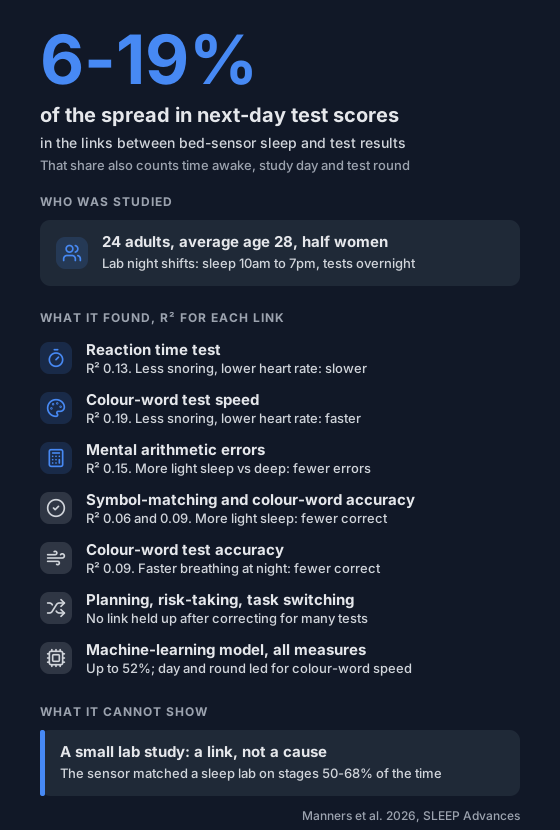
A 2026 lab study ran 24 adults through simulated night shifts with an under-mattress sleep tracker. Its sleep data lined up with next-day reaction time, working memory and mental arithmetic, but the links were small.
Sleep trackers give you a score each morning. It's tempting to read that score as a forecast of how sharp you'll be that day.
A 2026 study from Flinders University in Australia tested that on simulated night shifts. Sleep data from an under-mattress sensor did line up with some next-day test results. The links were small.
Who was studied?
- 24 healthy adults, average age 28, 12 men and 12 women.
- None had a sleep disorder on a full sleep lab night at the start.
- Each was booked for two 8-day stays in a sleep lab, one month apart, under two different lighting setups.
- Five of the 24 completed only one of the two stays.
- After staying awake for 27 hours, they slept from 10am to 7pm and worked a simulated night shift from midnight to 8am, for four days.
- Sleep was tracked with a Withings Sleep Analyzer, a pad under the mattress that picks up movement, breathing and heart rate.
- Each night shift had nine computer tests, covering reaction time, working memory, arithmetic, planning, risk-taking and task switching.
What did it find?
The researchers grouped the sensor's 22 measures into 7 patterns, such as "lighter sleep" or "less snoring and lower heart rate". Then they checked each pattern against each test score.
Six links held up after correcting for the number of comparisons:
- Reaction time test: less snoring and lower heart rate went with slower responses. R² 0.13.
- Colour-word test speed: the same pattern went with faster responses. R² 0.19.
- Mental arithmetic errors: more light sleep relative to deep sleep went with fewer errors. R² 0.15.
- Symbol-matching and colour-word accuracy: more light sleep went with fewer correct answers. R² 0.06 and 0.09.
- Colour-word accuracy: faster breathing at night went with fewer correct answers. R² 0.09.
R² is the share of the spread in scores a model accounts for. 0.13 means 13%. Those figures also include time since waking, study day and test round, so the sleep part alone is smaller. The authors call all six effects small.
Planning, risk-taking and task-switching tests showed no link that held up.
What about the machine-learning model?
A second model used all 22 sensor measures together, plus study day, test round, lighting setup and time since waking.
- It did best on the colour-word test speed, at 52%, and on arithmetic errors, at 49%.
- Reaction time came in at 42%.
- For the colour-word speed, study day and test round were the strongest inputs, not sleep.
- In the authors' words, the measures' importance was "relatively uniform", with heart rate, snoring and sleep stages near the top.
- More REM sleep and higher heart rate went with faster responses and fewer errors.
- More snoring went with more arithmetic errors and slower colour-word responses.
The authors say that's not yet accurate enough to use in high-risk workplaces.
Do the results agree with each other?
Not always.
- The same snoring and heart rate pattern went with slower reaction times on one test and faster ones on another.
- Higher heart rate went with better scores, which the authors say may reflect fitness rather than that night's sleep.
- They can't explain why more light sleep went with fewer arithmetic errors, and suggest the sensor's sleep stages may be off.
Their advice is not to read too much into any one measure on its own.
What can't it show?
- Cause. It shows what went together, not that sleep changed the scores.
- Everyday life. 24 young, healthy adults in a lab, on one shift pattern.
- Sleep stages. The sensor matched a sleep lab on stages 50% to 68% of the time, and tends to overestimate sleep by 30 to 45 minutes.
- Overfitting. The authors say the sample is small and the models may have overfitted.
- Practice. Scores may have gone up with practice, which they adjusted for but can't rule out.
The study was funded by Australia's Defence Science and Technology Group, Flinders University and REDARC. The authors declared no conflicts of interest.
For how the same sensor compared with CPAP data, see bed sensor vs CPAP data.
What can you do with this?
- Read a tracker's morning score as a rough guide, not a forecast of your day.
- Look at several measures together rather than one.
- Note how alert you feel each day, and see whether it lines up with your tracker over a few weeks.
- If you snore a lot or feel foggy most days, tell your doctor.
An overnight oximeter doesn't stage sleep. It logs your oxygen and pulse through the night. This study tracked pulse but not oxygen.
Related: broken sleep and next-day thinking speed and how accurate smart rings are for sleep.
Not a medical device. Does not diagnose, treat or prevent any condition. Discuss results and changes with a clinician.
References
- Manners J, Scott H, Guyett A, Stuart N, Catcheside P, Kemps E. Estimated sleep from an under-mattress device predicts next-day vigilance, working memory, and mental arithmetic performance. SLEEP Advances. 2026;7(2):zpag045. doi:10.1093/sleepadvances/zpag045