Broken Sleep and Next-Day Thinking Speed
A 2026 study tracked 261 older adults for 16 days. Processing speed was slower the day after a night with more time awake than usual. Sleep length, timing and naps showed no statistically significant link.
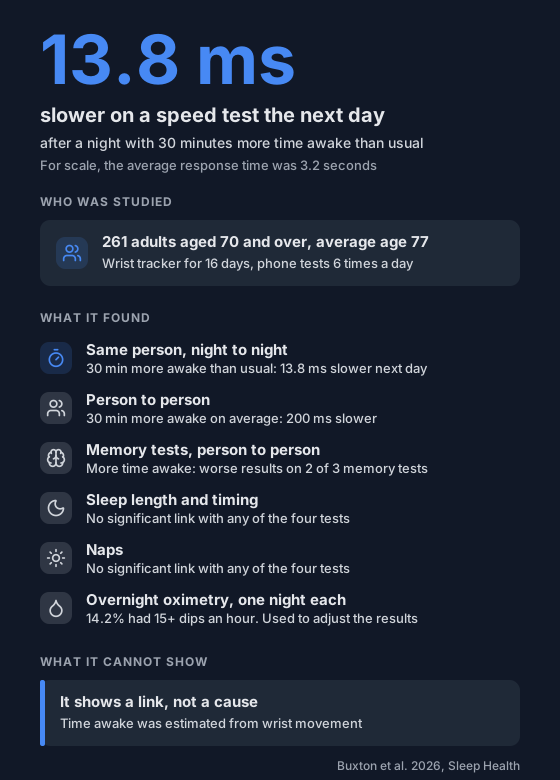
Most sleep advice is about how many hours you get. A 2026 study of older adults found no statistically significant link between hours of sleep and next-day test results. Time spent awake in the middle of the night did show one.
Who was studied?
- 261 adults aged 70 and over from the Bronx, New York, none with dementia. Average age 77.2, about two thirds women.
- Each wore a wrist movement tracker for 16 days. It estimated sleep length, sleep timing, naps and minutes awake after first falling asleep.
- Six times a day they did four short tests on a study phone: one of processing speed and three of short-term memory.
- That added up to 20,532 test sessions.
On average they slept 7.2 hours a night and were awake for 63 minutes during it.
What did it find?
The study asked two questions.
Does one person do worse after a worse night than their own usual?
- After a night with 30 minutes more time awake than that person's average, their response time on the speed test was 13.8 ms slower the next day.
- That held after allowing for how long they slept.
- For scale, the average response time was about 3.2 seconds (3,241 ms).
- None of the three memory tests showed a statistically significant night-to-night link.
Do people who are awake more on average do worse on average?
- 30 minutes more time awake per night went with a response time 200 ms slower.
- It also went with worse results on two of the three memory tests.
- The third memory test showed no statistically significant link.
What about sleep length, timing and naps?
No statistically significant link. That covers sleep duration, the midpoint of the night's sleep, number of naps and minutes napping, on all four tests, night to night and person to person.
The authors add a caution on naps. A wrist tracker can't easily tell an older adult sitting still from one asleep.
What role did overnight oximetry play?
A supporting one.
- Each person wore a wrist pulse oximeter for one night.
- 14.2% had 15 or more oxygen dips of 4% or more per hour. See what ODI means.
- 30.1% spent more than 5 minutes below 88%, as the paper prints it.
- Both were put into the statistical models, so the time-awake results are adjusted for them.
- 24 people were left out because they had no oximetry recording or one under 3 hours.
The paper doesn't report whether the oxygen measures themselves were linked to test results. So it says nothing either way about overnight oxygen and thinking speed.
What can't it show?
- It's an observational study. It shows a link, not that broken sleep slows thinking.
- Movement tracking estimates sleep. It isn't a sleep lab, and no sleep diaries were kept.
- 16 days is too short to pick up seasonal change.
- There was no test of longer-term memory.
- Everyone was 70 or over and from one New York borough.
- Oximetry was a single night. Here's why one night can mislead.
The study was funded by the US National Institutes of Health and Penn State. The lead author was editor in chief of the journal that published it, and a co-author was an associate editor. The paper says neither took part in its peer review.
What can you do with this?
- If you track sleep, look at how broken the night was, not only the hours.
- An overnight oximeter doesn't measure time awake. It logs oxygen and pulse, which this study handled as a separate measure.
- Keep a one-line note on nights you were awake a lot, and compare it with how the next day went.
- If you're often awake in the night and foggy the next day, tell your doctor.
Related: sleep apnea risk and memory and sleep apnea in older adults.
Not a medical device. Does not diagnose, treat or prevent any condition. Discuss results and changes with a clinician.
References
- Buxton OM, Gao Q, Hakun JG, Ji L, Gamaldo AA, Bertisch SM, Sliwinski MJ, Wang C, Derby CA. Within- and between-person associations of sleep characteristics with daily cognitive performance in a community-based sample of older adults. Sleep Health. 2026;12(2):297-304. doi:10.1016/j.sleh.2025.11.010