REM Sleep Oxygen Dips and Memory: 2024 Study
A 2024 study of 338 older adults with memory concerns found no statistically significant direct link between oxygen dips in REM sleep and memory scores. In 55 with a usable scan measurement, there was an indirect link through the size of one part of the hippocampus.
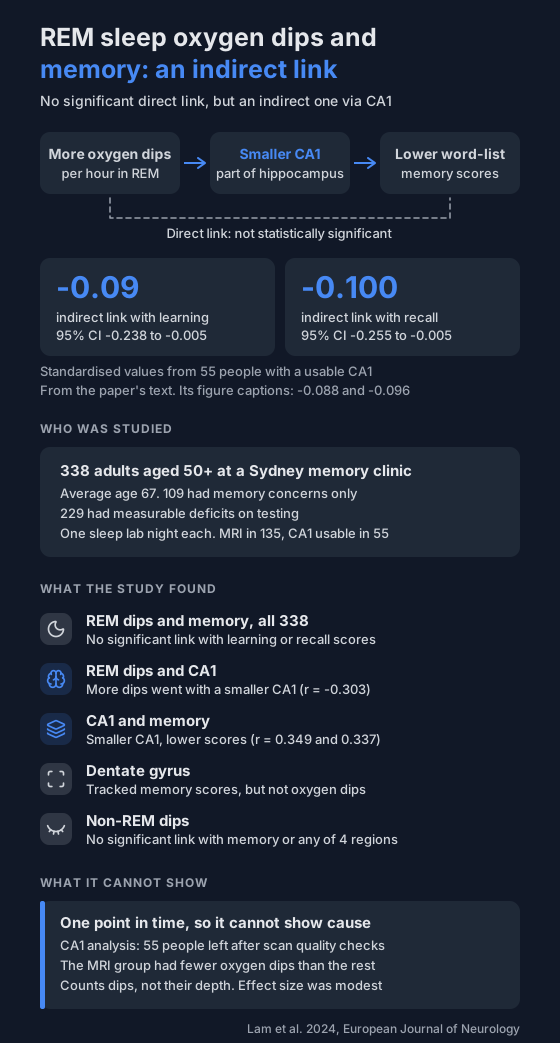
Sleep apnea has been linked to memory decline and dementia in earlier research. Oxygen dips are often deeper in REM sleep, the stage where most dreaming happens. A 2024 study from Sydney asked whether dips in REM sleep line up with memory, and whether the hippocampus sits in between.
Who was studied?
- 338 adults aged 50 and over, average age 67, referred to a memory clinic in Sydney.
- 109 had memory concerns but no deficits on testing.
- 229 had measurable deficits on testing.
- Nobody had dementia, and nobody was on CPAP.
- Everyone had one night in a sleep lab and a word-list test: learning 15 words over five tries, then recalling them 20 minutes later.
- 135 also had a brain MRI.
The oxygen measure was the number of dips of 3% or more per hour, counted separately for REM and non-REM sleep. That's the oxygen desaturation index, taken from a finger sensor.
Did oxygen dips line up with memory scores?
Not directly. Across all 338 people, dips per hour had no statistically significant link with learning or recall. That held for REM sleep, non-REM sleep and the whole night.
So where does the hippocampus come in?
The hippocampus is a brain region with a key part in forming new memories. The researchers measured four parts of it on MRI. One part, called CA1, stood out:
- More REM dips per hour went with a smaller CA1 (r = -0.303).
- A smaller CA1 went with lower learning scores (r = 0.349) and lower recall scores (r = 0.337).
- Put together, that gave a statistically significant indirect link between REM dips and both learning (-0.09, 95% confidence interval -0.238 to -0.005) and recall (-0.100, 95% confidence interval -0.255 to -0.005).
Those two values are from the paper's text and abstract. Its figure captions give -0.088 and -0.096, with the same intervals. This analysis used 55 people, not all 338.
The other three parts didn't follow that pattern. The dentate gyrus was also linked with memory scores, but not with oxygen dips. CA3 and the subiculum showed no significant link with memory scores.
Was it the same in non-REM sleep?
No. Dips in non-REM sleep had no significant link with the size of any of the four regions, so the researchers didn't run the indirect analysis for non-REM.
The authors give possible reasons, which this study didn't test:
- Breathing events in REM sleep tend to be longer, with deeper drops in oxygen.
- Blood flow in the brain responds more slowly in REM sleep.
For how sleep stage and position compare, see back sleeping vs REM sleep.
What can't it show?
- Cause. This was a cross-sectional study: everything was measured at one point in time. The data can't show that oxygen dips shrink CA1, or that a smaller CA1 lowers memory scores.
- Small numbers. Only 55 of the 135 people with an MRI had a usable CA1 measurement. The rest were dropped after quality checks on the automated scan measurements.
- Statistical power. The authors calculated they'd need 86 people to pick up a medium-sized direct link, and 55 for each step of the indirect one.
- A different MRI group. On average, people who had the MRI had fewer oxygen dips, overall and in REM, than those who didn't.
- Effect size. The authors call it modest.
- Dips counted, not measured. The index counts dips but not how deep each one is. The authors suggest future studies use a measure that does, such as hypoxic burden. See newer oxygen dip measures vs ODI.
- One kind of person. Everyone had memory concerns. The results may not apply to people without them, or to people with dementia.
- No Alzheimer's markers. The study had no blood, spinal fluid or PET measures, so it couldn't say what was behind each person's memory problems.
The study was funded by Australian government research grants and a dementia charity fellowship. One author declared consulting and speaker fees from drug and nutrition companies, and another declared drug company funding for separate trials.
What do the authors suggest?
- Checking for sleep apnea in memory clinics, with a sleep lab study or home pulse oximetry.
- Memory testing for people at sleep clinics with a high number of REM dips.
- More research on whether sleep apnea therapy protects memory. They say the evidence isn't there yet.
- They also point out that most REM sleep comes late in the night, so dips in REM sleep go unaddressed if CPAP comes off midway through sleep.
What does this mean for your own recordings?
- A finger oximeter on its own doesn't record sleep stages, so it can't tell you which dips happened in REM sleep.
- It can show when in the night your dips cluster.
- This study doesn't give a number of dips that predicts memory problems. It found no statistically significant direct link.
- If you're worried about your memory, tell your doctor, and mention your sleep. Here's how to share your recordings.
For a related study, see sleep apnea risk and memory.
Not a medical device. Does not diagnose, treat or prevent any condition. Discuss results and changes with a clinician.
References
- Lam A, D'Rozario AL, Palmer JR, McKinnon AC, Dalton MA, Espinosa N, Mowszowski L, Phillips CL, Grunstein RR, Naismith SL. Hypoxemia during rapid eye movement sleep mediates memory impairment in older adults at risk for dementia via CA1 hippocampal volume loss. European Journal of Neurology. 2024;31(12):e16491. doi:10.1111/ene.16491