New Oxygen Dip Measures vs ODI: A 2026 Study
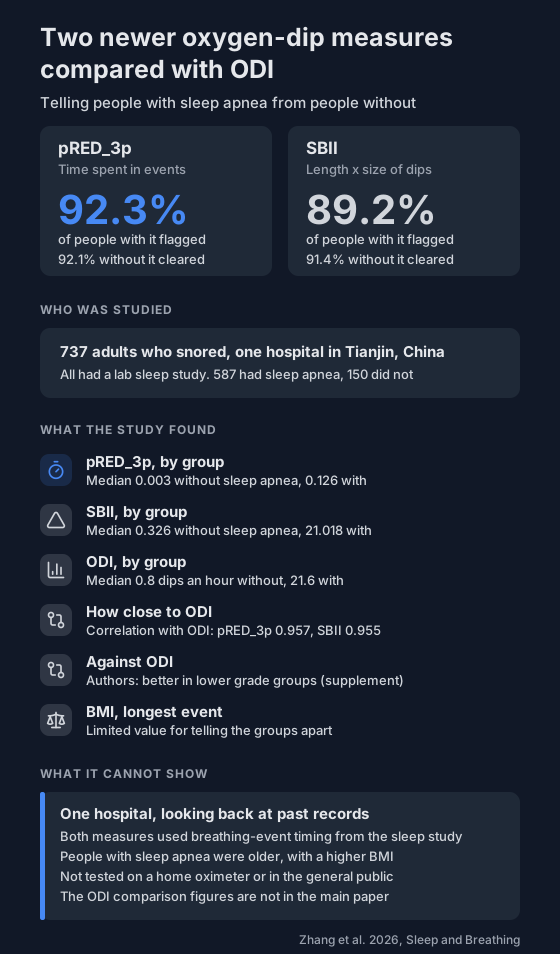
A 2026 study of 737 adults compared two newer oxygen-dip measures, SBII and pRED_3p, with ODI. Both tracked ODI closely, and both were worked out from lab sleep study data.
ODI counts how many times an hour your oxygen dips. It says nothing about how long or how deep each dip was.
Researchers have proposed measures that fold those in. A 2026 study from Tianjin, China compared two of them with ODI.
What are the two measures?
- pRED_3p. The share of sleep time taken up by breathing events that came with an oxygen drop of 3% or more.
- SBII. Each breathing event's length is multiplied by the size (depth and duration) of the oxygen dip that followed, and the total is divided by sleep time.
Both need the start and length of each breathing event. In this study those came from a lab sleep study, not from the oxygen trace alone.
Who was studied?
- 737 adults who snored and had a lab sleep study at one hospital between 2018 and 2025.
- 587 had sleep apnea on the sleep study and 150 did not.
What did it find?
Medians without and with sleep apnea:
- ODI: 0.8 against 21.6 dips an hour.
- pRED_3p: 0.003 against 0.126.
- SBII: 0.326 against 21.018.
For telling the two groups apart:
- pRED_3p flagged 92.3% of people with sleep apnea and cleared 92.1% of those without.
- SBII flagged 89.2% and cleared 91.4%.
Both moved almost in step with ODI. The correlation was 0.957 for pRED_3p and 0.955 for SBII, where 1 is a perfect match.
The authors rank ODI, pRED_3p and SBII as the three strongest measures. BMI and the longest breathing event had limited value.
Did they beat ODI?
The authors say so for people with fewer breathing events per hour, especially those who weren't obese and had smaller oxygen drops. The main paper doesn't print the ODI figures behind that. They're in a supplement.
What can't it show?
- It looked back at records from one hospital, where most people tested had sleep apnea.
- The authors say the results may not carry over to the general public.
- People with sleep apnea were older (median 43 against 32) and had a higher BMI (28.5 against 25.1).
- Nothing was tested on a home oximeter.
What does that mean for your own recordings?
As this paper defines them, SBII and pRED_3p need the length of each breathing event, which a ring or fingertip oximeter doesn't record. It does report ODI, which this study put in the top three. T90 and your lowest reading add the depth and duration that ODI leaves out. Home oximetry is not a sleep study.
Not a medical device. Does not diagnose, treat or prevent any condition. Discuss results and changes with a clinician.
References
- Zhang Y, Cai J, Liu M, Wang Y, Zhao H, Zhang J. Analysis of the predictive ability of novel hypoxia-related indicators for disease severity in obstructive sleep apnea syndrome. Sleep and Breathing. 2026;30(3):175. doi:10.1007/s11325-026-03721-z