Back Sleeping vs REM Sleep in Sleep Apnea
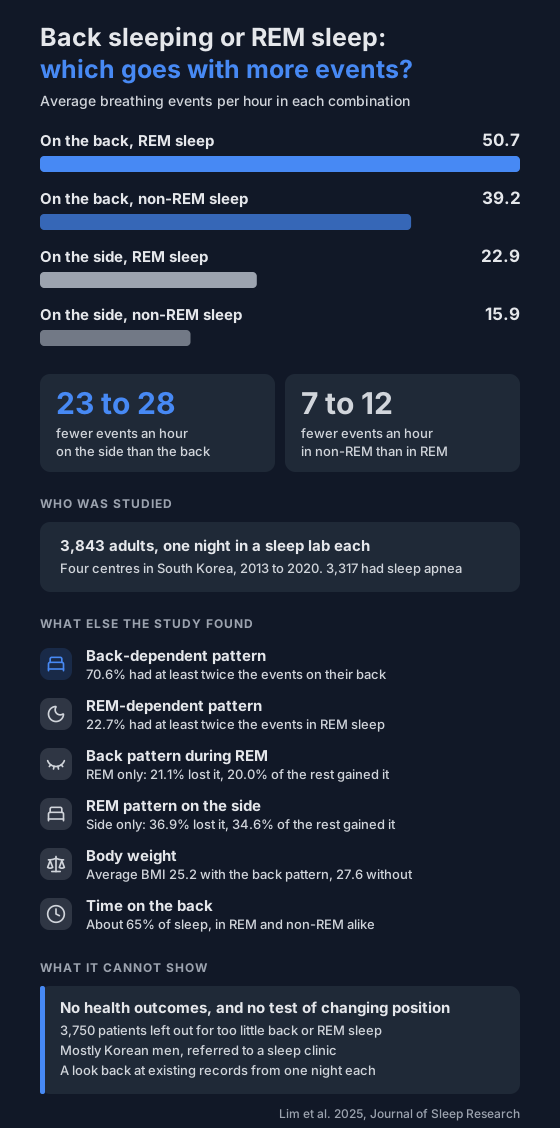
A study of 3,843 sleep lab patients compared breathing events by sleep position and sleep stage. The gap between back and side was bigger than the gap between REM and non-REM.
Two things are known to go with more breathing events in obstructive sleep apnea: sleeping on your back, and REM sleep. Most studies looked at them one at a time.
A study in the Journal of Sleep Research split each person's night four ways, by position and by sleep stage. Back sleeping went with the bigger gap.
Who was studied?
- 3,843 adults who had an overnight sleep study at one of four centres in South Korea between 2013 and 2020.
- They'd come to a clinic with insomnia, snoring, suspected sleep apnea or daytime sleepiness.
- 3,317 of them (86.3%) had sleep apnea, meaning 5 or more breathing events per hour. The other 526 were the comparison group.
- In the sleep apnea group, 83.9% were men, the average age was 45 and the average BMI was 25.9.
- Position came from video, and every event was tagged with the position and sleep stage it started in.
Which mattered more?
Average breathing events per hour, by combination:
- On the back, REM sleep: 50.7
- On the back, non-REM sleep: 39.2
- On the side, REM sleep: 22.9
- On the side, non-REM sleep: 15.9
That order is from the paper's summary and discussion. Its results section prints the same four numbers with the middle two swapped, which looks like a typo: the position averages in its main table (49.3 on the back, 20.5 on the side) only fit the order above.
Do the subtraction on those averages:
- Side instead of back: 23 to 28 fewer events an hour.
- Non-REM instead of REM: 7 to 12 fewer events an hour.
The authors say position had the stronger link, most of all in people with fewer events per hour overall.
Could it be that people just lie on their back more in REM?
The authors checked. About 65% of sleep was on the back, and that share didn't change significantly in REM or non-REM sleep (p = 0.051). So they conclude that the two act independently.
How common was each pattern?
The study used a "twice as many" rule.
- Back-dependent: at least twice the events per hour on the back as on the side. 70.6% of the sleep apnea group (2,343 people).
- REM-dependent: at least twice the events per hour in REM as in non-REM. 22.7% (754 people).
In both cases, the people without the pattern had more events overall.
- Back-dependent: 31.7 events an hour. Not back-dependent: 54.9.
- REM-dependent: 18.8 events an hour. Not REM-dependent: 44.3.
- Average BMI was 25.2 in the back-dependent group and 27.6 in the rest.
The authors' reading is that at a higher BMI the airway narrows in every position and stage, so position and stage make less difference. Women made up 28.6% of the REM-dependent group and 16.1% of the sleep apnea group as a whole.
Does one pattern change the other?
Yes, both ways.
- In REM sleep, 21.1% of the back-dependent group no longer met the rule. In non-REM, 93.5% still did.
- On the side, 36.9% of the REM-dependent group no longer met the rule. On the back, 11.5% didn't.
- Of the people who weren't back-dependent over the whole night, 20.0% met the rule when only their REM sleep was counted.
- Of the people who weren't REM-dependent over the whole night, 34.6% met the rule when only their side sleep was counted.
In plain terms: the labels weren't fixed, and some people moved in or out of a pattern depending on which part of the night was counted.
The authors note that people with the back-dependent pattern may benefit from positional therapy alone, citing earlier work. This study didn't test that.
What can't it tell you?
- What happens if you change position. Nobody was asked to sleep differently. It compares the parts of one night each person happened to spend in each position.
- Health outcomes. The records were stripped of clinical details, so there's nothing on symptoms, other conditions or medication.
- Everyone. The paper says 3,750 patients were left out for having under 10 minutes of back or REM sleep. In that group the order was the same (44.3, 37.4, 23.0 and 19.8 events an hour) but the gap between back and side was smaller.
- People who get very little REM. Anyone with REM under 5% of sleep was excluded, which the authors say may have left out some people with the most events.
- Other groups. Most patients were Korean men.
- Whether the comparison group slept well. The authors say people in it may have had other sleep problems.
- More than one night. It was a single lab night, looked at in hindsight, across four centres with different equipment. The authors also report disagreements between the people scoring the recordings.
- One author founded and runs a sleep technology company and holds stock in it.
What can you do with this?
A ring or fingertip oximeter doesn't know which way you're lying or what sleep stage you're in. You can still log your position yourself and see whether your overnight oxygen lines up with it.
- Back vs side sleeping explains how to run that comparison.
- Compare nights puts two recordings side by side.
- One night varies a lot, so read how many nights to record first.
For a bigger study of the back-dependent pattern, see positional sleep apnea in 12,000 patients.
An overnight oximeter can't tell you whether you have sleep apnea. If you snore loudly, someone has seen you stop breathing, or you're exhausted in the day, see a doctor.
Not a medical device. Does not diagnose, treat or prevent any condition. Discuss results and changes with a clinician.
References
- Lim S, Lee HK, Kang YJ, Shin HW. Differential effects of sleep position and sleep stage on the severity of obstructive sleep apnea. Journal of Sleep Research. 2025;34(4):e14379. doi:10.1111/jsr.14379