Positional Sleep Apnea in 12,036 Patients
A 2026 study of 12,036 sleep centre patients found that 66.3% had breathing events at least twice as frequent on their back, and that this group had fewer events and higher overnight oxygen.
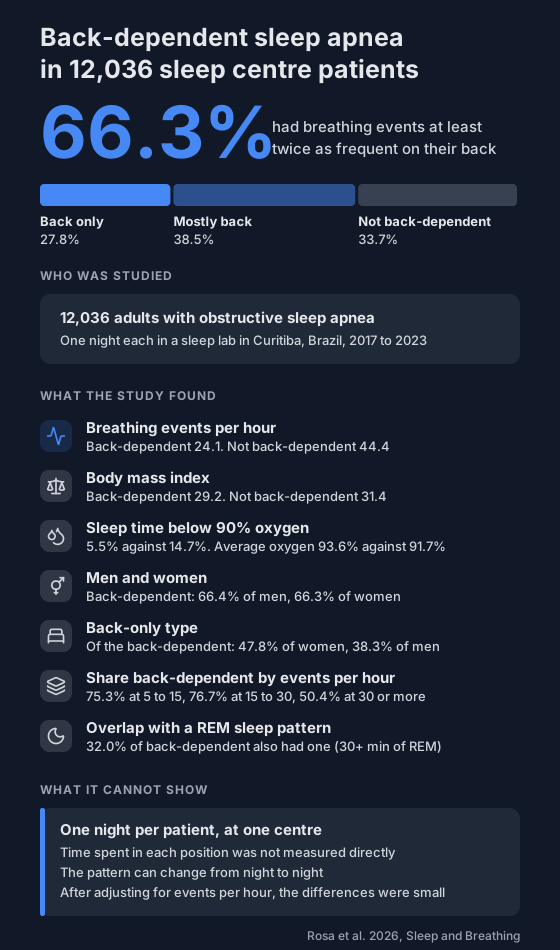
Some people with sleep apnea have most of their breathing events on their back. A 2026 study from Brazil counted how common that was among 12,036 sleep centre patients. Two in three had it.
Who was studied?
- 12,036 adults with obstructive sleep apnea, tested at one sleep centre in Curitiba from September 2017 to August 2023.
- Each had one overnight sleep study in the lab.
- Average age was 47.9, average BMI 29.9, and 61.6% were men.
- "Back-dependent" meant breathing events at least twice as frequent on the back as in other positions.
How common was it?
- 66.3% were back-dependent.
- 27.8% of all patients were the "back-only" type, with 5 or fewer events per hour off their back.
- Among back-dependent patients, more women (47.8%) than men (38.3%) were back-only.
- About three in four patients with 5 to 30 events per hour were back-dependent, against 50.4% of those with 30 or more.
How did those patients differ?
Compared with the rest, the back-dependent group had:
- Fewer breathing events per hour: 24.1 against 44.4.
- A lower BMI: 29.2 against 31.4.
- Less sleep time below 90% oxygen (T90): 5.5% against 14.7%.
- A higher average overnight oxygen level: 93.6% against 91.7%.
After the authors adjusted for events per hour, most of the sleep and oxygen differences stayed statistically significant, but they were small.
Did it overlap with REM sleep?
Partly, among the 11,073 patients with at least 30 minutes of REM sleep. 32.0% of the back-dependent ones also had events at least twice as frequent in REM sleep as in non-REM sleep. Of those with that REM pattern, 69.8% were back-dependent. The authors call this analysis exploratory.
What can't it show?
- Each patient had one lab night, and the authors note the pattern can change from night to night.
- Time in each position wasn't measured directly, so some patients may be in the wrong group.
- Symptoms and other health conditions weren't recorded.
- It's a retrospective look at one centre's records, so it shows associations, not causes.
- Two authors have ties to companies selling a home sleep test and sleep-ergonomics products.
What can you do with it?
A ring oximeter doesn't record your position, and home oximetry is not a sleep study. You can still note which nights you slept on your back and compare them. See back vs side sleeping and how many nights to record.
If your numbers look different on your back, that's worth discussing with your doctor.
Not a medical device. Does not diagnose, treat or prevent any condition. Discuss results and changes with a clinician.
References
- Rosa CFA, Chillcce KAS, Cahali MB, Boldt MS, Soares VHD, Rosa OA, Passos PHV, Alves MRS, Minniti EGO, Rodrigues JE, Ribas GRW. Analysis of positional obstructive sleep apnea features in 12,000 patients at a sleep center. Sleep and Breathing. 2026;30(4):207. doi:10.1007/s11325-026-03755-3