Shallow Oxygen Dips and Memory: 2026 Study
A 2026 study of 884 adults referred for a sleep study found that people who reported memory decline had a similar number of breathing events per hour, but shallower, shorter dips and more time with SpO2 below 95%.
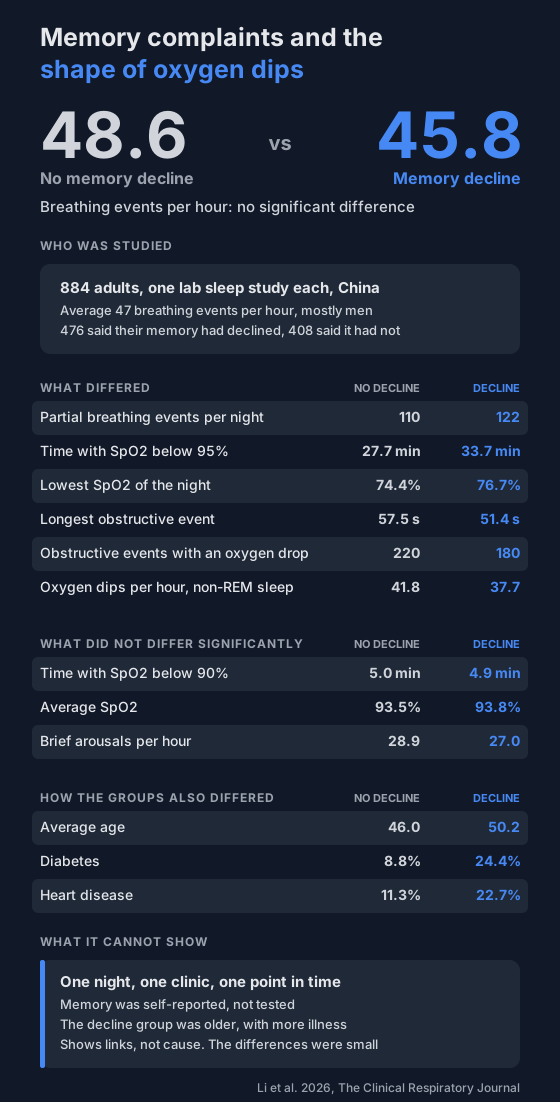
Sleep apnea is usually graded by how many breathing events you have per hour. A study published in 2026 asked whether that count lines up with memory complaints, or whether the shape of the oxygen dips matters more.
In 884 adults, the count was about the same whether or not people reported memory decline. The pattern of their oxygen dips was not.
Who was studied?
- 884 adults who had a lab sleep study at one hospital in Zhongshan, China, between 2020 and 2024.
- They were referred because a breathing problem in sleep was suspected.
- Most were men, the average age was 48, and the average was about 47 breathing events per hour.
- People with central sleep apnea, a known neurodegenerative disease, a major mental illness or on sleeping pills were left out.
- Memory was a self-rated checklist filled in on the night: no decline, or one of three grades of decline compared with before.
- 476 reported some decline and 408 reported none.
What was different in the memory decline group?
Breathing events per hour were similar: 45.8 against 48.6, not a statistically significant difference. Brief arousals per hour were similar too: 27.0 against 28.9. These are micro-arousals, shifts to lighter sleep of a few seconds that usually don't wake you.
What differed was the kind of event and the shape of the dips. People who reported memory decline had:
- More partial breathing events, where airflow drops but doesn't stop: 122 a night against 110.
- More time with SpO2 below 95%: 33.7 minutes against 27.7. The paper describes this as time awake.
- A higher lowest SpO2 of the night: 76.7% against 74.4%.
- A shorter longest obstructive event, where the airway is blocked: 51.4 seconds against 57.5.
- Fewer obstructive events with an oxygen drop: 180 against 220.
- Fewer oxygen dips per hour in non-REM sleep: 37.7 against 41.8.
The authors read this as shallower but more drawn-out low oxygen, rather than deep, brief dips.
Time with SpO2 below 90% (T90) showed no statistically significant difference: 4.9 minutes against 5.0. Neither did average SpO2: 93.8% against 93.5%. For what T90 measures, see what is T90.
Were the two groups alike otherwise?
No. The memory decline group was older, 50.2 against 46.0 on average. They also more often had:
- Diabetes: 24.4% against 8.8%.
- Heart disease: 22.7% against 11.3%.
- Stroke or other blood vessel disease of the brain: 19.7% against 6.1%.
- High blood pressure: 47.3% against 40.2%.
- Reflux, a blocked or runny nose, and past airway surgery.
The paper compares the groups side by side and doesn't adjust the oxygen results for age or these conditions.
What about the machine-learning model?
The authors trained a model to predict memory decline. It ranked brief arousals in non-REM and REM sleep, and the overall arousal rate, as its top predictors. The paper doesn't report how accurate the model was in numbers.
The paper isn't consistent here. The discussion says brief arousals did not stand out as predictors, and the summary at the top lists oxygen-drop measures among the top predictors of memory decline. In the results, those oxygen measures were the top predictors in a separate model, one that predicted how many brief arousals people had.
What can't this study show?
- Cause. It looked at one night per person at one point in time. It shows what went together, not what caused what.
- Real memory loss. Memory was self-reported, not tested. The authors say sleepiness, tiredness and mood can colour how people rate their memory.
- A fair comparison. The memory decline group was older and had more illness, and the authors say other differences may explain some of the results.
- Big effects. The authors call the differences modest, and with this many comparisons some could be chance.
- Oxygen burden. The study didn't measure the area of each dip, depth times length, which the authors say limits what it can show.
- Everyone. It was one clinic in China, and most people had many breathing events per hour.
Earlier studies on the same question include REM sleep oxygen dips and memory and sleep apnea risk and memory. For why counts alone leave things out, see what event counts miss.
What can you do with this?
If you've noticed your memory slipping and you snore, wake up tired or have been told you stop breathing in your sleep, mention both to your doctor. The sleep apnea risk check takes about a minute and helps you decide whether to.
An overnight oximeter can't tell you whether you have sleep apnea or why your memory has changed. It records your SpO2 through the night, including the lowest reading and time below set levels, and you can share that with your doctor.
Not a medical device. Does not diagnose, treat or prevent any condition. Discuss results and changes with a clinician.
References
- Li X, Zhu Y, Meng F, Lai K, Liang Y, Ting H, Mai Z, Li L. Exploring the role of nocturnal hypoxemia and sleep fragmentation in memory decline: insights from explainable machine learning models. The Clinical Respiratory Journal. 2026;20(5):e70188. doi:10.1111/crj.70188