Sleep Quality and Walking Steadiness
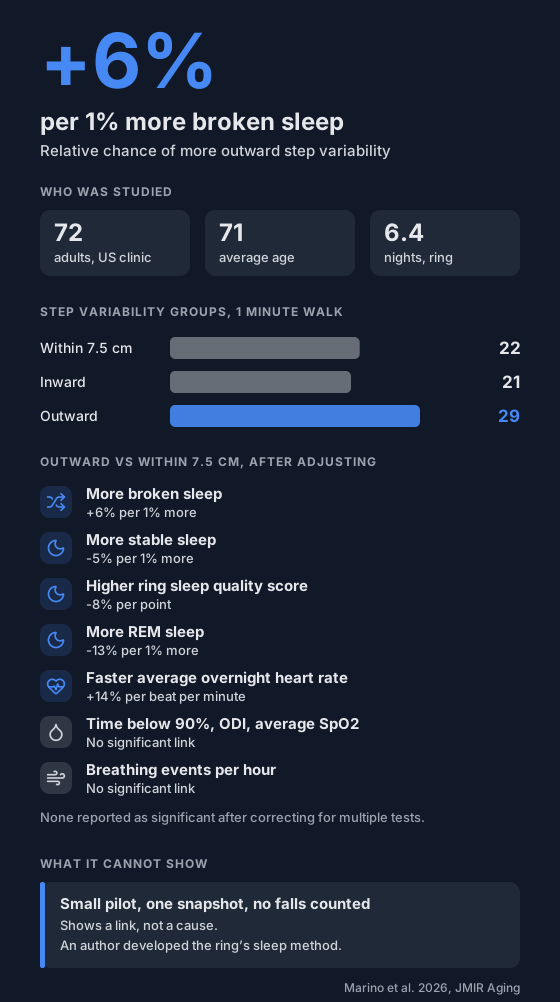
A 2026 pilot study of 72 adults aged 52 to 88 wearing a sleep ring found more broken sleep went with more outward step variability when walking. Oxygen measures like T90 and ODI showed no link.
Poor sleep is already linked with slower walking and more falls in older adults. Less is known about how steady each step is.
A pilot study published in June 2026 looked at side-to-side step variability, a measure of balance while walking. People whose sleep was more broken up on a sleep ring were more likely to have outward step variability. Their overnight oxygen numbers showed no link.
Who was in the study?
- 72 adults from the Boston University Alzheimer's Disease Research Center, a clinic-based research group.
- Average age 71, range 52 to 88. 51% were women and 90% were non-Hispanic White.
- 16 (22%) had some cognitive impairment on a dementia rating scale.
- 22 (31%) had a sleep apnea history on record.
How were sleep and walking measured?
- Sleep. A SleepImage ring at home, which records pulse, oxygen and movement. People were asked to wear it for at least 3 nights. They wore it for 6.4 nights on average.
- Walking. A 1 minute walk at their usual pace down a 10 m hallway, with motion sensors on the feet, wrists and lower back.
- The gap. On average 12.9 days passed between the two, and no more than 90.
The sensors scored how far foot placement wandered sideways from step to step, and in which direction. People were put into three groups:
- Within 7.5 cm either way: 22.
- 7.5 cm or more inward: 21.
- 7.5 cm or more outward: 29.
Higher step width variability has been linked with slower walking and more falls in earlier studies.
What did it find?
Compared with the within 7.5 cm group, after adjusting for age, sex, race, education, BMI and walking speed:
- Each 1% more broken sleep went with a 6% higher relative chance of being in the outward group.
- Each 1% more stable sleep went with a 5% lower chance.
A second analysis sifted the rest of the ring's report and found four more:
- Each point higher on the ring's sleep quality score: 8% lower chance.
- Each 1% more REM sleep: 13% lower chance.
- Each beat per minute faster average heart rate: 14% higher chance.
- Each second longer for the shortest breathing pause the ring recorded: 2.34 times the chance.
Nothing was linked to inward step variability, except faster heart rate (13% higher chance per beat per minute).
Looking at step variability in either direction, only REM sleep was linked: each 1% more REM went with 0.81 cm less.
Were oxygen measures linked?
No. None of these showed a significant link with either group:
- Time below 90%, as minutes or as a share of the night. See what T90 is.
- Oxygen dips per hour, the ODI.
- Average oxygen level.
- Breathing events per hour, on two different counts.
Sleep duration and sleep efficiency weren't linked either.
A separate 2026 study found a similar split for attention: broken sleep was linked, oxygen measures weren't.
Did it differ between groups?
- Men (35). The links with stable sleep, the sleep quality score and REM sleep held.
- Women (37). Only the heart rate link held.
- No cognitive impairment (56). Only the sleep quality score link held.
- Some cognitive impairment (16). Nothing held. The authors say the group may have been too small to show a link.
For men, women and those without cognitive impairment, the links that didn't hold were still a similar size.
How much weight can you put on it?
Not much yet, and the authors call it a first step.
- Multiple tests. After correcting for the number of measures tested, the paper reports none of the links as statistically significant. It calls the sleep quality score link a trend (p = 0.09).
- Size. 72 people is small, and the subgroups are smaller still.
- Cause. It's cross-sectional: one snapshot per person. It shows what went together, not what caused what.
- No falls. Falls weren't counted. Step variability is a marker linked to falls in other studies, not a fall.
- The cut-off. There's no agreed cut-off for these groups. The authors chose 7.5 cm.
- Other factors. The authors say unmeasured factors may explain some of the links.
- Who. A clinic sample, mostly White. The authors note skin pigment can bias light-based sensors like the ring's.
- Conflict of interest. One author developed the method the ring uses to score sleep, licensed to the ring's maker, and received royalties.
- Funding. The US National Institutes of Health, charities, a university and two biotech companies. The paper says the sponsor had no role in the study.
The paper's abstract says 2 or more nights of sleep, while its methods say people were asked for at least 3.
What does this mean for your own recordings?
The study didn't test fingertip oximeters, so this part is context, not a finding.
An overnight oximeter records oxygen and pulse, and in this study those oxygen measures showed no link with step variability. The sleep scores that did are estimates from the ring's own method, not from a sleep lab. For how well rings estimate sleep stages, see smart rings and sleep stages.
If you're unsteady on your feet or sleeping badly, tell your doctor. You can share your recordings with them too.
Not a medical device. Does not diagnose, treat or prevent any condition. Discuss results and changes with a clinician.
References
- Marino FR, Kim M, Hwang PH, Tripodis Y, Alosco M, Mez J, McKee A, Au R, Thomas RJ, Shih L. Impact of Sleep Quality on Gait Variability: Pilot Cohort Study. JMIR Aging. 2026;9:e81630. doi:10.2196/81630