Sleep Apnea and Attention: Oxygen or Sleep?
A 2026 study of 84 adults with sleep apnea found they reacted more slowly on an attention test. Of 8 sleep study measures, only sleep stage shifts were linked to it, and no oxygen measure was.
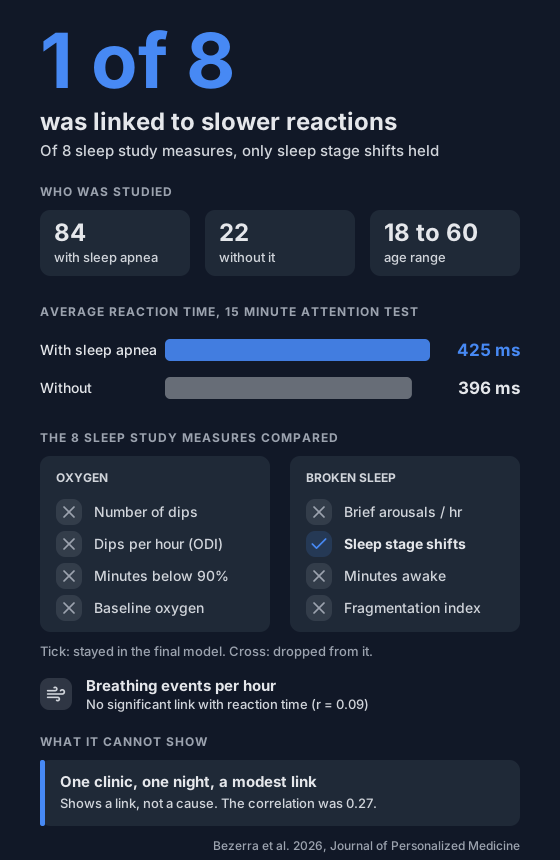
People with sleep apnea often react a little more slowly on attention tests. Two things could be behind it: low overnight oxygen or broken sleep.
A study published in February 2026 compared measures of both. Only one stayed linked to slower reactions, and it wasn't an oxygen measure.
Who was in the study?
- 207 adults aged 18 to 60 had a full overnight sleep study at a private sleep clinic in Rio de Janeiro, Brazil.
- 84 had obstructive sleep apnea, meaning 5 or more breathing events per hour. They were spread evenly: 27 had 5 to 14 events per hour, 30 had 15 to 29, and 27 had more than 30.
- 22 had no sleep disorder on the sleep study and were the comparison group.
- The other 101 were left out, for other sleep disorders or for not meeting the criteria.
- People on psychotropic medication, with a history of alcohol or drug abuse, or with a neurological, psychiatric, lung or neuromuscular condition, were excluded, as were pregnant women.
The sleep apnea group averaged 41 years old, 69% were men and their average BMI was 30.5. The comparison group averaged 37, 32% were men and their average BMI was 24.9.
How was attention measured?
With a 15 minute computer test, taken before the sleep study. You press the spacebar as fast as you can when a star appears, and don't press when a diamond appears.
The main result is average reaction time on correct presses. The researchers also adjusted each score for age and sex against 1,244 people who took the same test for a driving licence assessment.
Were people with sleep apnea slower?
Yes, by about 29 milliseconds on average.
- With sleep apnea: 425 ms.
- Without: 396 ms.
The difference was statistically significant after adjusting for age and sex (p = 0.029), and on the age- and sex-adjusted scores (p = 0.005).
Two things showed no statistically significant difference between the groups:
- How much reaction time varied from press to press (p = 0.602).
- Self-rated daytime sleepiness on a sleepiness score (10.2 against 8.2, p = 0.106).
For more on that second point, see sleep apnea without sleepiness.
Did more breathing events mean slower reactions?
No. Within the sleep apnea group, breathing events per hour had no statistically significant link with reaction time (r = 0.09, p = 0.398).
A separate 2026 review also found that event counts leave a lot out.
So was it oxygen or broken sleep?
The researchers put 8 measures from the sleep study into one model.
Four oxygen measures:
- Number of oxygen dips of 3% or more.
- Dips per hour, the ODI.
- Minutes below 90%, also called T90.
- Baseline oxygen level.
Four broken-sleep measures:
- Brief arousals per hour.
- Sleep stage shifts, the number of times sleep moved from one stage to another.
- Minutes awake after first falling asleep.
- A fragmentation index, counting awakenings and drops back to the lightest sleep stage per hour.
Only sleep stage shifts stayed in the final model (correlation 0.27, p = 0.013). More shifts went with slower reactions.
None of the oxygen measures stayed in. The number of dips and the ODI were taken out because they overlapped too much with the other measures.
The sleep apnea group averaged 29.1 stage shifts in the night, against 24.1 in the comparison group.
How much weight can you put on it?
Not a lot, and the authors call the effect sizes modest.
- Cause. It's a cross-sectional study: one night and one test per person. It shows what went together, not what caused what. The authors say other factors they didn't measure can't be ruled out.
- Size. A correlation of 0.27 is modest. The authors call sleep fragmentation one contributing factor, not the main one.
- Oxygen measures. A newer measure of the total depth and length of oxygen dips, which an earlier study linked to slower responses on a different test, wasn't available here.
- Arousals. The study didn't separate arousals caused by breathing events from spontaneous ones.
- Groups. The comparison group was small (22), with more women and a lower average BMI. The authors report that BMI wasn't significantly linked to reaction time in either group.
- One test. Other kinds of attention, like switching or dividing attention, weren't tested.
- Funding. Brazilian public research grants. The authors declare no conflicts of interest.
What does this mean for your own recordings?
The study didn't test oximeters or wearables, so this part is context, not a finding.
An overnight oximeter records oxygen and pulse. It doesn't record sleep stages, so it can't show you stage shifts. In the study those were scored from brain-wave recordings in a sleep lab.
Wearables that estimate sleep stages are less reliable at it. See how accurate smart rings are for sleep.
So a steady oxygen trace doesn't tell you how well you slept. If you're foggy or slow during the day, tell your doctor, whatever your oxygen numbers look like. You can share your recordings with them too.
Not a medical device. Does not diagnose, treat or prevent any condition. Discuss results and changes with a clinician.
References
- Bezerra MLS, Schmidt SL, van Duinkerken E, Maia A, Coutinho ALC, Lewandrowski KU. Sleep Fragmentation, Not Nocturnal Hypoxemia, Is the Primary Correlate of Attentional Slowing in Obstructive Sleep Apnea. Journal of Personalized Medicine. 2026;16(2):117. doi:10.3390/jpm16020117