Oxygen Dips and Reading Faces: A Small Study
A 2026 study of 55 Icelandic adults found that deeper overnight oxygen dips and more broken sleep went with slower, less accurate recognition of faint emotions on faces.
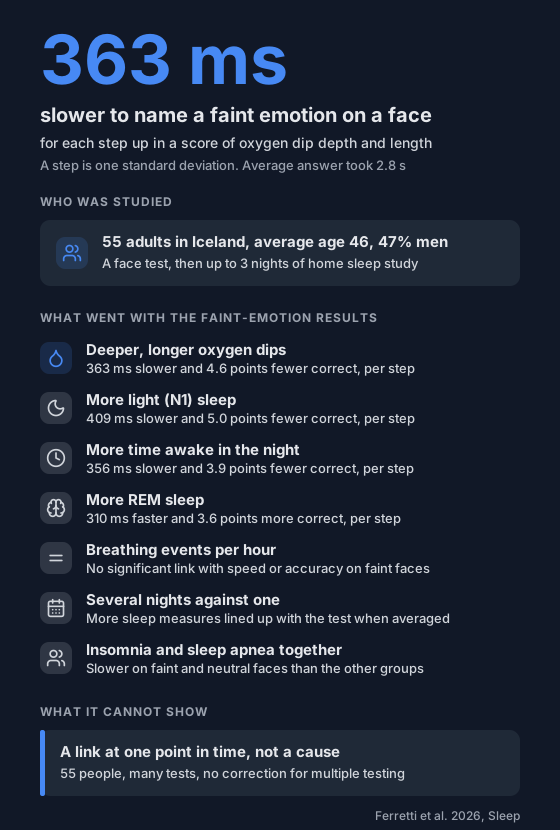
Research on sleep apnea and thinking mostly covers attention and memory. A 2026 study from Iceland looked at something else: how quickly and accurately people name the emotion on a face.
It compared that with oxygen dips and sleep stages recorded over up to three nights at home.
Who was studied?
- 55 adults recruited by advertisement from the general Icelandic population.
- Average age 46, 47% men. None were on therapy for sleep apnea.
- 36 of them averaged 5 or more breathing events per hour.
Each person took a face test in the morning: 40 photos showing happiness, sadness, anger, fear or no emotion, some strong and some faint. Then they wore a self-applied home sleep study kit, with a finger oximeter, for three nights in a row.
- 30 people had three usable nights, 17 had two and 8 had one.
- Results were averaged across each person's nights.
What went with slower answers?
The clearest results were for faint emotions. The average correct answer on those took about 2.8 seconds, and 73% of answers were correct.
After adjusting for age, sex and a depression symptom score, each step up of one standard deviation went with:
- Oxygen dip depth and length score: 363 ms slower, 4.6 percentage points fewer correct.
- Light (N1) sleep: 409 ms slower, 5.0 points fewer correct.
- Time awake in the night: 356 ms slower, 3.9 points fewer correct.
- REM sleep: 310 ms faster, 3.6 points more correct.
- Sleep efficiency: 335 ms faster, 3.4 points more correct.
For strong emotions, light sleep, time awake and sleep efficiency were linked with speed, and the oxygen dip score was linked with accuracy (3.3 points fewer correct per step). For neutral faces, nothing was linked with speed after adjustment.
Did the usual count of events matter?
Less than the dip score did.
- Breathing events per hour had no significant link with speed on any kind of face, or with accuracy on faint or strong ones.
- Neither did the oxygen desaturation index, which counts dips per hour.
- Both were linked with accuracy on neutral faces only (6.7 and 6.1 points fewer correct per step).
The dip score adds up how deep and how long each dip is, not just how many there are. For more on that kind of measure, see newer oxygen dip measures vs ODI and what ODI is.
Were several nights better than one?
The authors reran the analysis on the 47 people with at least two nights, once with the first night alone and once with the average.
- Average values did not differ significantly between the two.
- More of the sleep measures were significantly linked with the face test when the nights were averaged.
The paper reports this as a table of ticks, not as effect sizes. On why single nights vary, see multi-night tracking vs one sleep study.
What about insomnia and sleep apnea together?
The authors split people into four groups: neither, insomnia only, sleep apnea only (15 or more events per hour), or both. The group with both was significantly slower on faint and neutral faces than the other groups. Accuracy did not differ significantly.
Men had more breathing events and poorer sleep than women, but did about the same on the face test.
What can't it show?
The authors list these limits:
- It's a cross-section, so it shows a link and not a cause.
- 55 people is a small sample, too small to look closely at age or sex.
- Medication such as antidepressants or sleeping pills could not be accounted for.
- The test uses still photos. Reading faces in real life involves more than that.
- It did not test whether therapy for a sleep disorder changes the result.
Two more things to keep in mind:
- The study was exploratory and ran many comparisons with no correction for multiple testing, so some links may be chance.
- People with more breathing events were also older (average 58 in the highest group against 38 in the lowest). The models adjusted for age, but with 7 people in the highest group that adjustment is rough.
The study was funded by an EU research grant and Swedish public and charity funds. The authors declare no conflict of interest related to this work. Some report lecture fees from sleep device and drug companies outside it, including the maker of the sleep study kit.
What can you do with this?
Not much on its own, and it says nothing about any one person. Two points carry over to tracking your own nights:
- A count of dips per hour leaves out how deep and how long they are. T90 and your lowest reading cover part of that.
- An average over several nights is steadier than one night.
If you're often tired or foggy and your recordings show regular dips, share them with your doctor.
Not a medical device. Does not diagnose, treat or prevent any condition. Discuss results and changes with a clinician.
References
- Ferretti D, Richert E, Zou D, Hedner J, Strassberger C, Arnardottir ES, Grote L, Jóhannsdóttir KR. Impaired emotion recognition is associated with sleep-related hypoxic burden. Sleep. 2026;49(7):zsag078. doi:10.1093/sleep/zsag078