Exercise Plus Sleep Coaching for Poor Sleep
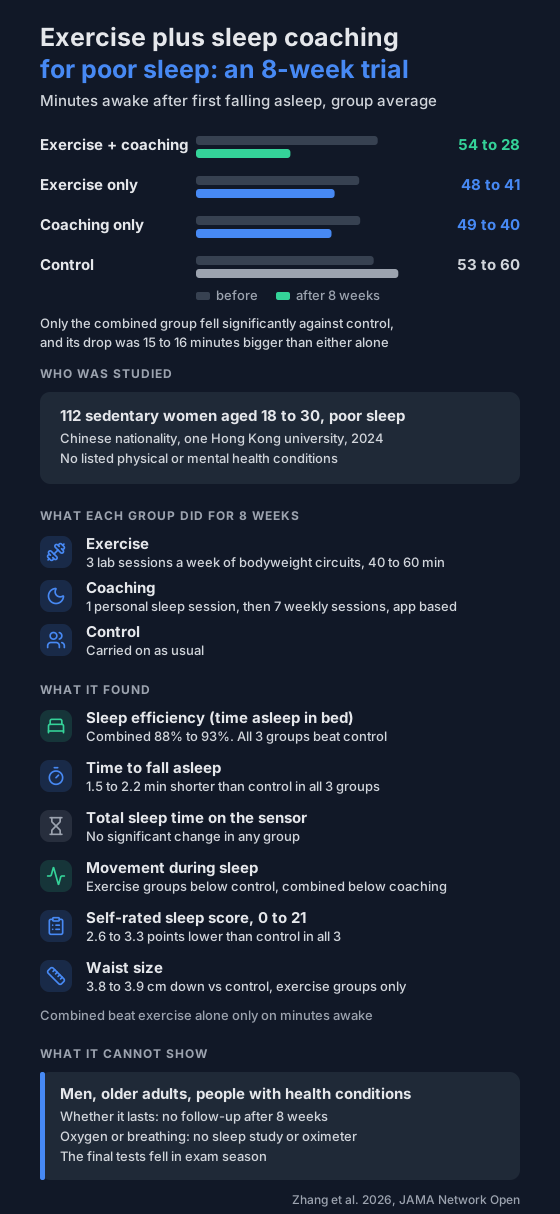
A 2026 trial gave 112 sedentary young women with poor sleep 8 weeks of circuit training, sleep coaching, both or neither. The combined group's time awake at night fell from 54 to 28 minutes, more than with either alone.
Exercise and better sleep habits are both linked with better sleep. Few trials have tested whether doing both at once adds up to more than either on its own.
A trial in Hong Kong, published in February 2026, tried it in young women who sat most of the day and slept badly.
Who was in the trial?
- 112 women aged 18 to 30, average age 23.5, all of Chinese nationality.
- All sat for at least 8 hours a day, measured by a movement sensor, and scored above 5 on a 0 to 21 sleep quality questionnaire (the Pittsburgh Sleep Quality Index), where higher means worse sleep.
- Anyone with a mental health condition, or heart, lung, nerve, muscle and bone, metabolic or hormone disease, was left out.
- Most had a typical weight: average BMI was about 22.
- About 1 in 4 to 1 in 3 in each group took melatonin for sleep at the start.
- 104 of 112 (93%) finished.
What did each group do?
They were split at random into four groups of 28 for 8 weeks.
- Exercise: 3 sessions a week in a lab, about 40 to 60 minutes each with warm-up and cool-down. The main part was 2 to 3 rounds of 12 bodyweight exercises at maximum effort, 20 to 30 seconds each.
- Sleep coaching: a 30-minute one-to-one session with personal advice, then 7 weekly sessions. The content came from a phone app based on cognitive behavioural therapy for insomnia, such as relaxation training, sleep education and limiting time in bed.
- Both: the exercise and the coaching together.
- Control: carried on as usual.
Sleep was measured with a research movement sensor (an actigraph) and the sleep quality questionnaire, before and 48 hours after the last session. People attended about 86% to 89% of their sessions.
What did it find?
The clearest result was time awake after first falling asleep. Group averages, before and after:
- Both: 54 to 28 minutes.
- Exercise only: 48 to 41 minutes.
- Coaching only: 49 to 40 minutes.
- Control: 53 to 60 minutes.
Only the combined group fell by a statistically significant amount against control, by about 30 minutes, using the paper's cutoff of P below .01. The abstract says all three active groups did better than control here, but the main results table does not support that for the single groups. Its drop was 14.5 minutes bigger than with exercise alone and 16.3 minutes bigger than with coaching alone.
Other movement sensor results:
- Sleep efficiency, the share of time in bed spent asleep: went up in all three active groups against control. The combined group went from 88% to 93%. That was 2.8 percentage points more than coaching alone. Against exercise alone, the gap was not statistically significant.
- Time to fall asleep: 1.5 to 2.2 minutes shorter than control in all three groups, with no clear gap between them.
- Total sleep time: no statistically significant change in any group.
- Movement during sleep: lower than control in both exercise groups, and lower in the combined group than with coaching alone.
- Number of times awake: fell against control only in the combined group, from about 21 to 14 a night.
On the questionnaire, the total score fell by 2.6 to 3.3 points against control in all three active groups. Doing both was not ahead here: the exercise-only group had the largest drop.
What about weight and blood tests?
- Waist size went down by 3.8 to 3.9 cm against control in the two exercise groups.
- Those groups also saw lower total cholesterol and triglycerides and higher adiponectin, a hormone made by fat tissue.
- These changes were not reported for coaching alone.
The authors say these results were exploratory, and they credit the exercise rather than the combination. All three active groups scored better than control on an insomnia checklist. No serious adverse events were reported.
What can't it tell you?
- Who else it applies to. Only young Chinese women without listed health conditions took part. It says nothing direct about men, older adults, people with more weight, or people with sleep apnea or other conditions.
- Whether it lasts. There was no follow-up after the 8 weeks.
- Sleep stages, oxygen or breathing. There was no sleep study or oximeter. The authors note a full sleep study would have given more reliable data.
- What the women felt versus what was measured. Sensor sleep time didn't change, but self-rated sleep duration on the questionnaire got better in all three active groups. Sensor gains in efficiency and time to fall asleep didn't show in those parts of the questionnaire.
- Exam effects. The final tests fell during college exams, which the authors say may have affected sleep.
- Blinding. The women knew which group they were in.
The authors report no conflicts of interest.
What can you do with this?
In this trial, exercise and sleep coaching together moved time awake at night more than either alone, in young women who sat a lot and slept badly. It's one small, short trial, so it shows what happened in this group, not what to expect for you. For how sitting time relates to sleep in a much larger group, see sitting time and sleep.
If you're running a self-experiment of your own:
- Record a few nights before you start, then keep recording, because one night tells you little.
- Log what you did each day, not only how you slept.
- Remember that wrist trackers estimate sleep from movement, which is less exact than a sleep study.
An overnight oximeter adds what this trial didn't measure: your oxygen and pulse through the night. If your sleep stays poor, share your recordings with your doctor.
Not a medical device. Does not diagnose, treat or prevent any condition. Discuss results and changes with a clinician.
References
- Zhang B, Zheng C, Liao Q, Zhang H, Fang Y, Wang W, Song H, Lau EY, Tse AC, Lo SK, Sun F. High-Intensity Circuit Training Plus Sleep Health Intervention for Sleep Improvement: A Randomized Clinical Trial. JAMA Network Open. 2026;9(2):e2556927. doi:10.1001/jamanetworkopen.2025.56927