Oxygen Burden and Night-Time Blood Pressure
A 2026 study of 377 adults with suspected sleep apnea found that a higher oxygen burden went with blood pressure that didn't dip at night. ODI and T90 didn't hold up the same way.
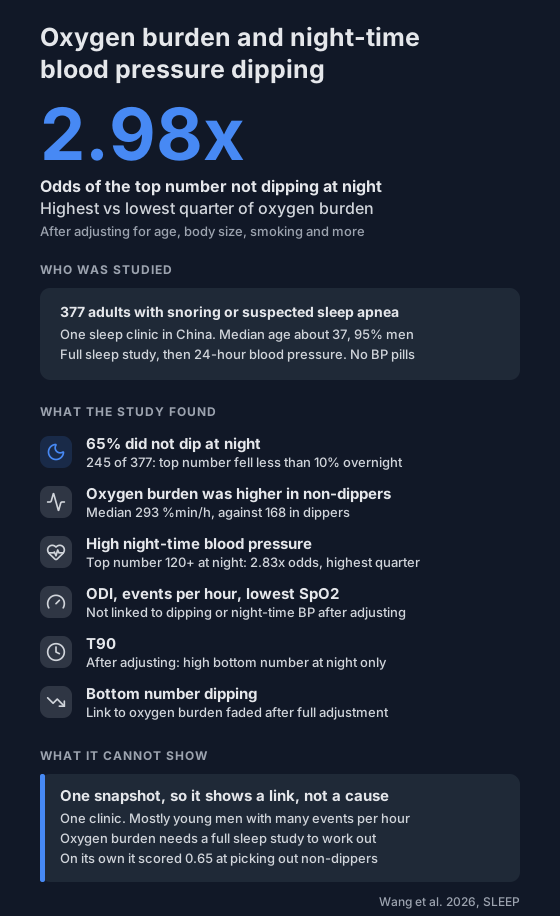
Blood pressure usually falls by 10% to 20% while you sleep. When it doesn't, that's called non-dipping, and it's linked to heart and blood vessel problems even when daytime blood pressure looks fine. It's common in people with sleep apnea.
A 2026 study from China asked which overnight oxygen number lines up best with it. Oxygen burden did. ODI, T90 and lowest SpO2 mostly didn't hold up once other factors were taken into account.
What is oxygen burden?
It adds up how deep and how long each oxygen dip tied to a breathing event is, per hour of sleep. The unit is %min/h. The paper calls it hypoxic burden.
ODI only counts the dips. T90 only counts time below 90%. Oxygen burden puts depth, length and number together.
For more, read long breathing pauses and oxygen burden.
Who was studied?
- 377 adults who came to one sleep clinic in Changchun, China, with snoring or suspected sleep apnea, between 2020 and 2022.
- Median age about 37, and 95% were men.
- Nobody was taking blood pressure medicine, or was already on CPAP or another sleep apnea therapy.
- People with heart failure, past heart attack or stroke, COPD and some other conditions were left out.
- Each had a full overnight sleep study, then wore a 24-hour blood pressure monitor starting the next morning.
Most had a lot of breathing events. The group averages were about 59 to 72 events per hour.
What did it find?
Blood pressure that didn't dip was the norm here.
- Top (systolic) number: 245 people (65%) didn't dip, meaning it fell less than 10% from day to night.
- Bottom (diastolic) number: 183 people (49%) didn't dip.
- Daytime blood pressure was much the same in dippers and non-dippers. The gap was at night.
Oxygen burden was higher in the non-dippers:
- Median 293 %min/h in top-number non-dippers, against 168 in dippers.
- Median 279 against 191 for the bottom number.
For scale, a German CPAP study of 141 adults reported a median of 57.7 %min/h, in a group with a median of 33 breathing events per hour.
Did it hold up after adjusting?
The team split each measure into quarters and compared the highest with the lowest. They adjusted for sex, age, BMI, neck, waist and hip size, smoking, alcohol, diabetes, daytime sleepiness and how often sleep was broken by arousals.
- Top number not dipping. Highest quarter of oxygen burden: 2.98 times the odds. This held for burden in both dream (REM) and non-dream sleep.
- Top number high at night (120 mmHg or more). Highest quarter: 2.83 times the odds.
- Bottom number high at night (70 mmHg or more). Highest quarter: 2.85 times the odds.
- Bottom number not dipping. Linked before the last round of adjustment (2.00 times the odds), but not after.
The older measures did worse:
- Events per hour and ODI. Neither was linked to dipping or night-time blood pressure after full adjustment.
- T90. Linked to the top number not dipping before adjustment (3.56 times the odds), but not after full adjustment. It was the one older measure still linked to a high bottom number at night.
- Lowest SpO2 and average SpO2. Not linked in the highest quarter after full adjustment.
A few middle quarters of the older measures still reached significance after full adjustment, but their highest quarters didn't.
Arousal counts on their own weren't linked either.
Can oxygen burden pick out non-dippers?
Not well on its own. It scored 0.65 for the top number not dipping, where 0.5 is a coin toss and 1.0 is perfect. It scored 0.72 for a high top number at night.
The best cut-off was about 226 %min/h. That picked out 62% of non-dippers and wrongly flagged 34% of dippers. The authors say a proper threshold needs larger, more varied groups.
What doesn't it tell you?
- Cause. It's a single snapshot, so it shows a link, not that oxygen dips cause blood pressure to stay up.
- Everyone. One clinic, mostly young men with many breathing events per hour.
- People on blood pressure pills. They were left out on purpose.
- One night. Blood pressure was measured over one day, after one sleep study.
- A home number. Oxygen burden here was worked out from a full sleep study, using the timing of each breathing event.
It also doesn't match every earlier study. A 2026 review of 24 studies found ODI had the most consistent link with 24-hour blood pressure; see oxygen dips and blood pressure.
The authors want larger studies that follow people over time. The study was funded by Chinese government science grants.
What can you do with this?
- An overnight oximeter gives you ODI, T90 and lowest SpO2, not oxygen burden.
- To see how deep and how long your dips are, not just how many, load a night into the free session viewer.
- Night-time blood pressure dipping is measured with a 24-hour monitor. If you're curious about yours, ask your doctor.
- Bring your recordings along: share your oximeter data with your doctor.
Not sure whether to talk to a doctor? The sleep apnea risk check takes about a minute.
Not a medical device. Does not diagnose, treat or prevent any condition. Discuss results and changes with a clinician.
References
- Wang Q, Lan X, Zhang Z, Song X, Wu S, Dong Y, Jia S, Yuan H. Correlation of hypoxic burden with blood pressure diurnal rhythm in obstructive sleep apnea. SLEEP. 2026;49(10):zsag167. doi:10.1093/sleep/zsag167