SpO2 Cut-offs for Opioid Breathing Problems
A 2026 systematic review of 16 studies found the SpO2 number used to mark opioid-related breathing problems ranged from 85% to 95%, with a median of 92% and no agreed cut-off.
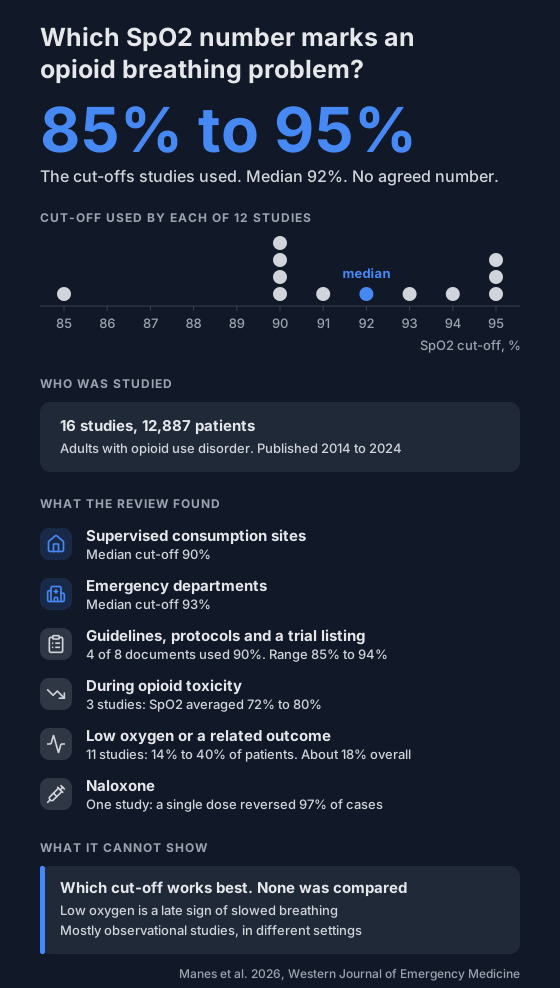
Opioids can slow breathing, and a pulse oximeter is the tool most often on hand to watch for it. You might expect one agreed SpO2 number that marks the problem. A 2026 systematic review looked for it and didn't find one.
What did the review look at?
- 16 studies published from 2014 to 2024.
- All were in adults with opioid use disorder.
- The paper gives a total of 12,887 patients, which is the sum of the 11 studies in its events table.
- The settings were supervised consumption sites, emergency departments, ambulance services and research units.
- The question: which SpO2 level did each study use to define opioid-slowed breathing?
Which numbers did the studies use?
- 12 studies stated a cut-off, and these ran from 85% to 95%.
- The median was 92%.
- Four used 90% and three used 95%.
- Only one went below 90%.
Setting made a difference:
- Supervised consumption sites: median 90%.
- Emergency departments: median 93%.
The reviewers suggest why. Hospitals have constant monitoring and can act on a small drop. Community sites have limited oxygen and less frequent monitoring, so they use a lower number.
The review also lists eight documents: guidelines, protocols and one trial registration. Four used 90%, and the rest ranged from 85% to 94%.
How low did SpO2 actually go?
- Three studies recorded SpO2 in people with opioid toxicity: one gave a median of 80%, and the other two gave means of about 80% and 72%.
- Across 11 studies, 14% to 40% of patients had low oxygen or a related outcome, about 18% overall.
- In one study, a single 1.6 mg dose of naloxone reversed the slowed breathing in 97% of cases.
What doesn't it tell you?
- The right number. The review counted cut-offs. It didn't compare how well each one worked.
- Early warning. The authors say low oxygen is a late sign. Shallow breathing and rising carbon dioxide come first, and an oximeter doesn't measure those.
- Cause and effect. Most of the studies were observational, in different countries and settings.
- Everyone. Only people with opioid use disorder were included.
The authors call for studies that test cut-offs between 90% and 95%.
What can you do with this?
A consumer overnight oximeter is a logging tool, not an overdose alarm. If someone who has taken opioids is hard to wake or breathing slowly, call emergency services straight away.
For background, read what SpO2 is and how accurate pulse oximeters are.
Not a medical device. Does not diagnose, treat or prevent any condition. Discuss results and changes with a clinician.
References
- Manes A, Sran J, Samra I, Dhaliwal B, Soliman A, Puri N. Oxygen Saturation Thresholds for Opioid-induced Respiratory Depression: A Systematic Review. Western Journal of Emergency Medicine. 2026;27(4):886-894. doi:10.5811/westjem.54000