CPAP and Heart Events: A 2026 Cohort Study
A study of 34,782 adults with sleep apnea found that CPAP users with 15 or more breathing events an hour had about half the rate of major heart events of non-users. It's observational and follow-up was short.
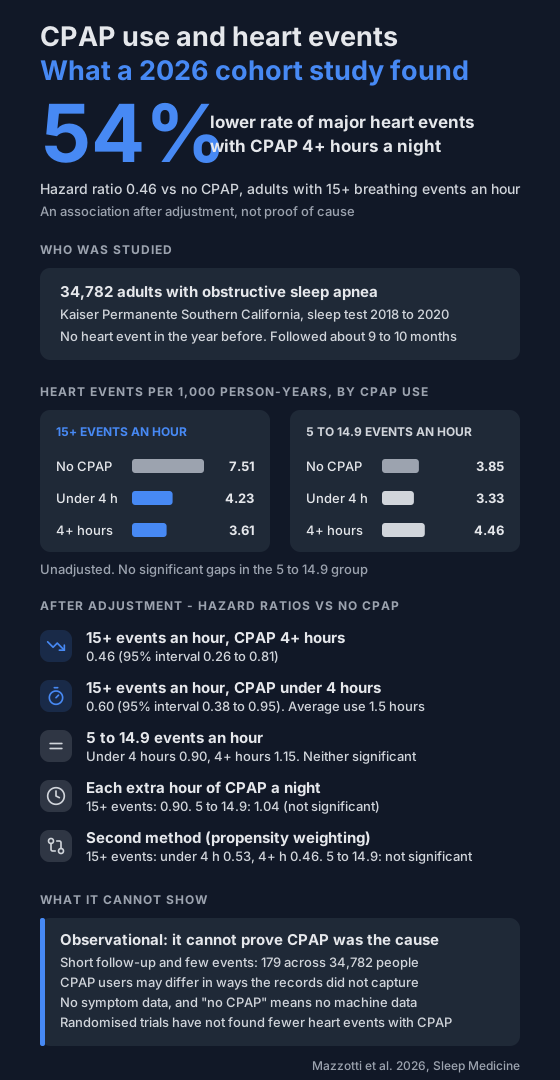
Sleep apnea is linked to heart attacks and strokes, but randomised trials haven't found that CPAP lowers the number of them. A study published in 2026 looked at the question a different way, using the records of 34,782 sleep clinic patients.
Among people with 15 or more breathing events an hour, those using CPAP had about half the rate of major heart events of those who didn't. Among people with fewer events, there was no statistically significant difference.
Who was studied?
- 34,782 adults at Kaiser Permanente Southern California, a health system with twelve sleep centres.
- All had a sleep test between January 2018 and February 2020 that showed 5 or more breathing events an hour.
- 20,613 had 15 or more events an hour. 14,169 had 5 to 14.9.
- Average age was in the early 50s.
- Nobody had a major heart event in the year before the test.
CPAP use came from the machines' own daily data, not from what people said. The authors sorted everyone into three groups: no CPAP, under 4 hours a night on average, and 4 hours or more.
About 60% of the whole group had no CPAP data. About 14% averaged 4 hours or more.
What counted as a heart event?
The first of any of these:
- Heart attack.
- Stroke.
- Unstable angina.
- Heart failure.
- Death from a cardiovascular cause.
People were followed until an event, leaving the health plan, death or August 2020. That came to about 9 to 10 months on average.
What did it find?
With 15 or more breathing events an hour, events per 1,000 person-years were:
- No CPAP: 7.51
- CPAP under 4 hours a night: 4.23
- CPAP 4 hours or more: 3.61
The authors then adjusted for factors including age, sex, weight, blood pressure, cholesterol, smoking, exercise, medication and other health conditions. Compared with no CPAP:
- CPAP 4 hours or more: hazard ratio 0.46 (95% interval 0.26 to 0.81).
- CPAP under 4 hours: hazard ratio 0.60 (95% interval 0.38 to 0.95).
- Each extra hour of average nightly use went with a 10% lower rate (hazard ratio 0.90).
A second method, which weights people by how likely they were to use CPAP, gave similar figures: 0.46 for 4 hours or more and 0.53 for under 4 hours.
What about people with fewer breathing events?
With 5 to 14.9 events an hour, the study found no statistically significant link between CPAP use and heart events.
- Event rates were 3.85 with no CPAP, 3.33 under 4 hours and 4.46 at 4 hours or more.
- Adjusted hazard ratios were 0.90 and 1.15, neither statistically significant.
- Extra hours of use showed no link either (hazard ratio 1.04).
This group had only 57 events in total, so the estimates are wide.
Why does this differ from the trials?
The authors point to who the trials enrolled.
- Trial participants already had heart disease. This study left out anyone with an event in the past year.
- Recent trials excluded very sleepy people, who the authors say are at the highest heart risk.
- CPAP use in the trials was generally low.
A 2026 review of reviews covers the trial evidence: CPAP and heart health. Another cohort looked at CPAP and long-term survival.
What doesn't it tell you?
- Cause. It's an observational study of health records. People who use CPAP may differ from those who don't in ways the records miss. At the start, the 4-hours-or-more users were older, more often men and had more breathing events an hour. The authors checked two markers of this, flu vaccination and missed appointments, and adjusted for many factors, but say unmeasured differences are still possible.
- The long term. Follow-up was under a year on average. The results table lists 179 events in all, 122 of them in the group with 15 or more events an hour. That was too few to look at heart attacks or strokes separately.
- The low-use result. The under-4-hours group averaged 1.5 hours a night and still had a lower event rate than non-users. The 4-hour line is a convention from US insurance rules, and the authors call it arbitrary.
- Who the non-users were. "No CPAP" means no machine data. Some of those people may have used CPAP without data reaching the system, or used another therapy.
- Symptoms. The study had no data on sleepiness.
The study was funded by the American Academy of Sleep Medicine Foundation, the American Heart Association and the US National Heart, Lung, and Blood Institute. One author holds a professorship endowed by the Philips Respironics Foundation, which is linked to a CPAP maker.
What can you do with this?
This study can't tell you what CPAP does for your own heart. Whether and how you use it is a decision for you and your doctor.
If you're on CPAP and want to see your nights, you can track your overnight oxygen alongside it and share the recordings with your doctor. For what tends to help people keep using it, see sticking with CPAP.
Not a medical device. Does not diagnose, treat or prevent any condition. Discuss results and changes with a clinician.
References
- Mazzotti DR, Chen A, An J, Chung J, Arguelles J, Keenan BT, Maislin G, Saconi B, Watach AJ, Glick H, Kuna ST, Pack AI, Sawyer AM, Hwang D, et al. Positive airway pressure therapy and cardiovascular events in obstructive sleep apnoea: an observational clinical cohort study. Sleep Medicine. 2026;139:108732. doi:10.1016/j.sleep.2025.108732